Miroslav Klose: The Last Great No 9 in Football
Miroslav Klose still lives in the penalty area.
Germany’s record goalscorer, the man who made a career out of arriving at exactly the right moment in exactly the right space, has not lost his conviction about what wins football matches. Strip away the tactical fashions, the buzzwords, the endless whiteboard arrows, and he always comes back to the same place.
The box.
The last great No 9 preaching the gospel
Across four World Cups, Klose scored 16 times. Only Kylian Mbappe and Lionel Messi now sit above him in the all-time list. Across club and country, he passed 300 senior goals. Almost all of them, he says, came from inside the area.
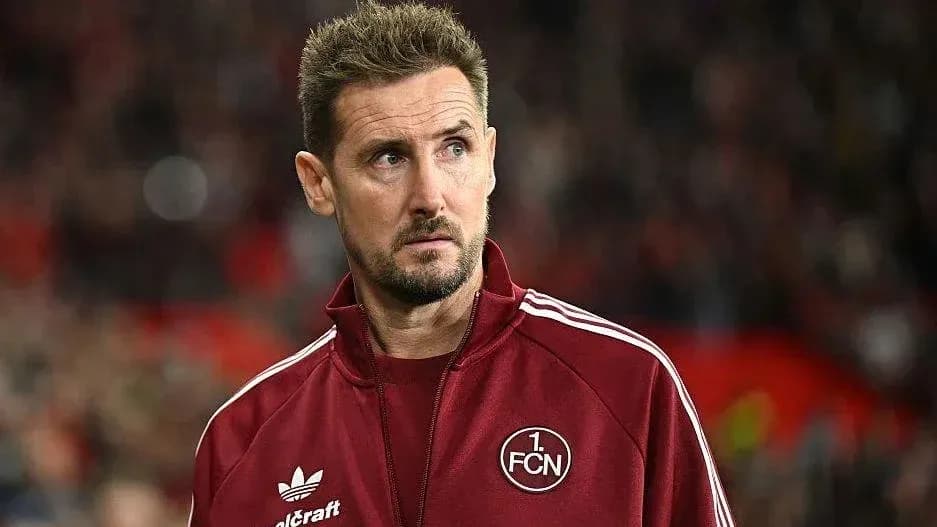
“Thankfully, we’ve moved away a little from the idea of the false nine or having a second striker playing around the main striker, with everyone coming towards the ball,” says the FC Nuremberg head coach.
For Klose, the game still starts with a finisher.
“You need someone who is there to score goals. You need someone in the box because that’s where you’re closest to the goal. That’s why I’m a big believer in practising the final ball, whether it’s a cross, a shot or something else.”
He talks about the “final ball” the way some coaches talk about pressing triggers or rest defence. Obsession, not detail.
“How do you create that final ball? When you develop automatisms and players get to know each other better, that’s when you see harmony on the pitch.
“It can make things look effortless, but it involves a huge amount of work. A lot of work in training and attention to detail, making sure the players communicate with each other and understand their team-mates’ strengths and weaknesses.”
This is not theory for him. It is muscle memory.
During his playing days, Klose spent hours studying opponents – the angles of a centre-back’s body, a goalkeeper’s stance as a shot came in, whether they made themselves big, whether their hands were high or low. He hunted for patterns, tiny tells that might turn half-chances into goals.
“When goals are scored, the whole team deserves credit,” he says, still sounding more team-mate than ex-star. “But you still need someone who has that ability in their feet or in their head to put the ball in the net.”
Kane, late bloomers and the long road to the top
Klose was 36 when he finally lifted the World Cup in 2014, breaking Ronaldo’s record on the way with that unforgettable 7-1 demolition of Brazil in Belo Horizonte. It crowned a career that had been built, step by step, from the amateur leagues up.
There is a message there for Harry Kane and for England: the story does not have to be over just because a tournament or two has slipped away.
Born in communist Poland, Klose moved to West Germany at the age of eight when his father Josef – a former Auxerre player – relocated the family. There was no fast track, no elite academy conveyor belt. He trained as a carpenter while playing in the lower leagues, before Kaiserslautern finally gave him his break.
Like Kane, he did not truly establish himself in top-flight football until his early 20s. Two years after his Bundesliga debut, he was starting a World Cup final against Brazil.
The parallel is not lost on him, nor is Kane’s evolution.
“You could always see his quality, and he’s worked incredibly hard to get where he is,” Klose says of the Ballon d’Or winner.
“He’s also a great role model for me, particularly because he has stayed in Germany. I often tell my players that they should look at someone like him as an example.
“Young players can’t yet have the instinct and experience he has developed, but that’s where it starts – thinking about what you can and can’t do as a footballer. You have to keep learning. That’s the crucial thing for me.
“If you understand that you train to become better, then in five years’ time you’ll naturally be a different player. But if you think everything will happen automatically just because 10 people around you tell you that you’re a fantastic player, I don’t think you’ll continue to develop.”
The line could double as the mission statement for his coaching career.
Building Nuremberg’s fearless youth
Klose has quietly carved out a reputation as a developer of talent. He cut his teeth with Bayern Munich’s under-17s, then worked alongside Hansi Flick with the first team, before stepping out on his own at Rheindorf Altach in Austria.
Now at Nuremberg, one of Germany’s grand old clubs, he has the youngest squad in the 2. Bundesliga. According to Transfermarkt, their average age is 23.3 – and it shows in the way they play.
“You need that balance and a certain core of experienced players,” he says. “But we’re very brave in that respect. Over the three years I’ve been here, we’ve made progress in how we assess young players and in the conversations we have about them.
“How do we rate them? How far along are they? What do they need to work on to take the next step? Is it perhaps more about their physical development? Because from a footballing perspective, we’re already producing some really good players.”
He arrived in 2024 and guided Nuremberg to 10th and then eighth. This season, they sit second, behind Hertha BSC, joint-top scorers in the division and pointing firmly at a return to the Bundesliga for the first time since 2019.
That is not a coincidence. It is the product of a club and a coach pulling in the same direction.
“When I first arrived, I spoke to the youth coaches about the club’s DNA and its coaching philosophy, and what they focus on,” Klose says.
“There was already a lot of common ground. We suggested trying certain things because we wanted to do a little more in particular areas, and they were open to that.
“That’s important. We benefit from this because our young players are getting opportunities in the first team, and everyone is paying attention to their development.
“But that journey starts with the youth coaches. I know how important it is to take those steps. We’re benefiting from that now because we have access to so many young talents.
“As a coaching team, we’re brave enough to give them opportunities when we see that they can compete at this level. That’s the first step.”
Among the 11 players with the most minutes this season, seven are 22 or under. Their leading scorer, Mohamed Ali Zoma, is already capped by Italy. Another teenager, 17-year-old midfielder Marc Kornwachs, has started to draw serious attention.
“Of course, everyone gets a lot of praise, as is currently the case with Marc Kornwachs,” Klose says.
“But his journey isn’t over yet. Now it’s about helping him become more consistent and establishing himself, while continuing to develop his game and take further steps forward.
“These players are so talented that we have absolutely no hesitation in giving them opportunities, regardless of the scoreline.”
The faith is genuine, but it is not blind. It comes with demands.
A learner who refuses to stand still
Klose’s humility as a player – the fair play awards in Germany and Italy, the quiet graft, the lack of theatrics – has carried over into the dugout. He talks about his own career as a coach the way he talks about a teenager breaking into his side: incomplete, still forming.
“I’m very comfortable with the steps I’ve taken, even though it involves a huge amount of work,” he says. “You learn something every day.
“I’ve said that I’m already a much better manager than I was three years ago. That’s perfectly normal, and you have to embrace it. I’ve always been willing and eager to learn, and I’ve always been a hard worker. That isn’t going to change.”
There is no nostalgia in his voice, no desire to drag the modern game back to some imagined golden age. He wants the ball, wants control, wants his team to dominate – but understands that domination now comes in different shapes.
“Personally, as a player, I always liked having the ball for long periods, and that hasn’t changed,” he says.
“When you have the ball, you have a certain level of dominance. I know you also have to be very adaptable in terms of possession, and that’s something we are. We constantly show the players different ways of playing out of situations.
“It’s great to see how they develop and to be able to support individual players along the way. That’s exactly the approach I like to take as a manager.”
The irony is striking. One of the most instinctive penalty-box finishers of his generation now spends his days constructing patterns, teaching structure, drilling automatisms. Yet at the heart of it all, his belief remains disarmingly simple.
You need someone in the box.
You need a final ball.
If Nuremberg do climb back into the Bundesliga with a fearless, free-scoring, youthful side led by one of the game’s great No 9s, it will be because that old truth still holds.