
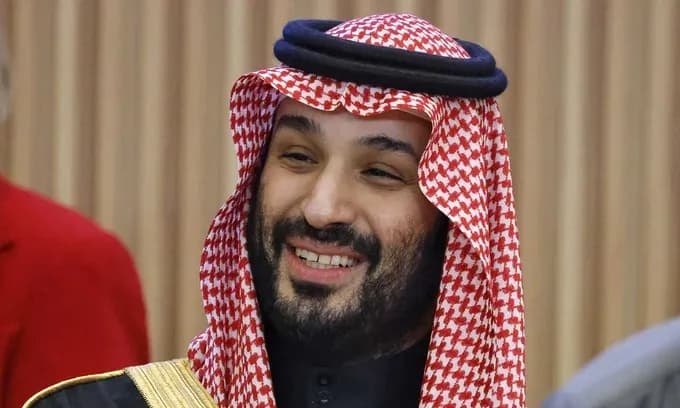
Mohammed bin Salman: The Crown Prince Reshaping Football and Luxury
The 134‑metre superyacht Serene says almost everything about Mohammed bin Salman’s world before a ball is even kicked.
He stepped aboard in 2015, liked what he saw, and within half a day closed a €429 million (US$550.7 million) deal with the Russian billionaire owner. Two helipads. An underwater viewing room. Cinema. Multiple pools. A private nightclub at sea. It is excess turned into floating architecture, the kind of purchase that announces a man determined to move quickly and think on a different scale.
On land, the numbers barely shrink. That same year, the Crown Prince paid more than $300 million for Château Louis XIV, just outside Versailles, widely described as the most expensive private home on the planet. Built in the style of 17th‑century French grandeur, the estate hides 21st‑century technology under its gilded skin: climate control, lighting and fountains all run from an iPhone, plus an aquarium sunk beneath the moat that turns the property into something between a palace and a movie set.
The art world felt the same shock a couple of years later. In 2017, an anonymous buyer stunned an auction room by paying $450.3 million for Leonardo da Vinci’s Salvator Mundi, a record-shattering price for a painting. The Crown Prince is widely believed to be the man behind that bid, another example of how his chequebook has redrawn the map of global luxury.
Those numbers matter in football. They explain why a 41‑year‑old with an estimated personal fortune of around $25 billion, according to House of Saud, now sits at the heart of the sport’s new power axis as chairman of Saudi Arabia’s Public Investment Fund (PIF). Vision 2030, the kingdom’s blueprint for a post‑oil future, leans heavily on sport and entertainment. Football is no side project; it is a frontline tool.
In 2023, that strategy snapped into sharp focus at home. PIF took majority control of four cornerstone Saudi Pro League clubs: Al Nassr, Al Hilal, Al Ittihad and Al Ahli. With that came the financial muscle to do something unthinkable a decade ago—lure Cristiano Ronaldo to Riyadh. His arrival at Al Nassr detonated the transfer market, opening the door for a rush of global stars to follow him into the Saudi league and forcing Europe’s elite to reckon with a new rival.
The reach stretches far beyond the Gulf. In 2021, PIF completed the takeover of Newcastle United, dropping a historic English club into the middle of Saudi Arabia’s long‑term play. Overnight, St James’ Park became a symbol of the game’s shifting economics, a Premier League institution now tied directly to the same fund that buys superyachts, châteaux and record‑breaking art.
MBS operates in a rarefied circle. His contacts list runs from U.S. President Donald Trump to tech titans like Mark Zuckerberg and Elon Musk, and Hollywood names such as Johnny Depp, Morgan Freeman and Lindsay Lohan. The football world is just one stage in a much wider performance of influence.
He has never pretended to be anything else. Asked by CBS about his lifestyle, the Crown Prince answered bluntly: “As far as my private expenses, I'm a rich person and not a poor person. I'm not Gandhi or Mandela. I'm a member of the ruling family that existed for hundreds of years before the founding of Saudi Arabia." It was a statement of identity as much as wealth, a reminder that this is old power using new tools.
Yet even this life of palaces and mega‑projects is not insulated from the region’s volatility. According to The Wall Street Journal, a recent surge in drone and missile attacks by Houthi forces—targeting airports and oil infrastructure in Riyadh and threatening commercial shipping lanes in the Red Sea—has forced a change of routine at the very top. The Crown Prince has shifted his day‑to‑day operations into heavily fortified palaces fitted with secure underground bomb shelters.
The man reshaping football from boardrooms and royal courts now conducts his business beneath reinforced concrete, a reminder that for all the yachts, paintings and clubs, the game he is helping to transform is still being steered from the middle of a live geopolitical fault line.





