Jose Mourinho's Beautiful Defeat at Camp Nou: A Historic Miracle
On 28 April 2010, Jose Mourinho walked into the Camp Nou with a two-goal cushion and walked out with a defeat he would later call “the most beautiful of his life” and a “historic miracle”.
Inter Milan had ripped into Barcelona eight days earlier at San Siro, winning the first leg of their Champions League semi-final 3-1 against the defending champions, the side everyone expected to retain the crown. The second leg, in theory, was simple: survive. Against Pep Guardiola’s Barcelona, against Lionel Messi at full tilt, against a stadium that devoured the timid.
It became anything but simple.
Thiago Motta’s red card after just half an hour turned a difficult night into a siege. Inter were down to 10 men for an hour, pinned back by wave after wave of Barcelona attacks, forced to defend their penalty area as if it were a trophy in itself. Mourinho’s plan, though, never changed. Stop Messi. Block the passing lanes. Suffer together.
Barcelona had the ball. Inter had the discipline. Messi probed, twisted, searched for space that never quite opened. Guardiola’s team, famed for suffocating opponents, found themselves suffocated by a defensive block that refused to crack. The clock ticked, the noise rose, the tension grew.
Eventually, the pressure told on the scoreboard, but not on the tie. Barcelona found only a 1-0 win, nowhere near enough to overturn Inter’s first-leg advantage. Over 180 minutes, Mourinho’s blueprint had done what few imagined possible: it had blunted one of the greatest attacking machines the game has seen.
The final whistle blew. Inter had lost the match but won the war. Mourinho exploded.
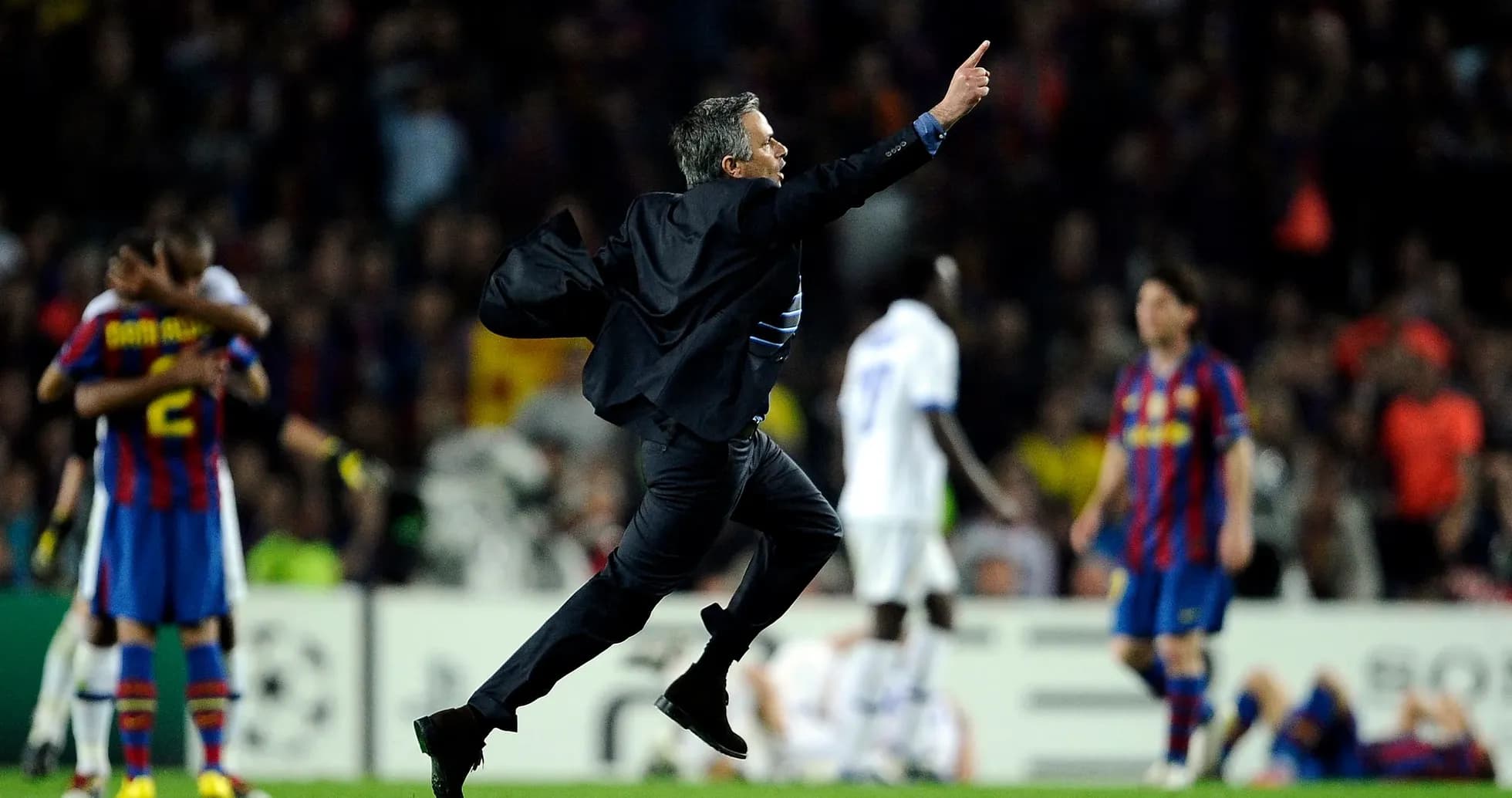
Index finger raised, he sprinted onto the Camp Nou pitch, straight through the chaos and the fury, celebrating with his players as if the grass itself belonged to them. Cameras locked onto him. So did the anger of the home crowd. His celebration, raw and unfiltered, instantly became part of Champions League folklore.
The scene turned almost surreal. As Inter’s players and staff revelled in front of their small pocket of travelling fans, the Camp Nou sprinklers suddenly came on, jets of water cutting across the pitch. Whether it was an attempt to cool tempers or wash away the image of Inter’s party, the effect was the same: Mourinho and his team were being drenched as they celebrated one of the most defiant performances in European history.
They did not care. The road to glory was open.
A few weeks later in Madrid, Inter completed the job. A 2-0 win over Louis van Gaal’s Bayern Munich in the final sealed the treble and confirmed Mourinho’s place in the club’s mythology. From the trenches of the Camp Nou to the podium at the Bernabeu, the arc of that season belonged to him.
Years on, the memories still chase him around Europe. So do the tributes.
“The mission is very difficult. It is almost impossible to present Mourinho with a gift here,” journalist Tancredi Palmeri said into his mobile phone, recording a video as he prepared a small surprise for the Portuguese coach. “It is difficult, but we will try.”
They tried. They succeeded. In a press room in Madrid, the gesture reached its target. Mourinho, so often the lightning rod in these arenas, softened for a moment. He accepted the gift, smiled, shook Palmeri’s hand and walked out with the look of a man who had been taken back, just briefly, to those wild nights and impossible missions.
Now comes another twist in a story that refuses to slow down.
On Tuesday, Mourinho’s present and past collide. His current club, Real Madrid, face his former club, Inter, on the opening matchday of the new Champions League league phase. The setting is familiar, the stakes always high, but the narrative is different.
At Inter, he conquered Europe. At Real Madrid, across his first spell from 2010 to 2013, he never quite managed to lift the trophy that defines the club. La Liga titles, Copa del Rey triumphs, iconic clashes with Guardiola’s Barcelona – yes. The Champions League, the competition that Real Madrid measure themselves by, eluded him.
This summer, he walked back through the doors of Spain’s record champions for a second time, older at 63, but still carrying that same aura of confrontation and conviction. The reunion with Inter arrives early, a reminder of where he has been and what he has already done.
The miracle of 2010 is written. The question now is whether the man who once celebrated a “beautiful defeat” at the Camp Nou can finally turn Real Madrid’s expectations into his third European crown.