NBA Punishes Los Angeles Clippers for Salary Cap Violations
The NBA lowered the boom on the Los Angeles Clippers on Wednesday, delivering one of the harshest punishments for salary cap misconduct the league has ever handed down.
A year-long investigation into Kawhi Leonard’s off-court money trail ended with a sweeping verdict: the Clippers broke the rules, their owner helped, their executives enabled it, and their star benefited from it.
Leonard keeps his contract. The Clippers lose a chunk of their future.
A franchise hit in the present, gutted in the future
The numbers are staggering.
- The Clippers must forfeit five first-round picks from 2029 through 2033.
- They’re fined $30 million.
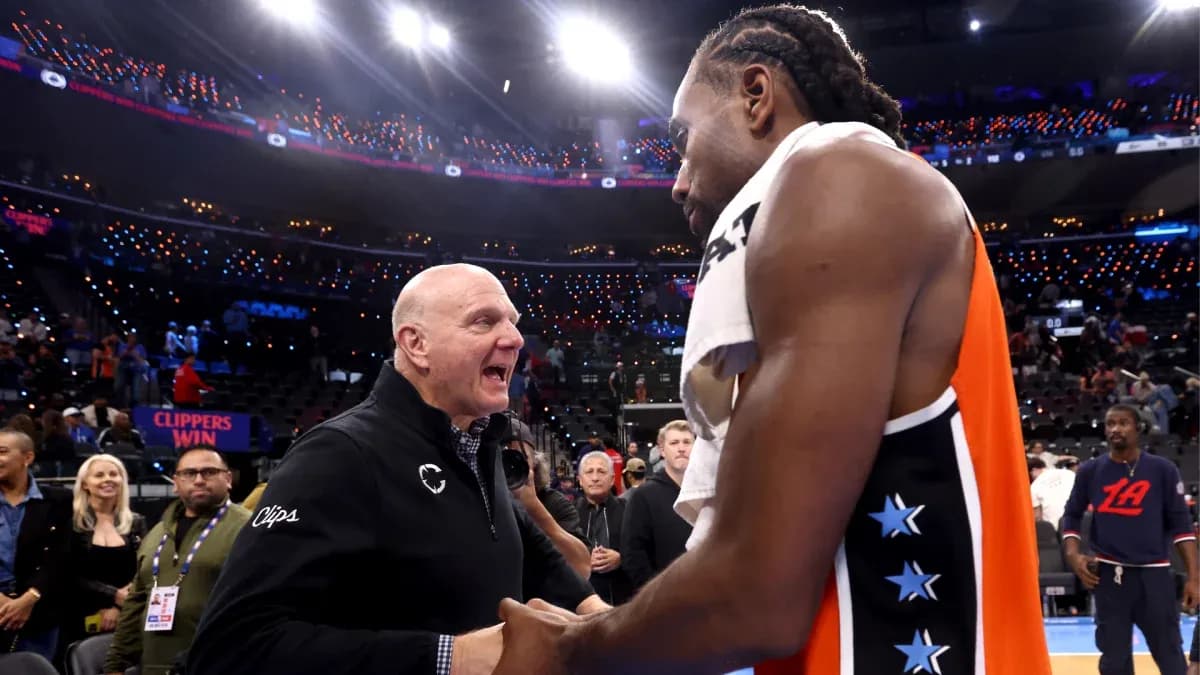
- Owner Steve Ballmer is banned from “all league and team activities” for one year.
- Kawhi Leonard owes the league $700,000.
- Gillian Zucker, the team’s president of business operations, is suspended without pay for a year.
- Lawrence Frank, president of basketball operations, is out for six months without pay.
- Leonard’s uncle and former business manager, Dennis Robertson, is banned for five years from doing business with any NBA team or affiliate.
For a franchise that already emptied its draft cupboard to build around Leonard, this is a brutal new layer. Those late-decade picks were supposed to be lifelines in a post-superstar era. Now they’re gone.
NBA commissioner Adam Silver didn’t bother softening the language.
The league said its investigation “found a pattern of misconduct and multiple significant rules violations by the Clippers organization, a prior offender of the salary cap circumvention rules.” Silver called the conduct “flagrant” and framed the penalties as a direct defense of the league’s economic system.
The NBA and the Players Association agreed the sanctions are “final and binding on all parties.” There will be no appeal through league channels.
How the scheme worked
The core allegation: the Clippers helped arrange and induce off-court income for Leonard as a way to boost his overall compensation beyond what the salary cap allows.
Investigators found that the team “affirmatively initiated off-court income opportunities” and “facilitated endorsement agreements” for Leonard with four companies: Aspiration Partners, Boingo Wireless, Daktronics and Lockton Insurance.
The report says the Clippers induced those companies into deals with Leonard “by offering them business from the team.” In other words, team-related business was used as leverage to funnel extra money to their star.
The violations didn’t stop there. The Clippers also paid “personal expenses on behalf of Leonard and his representatives” and failed to report “improper solicitations for off-court income opportunities” made on Leonard’s behalf by Robertson.
The league concluded Leonard violated the circumvention rules “through the conduct of Robertson,” stating that Robertson pressured the Clippers to secure off-court money, succeeded in obtaining those deals, and that Leonard failed to reimburse personal expenses the team covered.
The pressure, the inducements, the hidden benefits — taken together, the NBA saw it as a deliberate effort to get around the cap.
The Aspiration trail and a fraud conviction
The investigation’s roots stretch far beyond basketball.
In June, Aspiration co-founder Joe Sanberg was sentenced to 14 years in prison for defrauding investors. When Aspiration collapsed and bankruptcy filings surfaced, Leonard appeared as a creditor. The paper trail also showed Ballmer had invested a total of $60 million into the company. Dennis Wong, the Clippers’ only minority owner, put in $1.99 million just nine days before a $1.75 million payment went to Leonard. Wong’s daughter worked at Aspiration. The company even agreed to a jersey patch sponsorship with the Clippers, a deal that never actually launched.
Inside Aspiration, red flags went up. In 2023, two former employees filed an SEC Whistleblower Complaint, under penalty of perjury, alleging that Leonard was paid “an incentivized bonus to circumvent the NBA’s salary cap, disguised as an organic marketing sponsorship agreement.” A former finance staffer later said on the Pablo Torre Finds Out podcast that they were told not to question Leonard’s deal because “it was to circumvent the salary cap.”
The NBA interviewed Sanberg as part of its investigation and told the judge in his criminal case that he had cooperated. Ballmer, in turn, submitted a victim impact statement that attacked Sanberg’s credibility.
Aspiration wasn’t the only concern. The league also uncovered a similar endorsement arrangement between Leonard and Daktronics, and documented team-driven efforts to line up deals with Boingo Wireless and Lockton Insurance.
Piece by piece, a pattern emerged: a star player, a series of unusually structured endorsements, team investors and partners in the background, and a steady flow of off-court money linked back to the franchise.
A long shadow from 2019
The Leonard saga didn’t start with Aspiration or this season’s investigation.
When Leonard was a free agent in 2019, multiple reports described extraordinary demands from Robertson to teams chasing him. Bruce Arthur of the Toronto Star reported that Leonard’s camp asked the Raptors for illegal benefits, including ownership stakes in both the Raptors and Maple Leafs and an extra $10 million per year in sponsorship income. When Toronto officials reportedly pointed out that local companies would line up to sign Leonard as an endorser, the response from his camp was allegedly blunt: “We don’t want to do anything.”
The Athletic reported that Robertson made similar requests of the Los Angeles Lakers — use of a private plane, a home, and a stake in the team. The Lakers refused. The NBA investigated those claims at the time and cleared the Clippers of wrongdoing.
Those stories now read differently. What once looked like aggressive negotiating now sits alongside a formal finding that Leonard, through Robertson, pressured a team to help secure off-court money in violation of league rules.
Clippers come out swinging
The franchise isn’t taking the verdict quietly.
In a lengthy statement, the Clippers said they “vehemently reject” the NBA’s findings and blasted the investigation, conducted by law firm Wachtell Lipton, as “heavily biased.”
They accused the league of pushing “a predetermined narrative rather than facts and evidence” and claimed that what they were told privately by the NBA doesn’t match what was announced publicly. The organization vowed to “vigorously challenge these findings and penalties through every avenue available” and said it looks forward to “an ethical and impartial arbitration process.”
The league, for its part, has already locked in the penalties inside its own framework. Any fight now moves outside the NBA’s internal system.
Leonard accepts blame, denies intent
Leonard struck a different tone.
Through his new agent, Harrison Gaines, he released a statement accepting “full responsibility for lapses in judgment” by people in his “inner circle,” while insisting he had “no knowledge of any intent on anyone’s part to circumvent the salary cap.”
“Integrity and respect for this game are fundamental to who I am,” Leonard said. He described entering his Clippers contract and the endorsement deals “in good faith,” said he was “fully committed to fulfilling my obligations,” and emphasized that for 15 years his priority has been his family, the game and his teammates.
Leonard also pointed forward. With his long-delayed trade to the Toronto Raptors now expected to proceed — it had been on hold while the investigation played out — he said he wants to “close this chapter” and “move forward with a clean slate” as he returns to Toronto.
A turbulent season, a brutal fallout
On the court, the Clippers’ year was already a letdown. Leonard played well, but a team built to contend never found its stride. They stumbled out of the gate, finished 42–40, and fell to the Golden State Warriors in the Play-In Tournament.
At the trade deadline, they pivoted. James Harden and Ivica Zubac were shipped out, a tacit admission that the current version of the roster wasn’t going anywhere special.
Now the off-court hit dwarfs the on-court disappointment. A $30 million fine. A one-year ban for one of the league’s most visible owners. Two top executives sidelined. A star player fined and his uncle effectively exiled from NBA business. Five first-round picks wiped off the board.
For a franchise that moved heaven and earth to lure Leonard and Paul George in 2019, this was supposed to be the era that rewrote its history. Instead, the question hangs over everything:
When the dust settles on these penalties and the draft capital is gone, what exactly will be left of the Clippers’ future?