
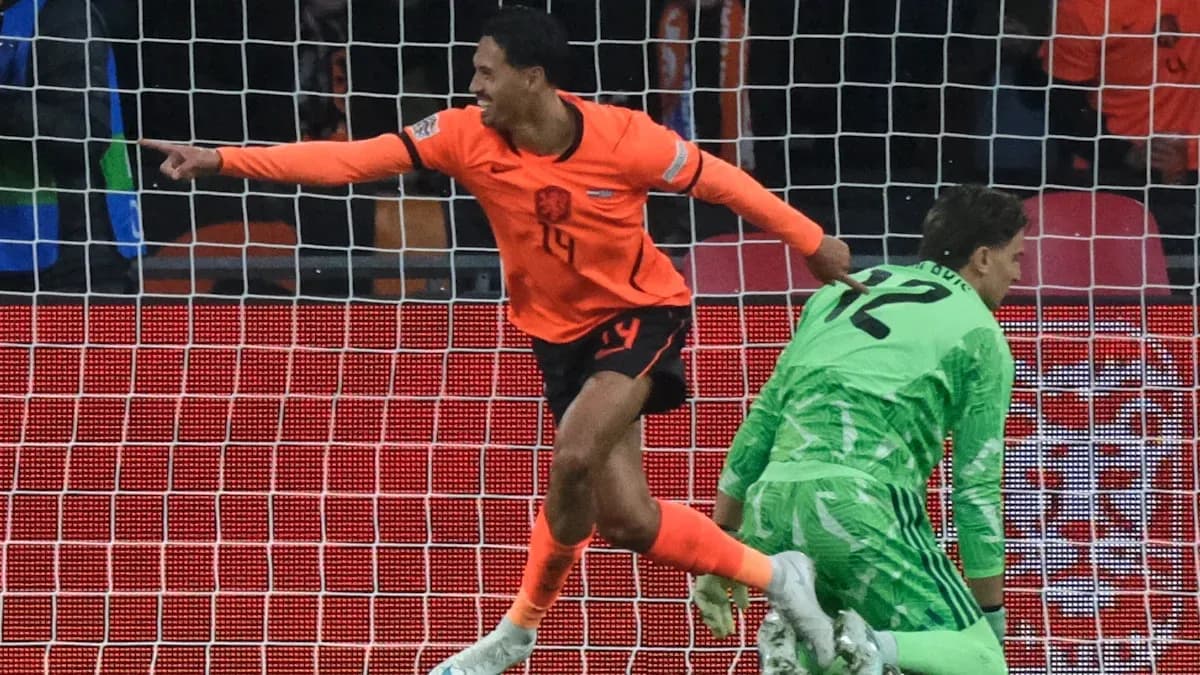
Netherlands Dominates Greece 7-0 Under Xavi
The rain lashed down in Belgrade, the stands lay almost bare, and yet on a night that felt like a rehearsal, the Nations League found its headline act somewhere else entirely.
In Amsterdam, the Netherlands tore Greece apart.
Xavi’s Oranje make a statement
Under new coach Xavi, the Dutch produced a ruthless 7-0 demolition of Greece that felt less like a group game and more like a declaration. They stayed unbeaten under their new boss and matched the biggest winning margin in the competition’s eight-year history.
The tone was set early. Crysencio Summerville needed just six minutes to crack open a Greek defense that never recovered. From there, the evening turned into a showcase of fluid attacking football and cold finishing.
Tijjani Reijnders stole the spotlight. He struck a hat trick inside 21 breathless minutes, each goal the product of crisp passing and sharp movement that sliced through Greece at will. When he celebrated, beaming and holding up three fingers, it summed up the swagger of a team that knew it was in complete control.
Jurrien Timber then joined the party with two goals of his own before Donyell Malen added a seventh, the final flourish on a night that bordered on cruel for the visitors. By halftime, the Netherlands were already 5-0 up, the contest long gone, the only question how big the final number would be.
“We need to continue like this, but this is the way,” Xavi said, pleased but pointedly cautious. The first half, he admitted, had been “amazing,” and he reserved special praise for the intensity his players have brought to training. Pride, yes. Complacency, no.
The result places the Netherlands alongside England, Germany and Finland as the only sides to win a Nations League match by seven goals. England’s 7-0 against Croatia last month now has company.
More importantly, it sets up a heavyweight showdown.
Klopp keeps pace in the rain
While Amsterdam roared, Berlin began to loom large. Germany, coached by Jürgen Klopp, did what it needed to do in Serbia, winning 3-1 and staying three points behind the Dutch in Group A2 ahead of Monday’s meeting in the German capital.
The setting in Belgrade was surreal. The 50,000-seat Rajko Mitic Stadium was almost empty, with only 5,000 children and teenagers in attendance as part of a UEFA punishment for previous offensive fan behavior. The noise came in bursts, high-pitched and hopeful, but it never felt like a true home advantage.
Germany silenced what little resistance there was almost immediately. After just three minutes, Kai Havertz’s header forced Srdjan Babic into turning the ball into his own net. The early goal stripped away any nerves and allowed Klopp’s side to play with freedom.
The pressure told again soon after. Vanja Milinkovic-Savic parried a Havertz effort, only for Florian Wirtz to react quickest and deftly flick the rebound over the goalkeeper for 2-0. Clinical, simple, effective.
Klopp, still shaping and testing his squad, left out Barcelona forward Karim Adeyemi and handed a chance to Freiburg winger Derry Scherhant. The most eye-catching contribution, though, came from debutant Brajan Gruda. The Leipzig attacker collected the ball centrally, drove straight through the heart of the Serbian defense and finished with authority for Germany’s third.
Babic partially redeemed his earlier error by scoring at the right end from a rebound, but any hint of a Serbian fightback evaporated with the red card to Vanja Dragojevic for a reckless lunge on Joshua Kimmich’s ankle. Andrija Zivkovic’s late dismissal for dissent left Serbia down to nine and the game drifting to its inevitable conclusion.
“We probably should have scored more, but there is no reason to be critical tonight,” Klopp said. Two wins from five is hardly perfection, yet the performance suggested a team beginning to find its stride.
Group picture: all eyes on Berlin
The stakes are now clear. The Netherlands top Group A2, three points ahead of Germany. The top two qualify for the quarterfinals, with head-to-head record the key tiebreaker. The Dutch, Germans and Greeks all remain in contention; Serbia, beaten in all five of their games, are marooned at the bottom.
Elsewhere, Switzerland’s push to climb back into the Nations League’s top tier stayed on track with a controlled 0-0 draw against Slovenia in Group B1, keeping their promotion bid steady. Scotland edged North Macedonia 2-1 to keep their own campaign alive and meaningful.
But the spotlight is fixed on Monday.
A Dutch side that just equaled a Nations League record win marches into Berlin brimming with confidence. A German team under Klopp, still imperfect but increasingly dangerous, stands in their way.
Two giants. Two charismatic coaches. One group on the line.
After nights like these, how could the decider be anything but explosive?





