
Nmecha Celebration Sparks Dortmund Debate on Faith and Inclusion
When Felix Nmecha wheeled away after scoring for Borussia Dortmund against Elversberg, it looked at first like a familiar scene. Arms aloft, eyes lifted, a routine nod to the heavens from a midfielder enjoying his moment in a 2-1 win.
Then came the gesture that lit the fuse.
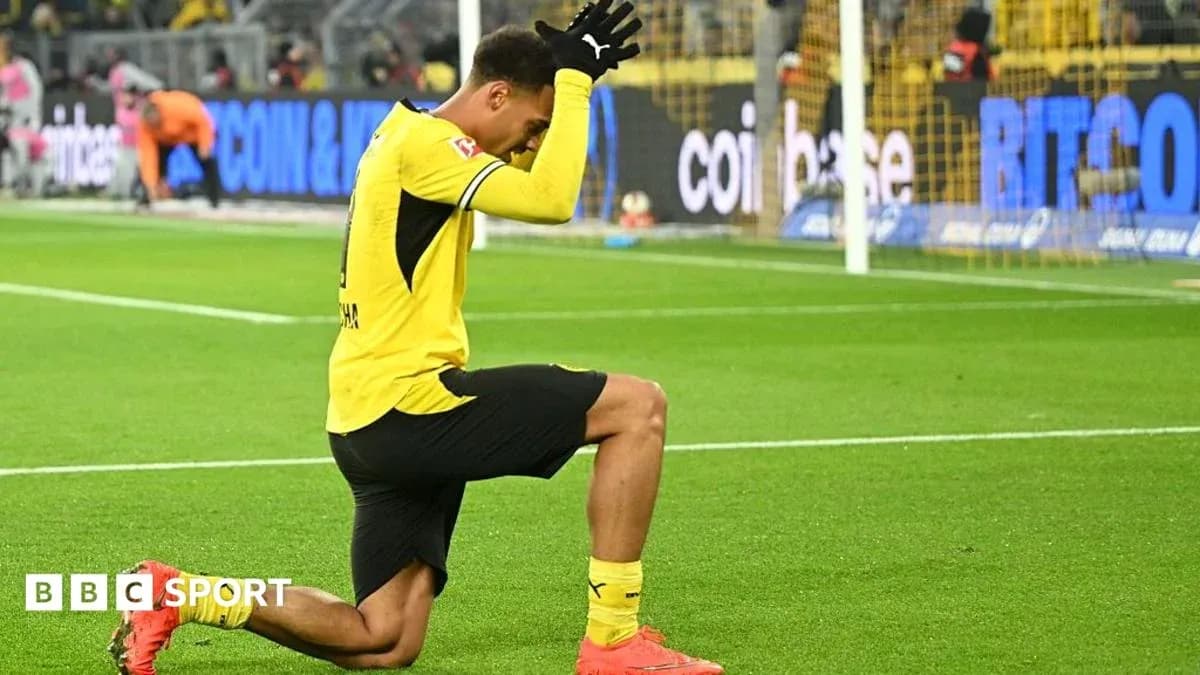
Nmecha pointed to the sky, then mimed removing a crown from his own head and placing it on the ground. It was deliberate, rehearsed – and, as it turned out, deeply contentious.
A Borussia Dortmund supporters’ group quickly linked the celebration to “The King’s Return”, a campaign promoted by the Christian organisation Ballers in God. That connection dragged a private expression of faith into a very public row over the boundaries between religion, club values and LGBTQ+ inclusion.
Fans See Clash With Club Values
The supporters’ group said it objected to the celebration because of what The King’s Return stands for. Citing a recent investigation by German broadcaster ARD, it argued that the campaign advocates “extremely conservative positions against homosexuality and transgender identity”, portrays abortion as “Satan’s plan”, and sits squarely at odds with Dortmund’s long-stated commitment to tolerance and diversity.
For many Dortmund fans, this wasn’t just about a player’s personal beliefs. It was about the symbolism attached to the shirt. The club has built a reputation on its anti-discrimination stance; the Südtribüne prides itself on being a home for everyone. A celebration linked to a campaign accused of targeting LGBTQ+ rights felt, to some, like a direct challenge to that identity.
Ballers in God Responds
Ballers in God, founded by former Crystal Palace and Tottenham midfielder John Bostock, now finds itself under a spotlight it rarely receives outside faith circles.
The organisation, which promotes Christian beliefs and counts high-profile players such as England internationals Marc Guehi and Bukayo Saka and former Brazil forward Kaka among its followers, pushed back against the criticism.
In a statement addressing the supporters’ concerns, it said it was “encouraged by player-led movements such as The King’s Return, where footballers themselves take the initiative to express their faith in Jesus”.
The group stressed its intentions: “Our desire is not only to share our hope, but to demonstrate love and respect towards everyone, including those who do not share our beliefs. Our focus has always been, and will always be, to point people to Jesus with grace and love.”
The message was clear: from their perspective, this is about faith, not hostility.
Nmecha Insists Message Was Misunderstood
Caught in the middle is Nmecha himself. His two goals should have been the story of the day. Instead, he has had to explain what he meant by a few seconds of celebration.
He called the reaction a result of “misunderstandings” and stressed that the gesture “was not intended to promote myself or any organisation”. He also underlined his stance on the wider accusations, saying: “My message has never been about promoting intolerance, discrimination, or hate in any form.”
For a player still shaping his identity at a major club, every action is now being read in layers. A goal is no longer just a goal; a celebration is no longer just joy.
Football’s Uneasy Battle Lines on Belief and Inclusion
This is not an isolated flashpoint. Across European football, the friction between institutional support for LGBTQ+ campaigns and individual religious convictions has grown more visible.
Last year, the Premier League withdrew from the Rainbow Laces campaign and ended its partnership with LGBTQ+ charity Stonewall, a move that raised questions about how far the league wanted to go – or felt able to go – in tying itself to specific social initiatives.
In 2024, then Ipswich captain Sam Morsy, a Muslim, explained that he did not wear a rainbow armband because of his “religious beliefs”. At Crystal Palace, Marc Guehi wrote “I [heart] Jesus” on his rainbow armband when he captained the side, an attempt to straddle both commitments: support the campaign, state the faith.
Even the biggest clubs have had to adjust on the fly. Manchester United abandoned plans to wear a jacket in support of the LGBTQ+ community after a player refused, forcing a rapid rethink and exposing the limits of top-down messaging in a dressing room full of different cultures and convictions.
Dortmund now finds itself on that same tightrope. A fanbase that prides itself on inclusion. A player who insists his faith-driven celebration was never about exclusion. An external campaign accused of pushing a hard line on issues the club has long approached from the opposite direction.
The goals against Elversberg are already fading from memory. The image that remains is a crown, lifted from a head and placed on the turf. The question that lingers is sharper: how long can elite football keep asking players and clubs to carry every cultural battle onto the pitch and into a single, split-second celebration?





