Opals' World Cup Dreams End as Magbegor Faces ACL Injury
The Opals walked into their quarterfinal with Spain already reeling. Half an hour before tip-off, the hammer dropped.
Ezi Magbegor, the captain and cornerstone of Australia’s campaign, had torn her ACL.
The news came not from the Opals camp, but from her WNBA side, the Seattle Storm, who confirmed the worst just minutes before Australia’s 89–66 defeat – a 23-point loss that ended their Women’s Basketball World Cup run and reshaped the program’s immediate future.
A brutal twist for Magbegor
Magbegor’s injury story this year was already cruel. She had only just returned to the court in early July after partially tearing her Achilles in March. Then, in the qualification final win over Italy, she went down again, taking a knock to her right knee early in the game.
What at first looked like a scare is now season-ending.
“It makes me emotional when I see anyone go down,” Opals coach Sandy Brondello said after the loss to Spain.
“But Ezi's come back from an injury and it's just another injury. [It's] just really unfortunate. She's a key part of what we want to do. It sucks, but that's sport isn't it?
“She's got to have a great recovery and she'll get back, I don't have a doubt about that. Just disappointed for Ezi that she's going through another rehabilitation.”
Her absence left a gaping hole at both ends of the floor. It also added to an injury list that has shadowed this entire campaign.
A roster stripped bare
By the time the ball went up against Spain, Australia’s depth chart looked more like a triage list.
Magbegor joined Alanna Smith (leg injury) and Jade Melbourne (illness) on the sidelines. Veteran guard Sami Whitcomb never even made it to the tournament, ruled out beforehand with injury. Cayla George was unavailable due to pregnancy.
Smith had gone down in the opening game with a lower-leg injury. Melbourne managed just three minutes against Italy and couldn’t suit up for the quarterfinal at all.
That left Brondello with a threadbare rotation and a locker room full of rookies in major-tournament terms. Seven players were experiencing their first big international event. Experience, or the lack of it, told.
Veteran Steph Talbot admitted the scene felt surreal.
“It's very weird. It was very quiet, very unusual. We were all looking around like, 'Is this it?'” she said.
“But a job's a job and we fought hard to the end. I'm really proud of the effort they put in. It's definitely a different experience.”
Spain punish errors as Opals run out of miracles
The Opals had survived one escape act already. Against Italy, they almost surrendered a 20-point lead at three-quarter-time before 21-year-old Izzy Borlase detonated for 30 points to drag them into the last eight.
There was no such rescue this time.
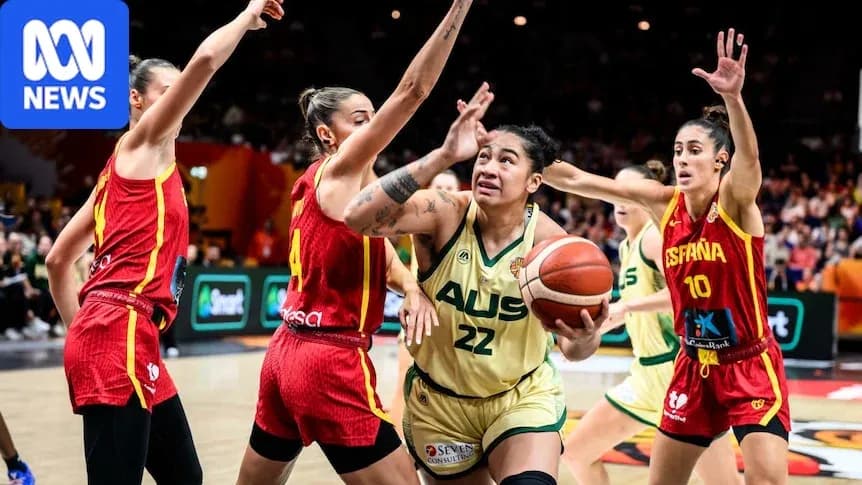
Spain controlled the tempo and picked apart a tired, short-handed Australia. The Opals coughed up 23 turnovers and shot just 40 per cent from the field, numbers that left them chasing shadows as the game wore on.
Ally Wilson led Australia with 13 points, but without Magbegor’s inside presence, Smith’s versatility, Melbourne’s spark and Whitcomb’s composure, the Opals simply didn’t have enough weapons. The scoreboard – 89–66 – reflected the gap.
The effort never really dipped. The margin did.
Pain now, promise later
For Brondello and her staff, this World Cup will sting, yet it also becomes a crash course for a new generation.
Seven debutants have now felt the pressure of knockout basketball, the emptiness of a short bench, the silence Talbot described when you look around and there are only eight teammates ready to go.
Brondello was clear: this experience matters, even when it hurts.
This is the group that could form the backbone of the Opals at the 2028 Los Angeles Olympics. How they carry the memory of this week – of Magbegor’s cruel setback and Spain’s ruthless exit – will shape what comes next.