Orlando Magic Dominating the Opportunity Game
The box score in Sacramento told one story. The possession game told the real one.
Over the last two outings, the Orlando Magic have quietly become the league’s most ruthless collectors of chances. More shots taken than anyone else. Fewer shots allowed than anyone else. That’s not pace. That’s control.
They’ve carved out that edge the hard way: by refusing to give the ball away, ripping it loose from opponents, and swallowing rebounds at both ends. Every 50–50 ball is starting to feel more like 80–20 in Orlando’s favor.
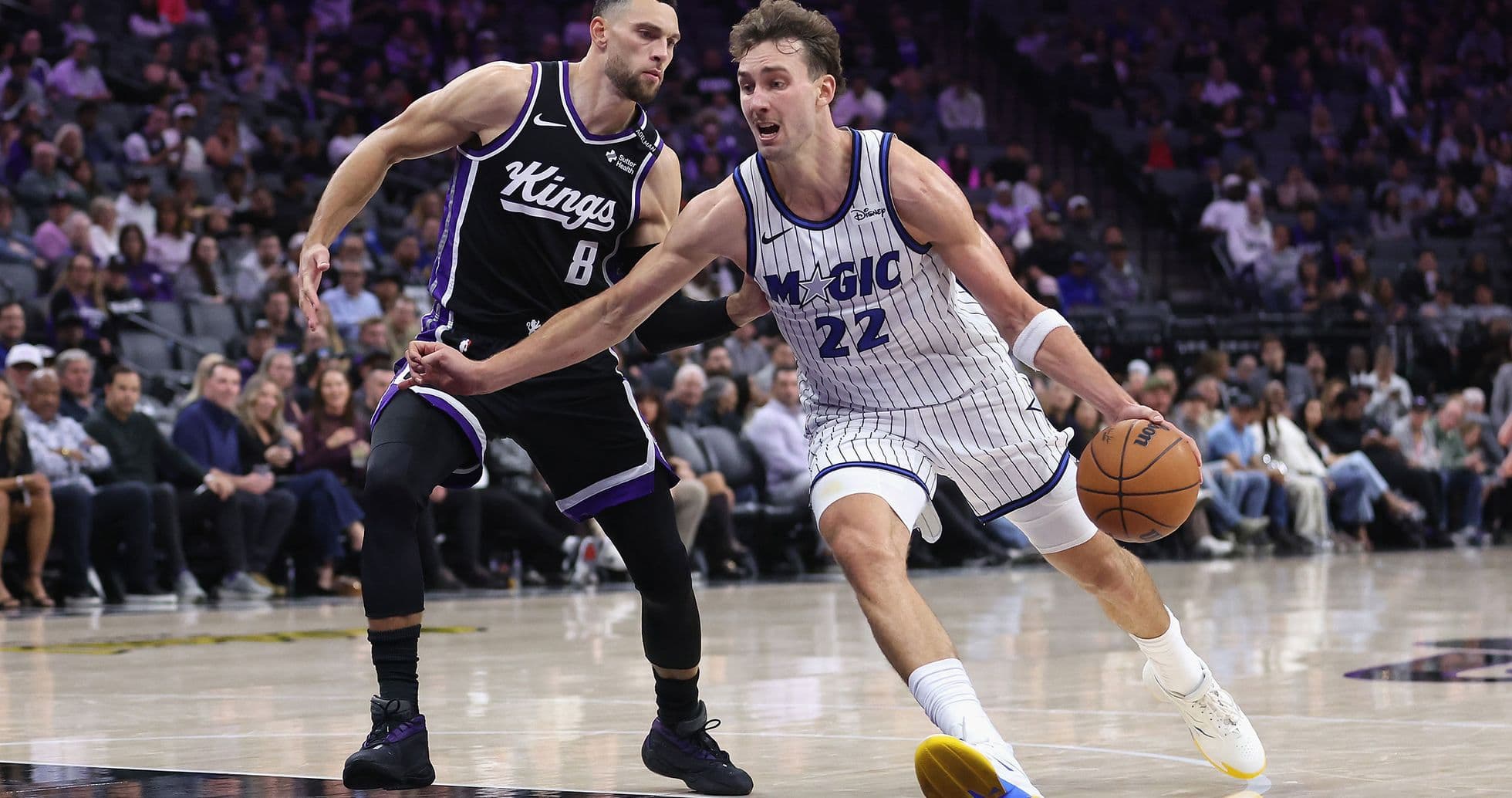
In Tuesday’s win over the Kings, those “opportunity” categories didn’t just tilt toward the Magic – they broke. Sacramento coughed it up 21 times, hounded by Orlando’s ball pressure and busy hands, and those mistakes turned into 33 Magic points. Turnovers are usually described as “costly.” These were brutal.
On the other side, Orlando stayed clean. Just 14 turnovers. That’s seven extra possessions right there. Then came the offensive glass: 12 offensive rebounds for the Magic, only four for the Kings. Twelve extra lifelines, extra threes, extra put-backs. Sacramento kept getting stops, only to see the ball bounce back into a blue jersey.
When you stack that many extra chances on top of competent shot-making, you don’t just win. You suffocate teams.
Anthony Black Forcing His Way Into the MIP Conversation
Anthony Black looks like a different player. Not in body language or role, but in conviction.
He’s attacking the paint with a sharper purpose, yet with more patience. The drives that ended in wild finishes last season now come with balance and control. The numbers back it up: he’s converted 58.3 percent of his 36 shots on drives so far, a huge leap from last year’s 48.2 percent. Same lane, same rim, entirely different outcome.
The jumper, long considered the swing skill, is starting to cooperate too. Through seven games, Black is hitting 42.4 percent from beyond the arc. These aren’t just standstill corner looks, either. He’s knocking down threes both off the catch and off the dribble, a crucial distinction for a guard trying to move from “promising” to “problem.” Last season, he sat at 33.3 percent from deep. That’s not a tweak. That’s a jump.
Ty Jerome in Memphis has an early claim as the frontrunner in the Most Improved Player race, but the field is already crowded. Dallas’ Cooper Flagg, OKC’s Ajay Mitchell, Washington’s Kyshawn George, Houston’s Jabari Smith Jr., Detroit’s Duncan Robinson and Minnesota’s Ayo Dosunmu are all building their cases.
Black is right there with them. If this level of aggression and shot-making holds, he won’t just be “in the conversation.” He’ll be a fixture in it.
Franz Wagner, the Quiet Playmaking Engine
Scan the assist leaderboard and one name jumps out. Not because it sits at the top, but because of the company it keeps.
Only Nikola Jokic and Trae Young are averaging more assists than Franz Wagner among players who have logged at least five games. That’s it. That’s the list.
Wagner, the 6-foot-10 German forward, has turned his feel for the game into a full-blown playmaking hub. When he gets into the paint, he doesn’t just look to score; he sees the floor unfold. Help defenders step in, and he punishes them with the pass.
Right now, Wagner leads the entire league in total kickout passes. Those sprays to the perimeter aren’t empty, either. His teammates are hitting 40.7 percent of their threes off his kickouts. That’s elite efficiency on high-volume reads, the kind of combination that bends defenses before the ball even leaves his hands.
Only one other player matches that blend of volume and accuracy on those specific passes: Portland’s Deni Avdija. They stand alone as the only two players to deliver at least 40 kickout passes for threes while seeing their teammates convert at least 40 percent of those shots.
For Orlando, it means this: every Wagner drive is a decision tree the defense can’t win. Stay home, and he finishes. Collapse, and he finds shooters who are making teams pay.
Alex Morales and the Value of the “Little Things”
On a night full of numbers, one of the most telling performances came from a player whose impact rarely shows up in a headline.
Alex Morales finished with seven points and seven rebounds in Sacramento, but the raw line barely covers his imprint. He chased boards at both ends, battled on the ball, and did the unglamorous work that stitches together winning possessions.
Magic head coach Sean Sweeney spelled it out. Morales, he said, brings effort on both ends – attacking offensive and defensive boards, setting strong screens, and doing “all the little things that you need to win.” Sweeney pointed out that Morales did it in the G League for Osceola, and he’s carried that same mentality into practices and games with the Magic. The three Morales knocked down was nice, Sweeney added, but it was everything else – the defense, the physicality, the dirty work – that truly swung things.
That’s the emerging identity of this Orlando team. Stars who share the ball. Young guards who suddenly hit shots off the dribble. Role players who treat every loose ball like it belongs to them.
When a group starts to dominate the opportunity game this thoroughly, the question stops being whether the surge is real. It becomes something sharper: how far can this formula take them in a conference that’s starting to notice?