Peyton Watson's Departure: A Business Decision for the Nuggets
The Denver Nuggets didn’t lose Peyton Watson on the court. They lost him on the balance sheet.
One of the breakout stories of their season is gone, shipped to the Cleveland Cavaliers in a three-team sign-and-trade that underlined the financial squeeze on a contender trying to keep its core together. Cleveland, Denver and the LA Clippers agreed to a deal sending Watson to the Cavaliers, Max Strus to Los Angeles, and draft capital — an unprotected 2031 Cavs first-round pick and a 2032 Kings second-rounder — back to Denver, as first reported by ESPN’s Shams Charania.
Watson will sign a new four-year, $88 million contract with the Cavaliers, complete with a player option and a trade kicker. For a player who arrived as a raw prospect out of UCLA, it’s a payday that confirms what last season hinted at: he’s no longer a project. He’s a piece.
Denver simply couldn’t meet that price.
According to Bennett Durando of The Denver Post, the Nuggets’ best offer landed at four years and $72 million. Respectable money. Just not enough in a market that has started to reward two-way wings with size and upside as if they were gold.
Watson was a restricted free agent, which usually gives teams control and leverage. But this wasn’t about fit or faith. It was about math.
He had played his way into a salary tier that pushed Denver beyond its comfort zone, and in an era of punitive luxury tax rules, even a defending champion has to draw lines.
Gordon’s Perspective: Brother First, Teammate Second
Inside the locker room, Watson’s departure hits a little differently.
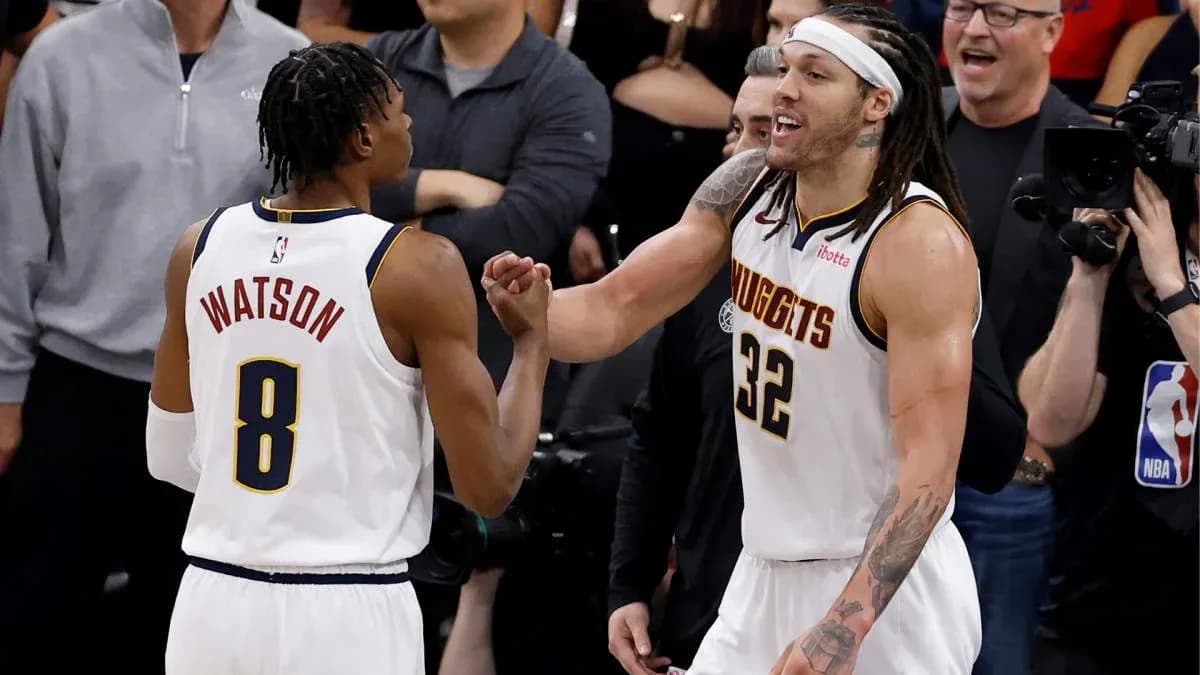
Aaron Gordon, who watched Watson cover his minutes and responsibilities for large chunks of last season, didn’t hide the personal side of the move when he spoke at his youth camp.
“That’s my dawg, but it’s deeper than basketball with Peyton and I,” Gordon said, via DNVR Nuggets. “Our families members go to the same church, Peyton’s just like my brother. I’m happy for him, the situation that he’s in. Obviously, we would’ve loved to have him, but it worked out the way it should’ve. That it was supposed to.”
No bitterness. No subtext. Just a veteran recognizing that a younger teammate cashed in on the opportunity he earned.
Gordon knows exactly what Watson gave Denver. When injuries hit, it was Watson who stepped into the void, particularly during Gordon’s absence and the stretch when Nikola Jokic went down with a knee injury and missed roughly a month.
The response from Watson was emphatic.
He averaged 14.6 points, 4.9 rebounds and 2.1 assists per game in his breakout campaign, flashing the kind of two-way versatility that front offices chase every summer. There was a point in that Jokic-less stretch when Watson was, by many measures, the second-best player in Denver behind Jamal Murray — not just surviving extra minutes, but driving games with energy, length and aggression.
Those weeks changed the way the league looked at him. They also changed his price.
From Naive Rookie to Coveted Wing
For Nuggets fans, the trade cuts through more than just depth charts. Watson had become one of their own.
He acknowledged that bond in a lengthy Instagram message after the deal, a note that read less like a goodbye and more like a thank-you letter from a player who grew up under the Mile High lights.
“Nuggets Nation and the city of Denver, thank you for having me for the first four years of my career,” Watson wrote. “As a young NBA player, who was a bit naive and hadn’t seen much of the real world, you guys took care of me better than I could have ever imagined. Thanks for that. Playing this game every night on the national stage is difficult on both the body and the mind, but the love from the fans always makes it so worthwhile.”
He didn’t stop at the fan base.
Watson made a point of thanking former Nuggets general manager Calvin Booth for drafting him out of UCLA, a decision that set his NBA journey in motion. He mentioned the Kroenke family, former head coach Michael Malone, current coach David Adelman, and his current and former teammates — a full roll call of the people who helped turn a raw wing into a confident starter-level player.
For Denver, that’s the sting: they developed him, trusted him, watched him blossom in real time. Then watched the market take him away.
For Cleveland, it’s the opportunity: a 22-year-old wing with size, production and room to grow, locked in on a four-year deal with the kind of upside that can tilt a franchise’s long-term ceiling.
Denver walks away with picks and flexibility. Watson walks away with security and a starring chance in a new conference.
The question now is simple: when these two paths cross again, will the Nuggets see a familiar face — or a player who has grown into the kind of star they no longer could afford to keep?