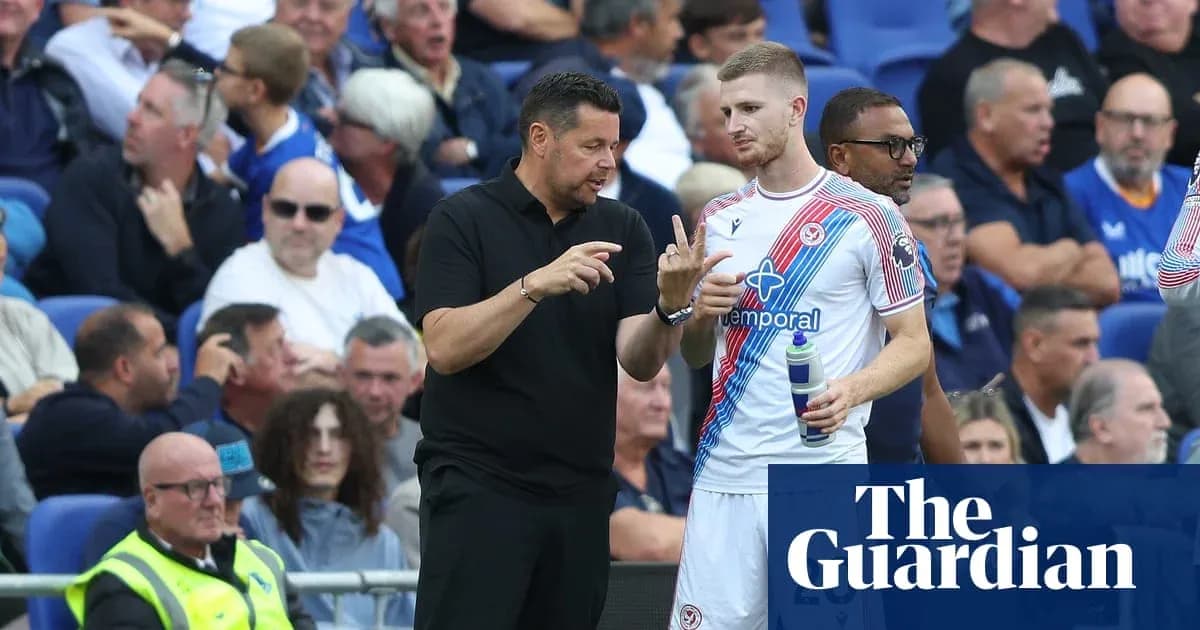
Pierre Sage's Challenges at Crystal Palace: Transfer Turmoil and Squad Reshaping
Pierre Sage knew exactly what he was walking into at Crystal Palace. He had watched the tapes, studied the timelines, understood the chaos. At Selhurst Park, transfer windows don’t close quietly; they rattle the windows.
What he could not control was the timing of his arrival. Stepping in after Oliver Glasner, the architect of the most successful era in the club’s history, Sage has opened his Premier League life with defeats to Everton and Manchester City, while the foundations of his squad shook under constant speculation and late-night negotiations.
Key men Ismaïla Sarr and Jean-Philippe Mateta looked halfway out of the door at one stage, Liverpool circling Sarr and Aston Villa hovering over Mateta. Both stayed. Palace still managed to bring in four new faces after losing out, dramatically, to Sunderland for Malick Fofana on deadline day. For a coach fresh to south London, it was a crash course in how this club lives.
“I knew that and I had to deal and adapt to that,” Sage said of Palace’s habit of leaving things late, a trend that has seen them sign 10 players on deadline day across the last three summer windows.
He sounded calm, almost philosophical. The important thing, he stressed, was profile over timing. “At the end the most important thing is to have the player or the profile we choose and that’s the case. I think we are in line with what we need.”
Glasner never hid his irritation with that model. He wanted business done early and said so. He eventually left for Nottingham Forest, taking Daniel Muñoz with him. Sage, by contrast, does not kick the boardroom doors in public. Behind the scenes, though, there has been frustration, particularly over the attempt to replace Maxence Lacroix after the France defender’s sale to Chelsea in July.
Sage’s first choice was clear: Ismaëlo Ganiou, the 21-year-old centre-back who had been a cornerstone of his Lens side that won the Coupe de France and finished second in Ligue 1 last season. Palace pushed. Lens resisted. Ganiou signed a new deal at the start of August and the door slammed shut.
The search moved on. A move for Joel Ordóñez at Club Brugge collapsed when the Ecuadorian’s recovery from a broken foot raised too many doubts. Approaches for Augsburg’s Chrislain Matsima and Raphaël Le Guen of Brest went nowhere. Palace eventually turned to Axel Disasi and teenage defender Honest Ahanor, brought in on loan to shore up the back line. They add bodies, and some pedigree in Disasi’s case, but the question lingers: who replaces Lacroix’s authority, his voice, his command?
The same story played out in midfield. Palace tried to prise Mamadou Sangaré from Lens, only to watch the Mali international choose Brentford. That setback pushed Sage back towards familiar ground. He became the driving force in the chase for Fofana from Lyon, another of his former clubs. This was personal. A series of deadline-day phone calls to the Belgium forward underlined how badly he wanted him in south London.
It still wasn’t enough. Fofana chose Sunderland.
“I’m really proud and happy with what the club did for that,” Sage insisted. “We fight a lot and sometimes you cannot give more than this, but we give our best in this situation. At the end, the player chooses.”
Palace pivoted to Dario Osorio, the Chile forward arriving from Midtjylland on an initial loan with an obligation to buy next summer for £26m. Osorio operates mainly from the right, so whether he can fill the emotional and tactical gap left by missing out on Fofana is an open question.
Up front, at least, Sage is not short of options on paper. Palace are loaded in attacking zones. Dwight McNeil has arrived, Evann Guessand too – although the latter has been left out of the Europa League squad – and Sarr remains, his move to Anfield never materialising. Behind them, the midfield has been padded out by the return of Ben Chilwell and the late capture of Quinten Timber, signings that have eased some of Sage’s concerns and helped persuade him that the squad is not being stripped for parts.
That stance is underlined by the club’s refusal to cash in on Adam Wharton. Bids came in from unnamed clubs, with Manchester City and Chelsea believed to be among the suitors. Palace held firm. “The club was strong with the situation, and I think the player is completely in line with that,” Sage said. It was a small but significant show of resistance in a summer defined by sales.
Because the numbers tell a stark story. After breaking their transfer record twice in January – signing Jørgen Strand Larsen and Brennan Johnson, the latter eventually swapped with Everton for McNeil – Palace have just posted a summer net profit of almost £40m, the second lowest spend in the division behind Aston Villa. Over the past five seasons, Hull and Coventry, both in the Championship, have outspent Palace’s £90m outlay.
That would cause many managers to bristle. Sage reached for a different reference point: his childhood in Belley, watching his parents run a brasserie in the Ain region of eastern France. “I’m not frustrated – we are not a bank,” he said. “We do with what we have. My parents had a restaurant and I prefer every day there’s a lot of clients but it was not the case sometimes and we have to deal with that every day. In football it’s the same.”
That mentality will be tested at Craven Cottage. Palace travel to Fulham on Saturday without Sarr and Mateta, two forwards who spent the summer with one foot out of the club and now find themselves on the treatment table instead. Mateta’s hamstring injury, which scuppered hopes of a move, will keep him out for another three weeks. Sarr is expected back from a groin problem in time for the Ipswich game next Saturday, but Sage admitted the Senegal international “needs time” after a turbulent few weeks in which Liverpool’s interest and a public statement from his agent left him bruised.
For now, Sage must juggle. He has a squad reshaped by sales, padded by opportunistic deals, and still haunted by the shadow of Glasner’s success. He has a fanbase used to late drama in the boardroom and now demanding clarity on the pitch.
The research is done. The window is shut. The excuses have gone. What remains is the simple, unforgiving question every new manager faces in this league: can he make this version of Crystal Palace his own?