
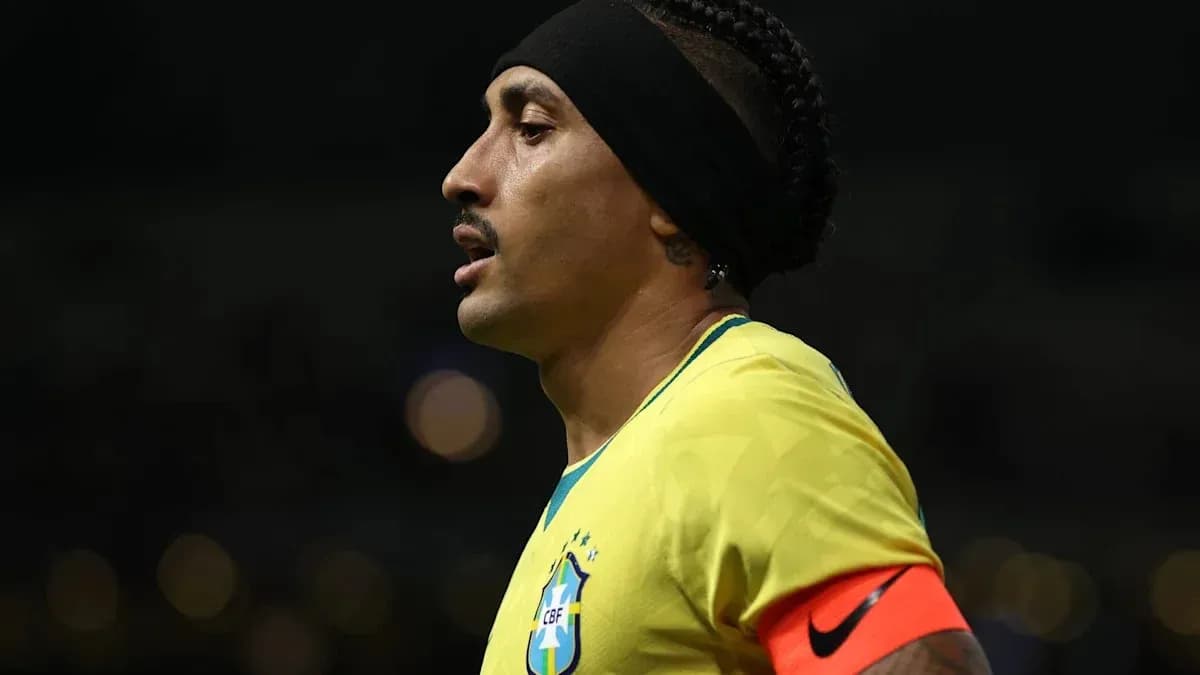
Raphinha's Chaotic Night in Singapore: Red Card and Controversy
Raphinha’s night in Singapore began as a test of fitness and ended as a test of temperament.
Brazil’s 3-2 defeat to Japan on November 14 will be remembered less for Vinicius Jr.’s brace and more for the chaotic finale that saw Raphinha and head coach Carlo Ancelotti sent off in stoppage time after Tatsuhiro Sakamoto’s winner.
For the Barcelona captain, already under scrutiny over his international workload, it was the worst possible way to close an already uneasy international window.
A fragile body, a loaded context
Raphinha arrived in Singapore carrying more than just a suitcase. Fresh off a muscle problem and a contract renewal at Barcelona that ties him to the club until 2030, he had publicly admitted he was not yet fully fit.
Those comments, made during his renewal ceremony, were meant as honesty. They became ammunition.
Back in Brazil, they were seized upon as a sign he wanted to manage his minutes in the national team shirt. The suggestion that a Seleção regular might be picking and choosing his workload did not sit well.
He moved quickly to clarify. The forward stressed that his concern was purely physical — a desire to avoid the kind of recurring muscular issues that have stalked him through recent international breaks, not an attempt to dictate when he should or should not play for his country.
In Singapore, he doubled down on that message. At a pre-match press conference, Raphinha insisted he wanted to represent Brazil whenever he was physically capable. No conditions. No caveats. Just the plea that his body be managed sensibly.
Barcelona, watching from afar, had every reason to be wary. Each international window has felt like a medical tightrope.
Ancelotti’s call: Raphinha as Brazil’s No 9
Ancelotti, though, made his stance clear the moment the teamsheets dropped. Raphinha started.
Not out wide, where he usually does his best work, but centrally — deployed as Brazil’s number nine against a sharp, organised Japan side.
The decision underlined the trust the coach still places in him. It also raised the stakes for a player whose fitness and form had become a talking point before a ball was even kicked.
On the pitch, Raphinha worked. He drifted, dropped, linked play. Across 71 minutes he recorded 39 touches, registered two shots on target and carved out one clear chance. It was not a quiet outing, even if it lacked the defining moment in front of goal he would have wanted.
When Endrick replaced him in the 71st minute, the forward’s night seemed to be over: a solid, if unspectacular, contribution in a chaotic game. But this match still had a final act waiting.
Brazil wobble, Japan pounce
Brazil never looked settled defensively. Japan sensed it early and struck.
Takefusa Kubo opened the scoring, and Keito Nakamura added a second before 20 minutes had passed. Brazil’s back line creaked, then cracked, leaving Ancelotti’s side chasing shadows and the scoreboard.
Vinicius Jr. dragged Brazil back into the contest almost by force of will. His first goal reduced the deficit and shifted the energy. His second, on 75 minutes, completed the comeback and seemed to steady a side that had been reeling.
At 2-2, Brazil finally looked like Brazil again. The ball flowed, the chances came. Japan, though, never lost their edge.
Deep into stoppage time, Sakamoto struck. A late winner, a dagger to Brazilian hopes — and the spark for the evening’s most combustible moment.
Fury at the whistle: red for Raphinha and Ancelotti
As Japan celebrated, Brazil erupted.
The flashpoint came in the build-up to Sakamoto’s goal, with Brazilian players and staff adamant there had been a foul on Joao Gomes. The protests were instant and intense.
Raphinha, no longer on the pitch but very much in the thick of the argument, led the complaints. Ancelotti joined him. The referee’s response was uncompromising: two straight red cards, one for the Barcelona forward, one for the Brazil head coach.
What had been a difficult night turned into a damaging one.
For Raphinha, the dismissal adds a disciplinary stain to an international break already overshadowed by questions about his body and his role. For Ancelotti, it was a rare loss of composure on the touchline, born of frustration at a late decision that flipped the narrative of the game.
An unwanted complication
The fallout will not be limited to the match report.
Brazil must now assess Raphinha’s availability for their next friendly, again in Singapore, on November 17. Any suspension or internal sanction will only deepen the sense of disruption around a player trying to balance national pride with physical fragility.
Barcelona, monitoring every minute and every muscle fibre from a distance, will not have enjoyed what they saw: a recently injured captain pushed through a demanding game, then dragged into controversy at the final whistle.
Raphinha came to Singapore hoping to prove he was ready to carry both club and country again. He leaves with his fitness still under the microscope and a red card hanging over his name.
The question now is not just how quickly his legs recover, but how he rebuilds trust on both sides of the divide.





