Ronaldinho's Return to Football with Ravenna: A Dream Project
The old hero stepped off a private jet on Friday and into a dream that, on paper, makes no sense at all.
Ronaldinho, retired since 2018 and absent from serious competition for nearly a decade, is about to lace up his boots again. Not for Barcelona, not for Paris Saint-Germain, not even for a glamour friendly in some far‑flung stadium. For Ravenna. For a provincial club with big-city ideas and a president who grew up worshipping the Brazilian who turned football into a travelling carnival.
A childhood idol, a grown man’s project
When Alessandro Cipriani bought his hometown club in June 2024, he didn’t talk about balance sheets or resale value. He talked about teenagers.
His mission, he said, was “to make young people of Ravenna fall in love with football”. To do that, he went back to the player who had made him fall in love with the game. Ronaldinho. The grin, the tricks, the feeling that anything could happen whenever the ball hit his feet.
“I don't think there’s any other player who inspires such a love for the game as Ronaldinho does,” Cipriani told Gazzetta dello Sport. Few would argue. Inside football, Ronaldinho sits in rare company: almost universally liked, almost impossible to resent. He is, as many see it, jogo bonito in human form.
There was, of course, one glaring issue with Cipriani’s romantic plan. Ronaldinho is 44. His last spell of professional football ended at Fluminense in 2015. His retirement became official in 2018. This is not a comeback built on recent minutes or sports science.
What it is built on is a relationship.
The pair struck up what Cipriani calls “a genuine friendship” after being introduced by Lorenzo Tonetti, the former co-owner of Milan’s famous ‘Giannino’ restaurant, a haunt for Ronaldinho during his two-and-a-half years at AC Milan between 2008 and 2011. When Cipriani floated the idea of a return, there was no long negotiation.
Ronaldinho, he says, “said yes immediately”. That’s the character: if there is a chance to have fun and to excite people, he’s in.
The show comes to town
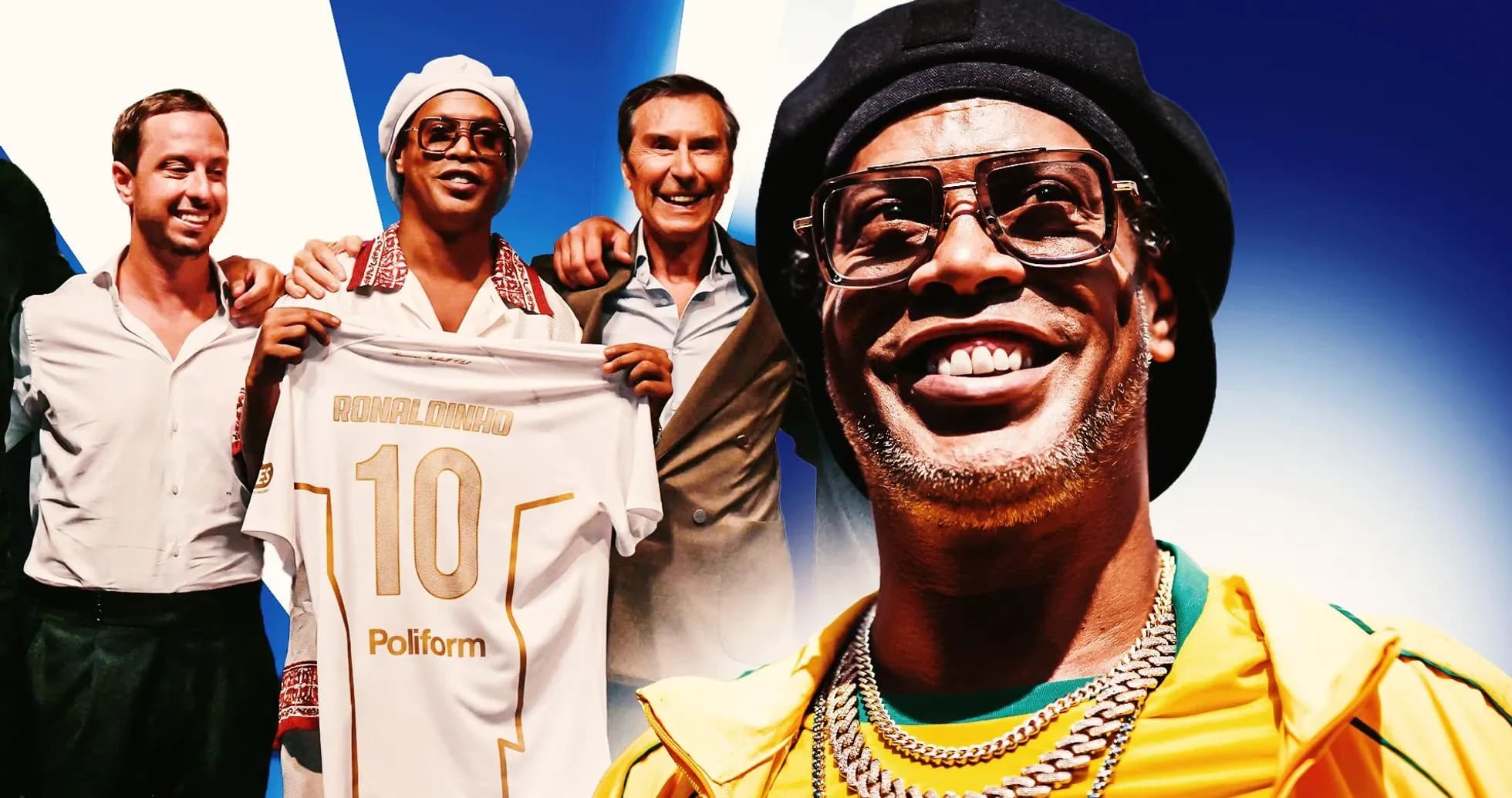
The first taste of that excitement came in August, when Ronaldinho made his initial appearance in Ravenna at a lavish media event. He walked into a hero’s welcome and looked genuinely moved by it.
“This is why I came back!” he told reporters, gesturing toward the crowd that had turned out just to see him. “Do you understand now?”
What nobody fully understood that day was whether he would actually play any meaningful football. Was this a nostalgia tour, a handshake, a wave, a few keepy-uppies and a smile for the cameras? Or something more?
Cipriani has been clear: Ronaldinho will play. The plan, according to Ravenna coach Andrea Mandorlini, is “around half an hour” in Sunday’s derby, despite the Brazilian having trained only once with the first team since landing by private jet on Friday.
The city has treated that half-hour as an event. Tickets have been selling at more than double their usual price. A temporary stand, inevitably named ‘R10’, has been erected for the occasion. Extra suites have been installed at the stadium to cope with demand. For a league that often “goes unnoticed”, as Cipriani freely admits, this is a rare moment with the world’s eyes pointed in its direction.
More than a cameo, more than a stunt
Cipriani insists this is not a one-night circus.
“Ronaldinho is here with a specific, romantic goal: to try and score the final goal of his career,” the president says. There is something wonderfully old-fashioned in that ambition: a great player seeking one last, tangible memory, not in a Champions League final, but in a provincial derby.
Yet the project runs deeper than a farewell flourish or a viral clip. Ronaldinho is not just a guest star. He is coming in as a shareholder.
“His involvement is not just a superficial gesture or a marketing ploy to get people talking about us,” Cipriani stresses. Ronaldinho, he says, will be a long-term partner in the club’s future.
The partnership also carries a sharp commercial edge. Ronaldinho wants to launch his own sportswear brand, R10, using Ravenna as the first team to wear it. Cipriani describes it as “the Michael Jordan model” applied to football: a club and a brand rising together.
The early evidence suggests the idea works. When Damiano David, frontman of Italian rock band Maneskin, asked on social media in August, “Where can I buy the [R10 Ravenna] shirt?!”, the answer was: nowhere. The first limited-edition batch had already sold out.
Since then, stocks have been replenished. The club now swims in Ronaldinho-branded merchandise, both online and at the stadium, where the new suites and the R10 stand underline the scale of the operation. Every selfie, every shirt, every ticket sold feeds not just nostalgia, but a broader business plan.
A provincial club with a global face
The strategy is clear: use Ronaldinho’s global magnetism to drag an entire league into the spotlight.
“When Ronaldinho and Ravenna made headlines worldwide during the World Cup, it showed that provincial football can capture attention anywhere,” Cipriani argues. If Ravenna can pull in that attention, he believes, the whole division benefits — TV rights, sponsorship, attendances, the lot.
This is why Sunday is framed as a beginning rather than a one-off. “I’ll state it clearly, because I work better when I make a public commitment,” Cipriani says. “Ravenna must reach Serie A and, in time, compete at a European level. It will require patience and a solid structure, but that is the direction we are heading in.”
The words are bold. The roadmap is ambitious. And Ronaldinho, in this vision, is not just a nostalgia act dropping in for a cameo. “He is our global ambassador and a long-term partner in this project,” Cipriani says. A symbol, a salesman, a shareholder.
Building credibility, brick by brick
Cipriani knows that a famous smile and a sold-out shirt can only take a club so far. If Ravenna are to climb the Italian football ladder, they need structure, expertise, and credibility.
So he has gone back to another piece of Milan history: Ariedo Braida. The former AC Milan CEO and sporting director, now 80, has agreed to become vice-president. His presence alone carries weight. This is a man associated with some of the most astute squad-building in modern Italian football, now lending his name to a club many are already calling “the next Como”.
Cipriani hears the comparison and embraces part of it, while drawing a line. “That’s certainly something that makes us proud,” he says, “but the fundamental difference is that our ownership is local and deeply rooted in the community. Ravenna is my home, and my lifelong dream has always been to turn every young football fan in the area into a supporter of our city’s club.”
To do that, he knows the club must change physically as well as symbolically. Facilities matter. Infrastructure matters.
“Our general manager, Paolo Scocco – who is doing an outstanding job – is overseeing the development of our new, modern training centre, which should be ready by January,” Cipriani explains. Once that is complete, the focus shifts to the stadium.
Renovations at the Stadio Benelli are ongoing, but they are only a stepping stone. The long-term plan is a brand new stadium, complete with offices and a Hotel Cipriani. A club that has often lived on the margins of the Italian game is trying to reimagine itself as a destination.
One last goal, one huge gamble
So here we are. A retired genius chasing one final goal. A hometown president chasing Serie A and European nights. A provincial club dressing itself for a bigger stage.
On Sunday, Ronaldinho is expected to play “around half an hour” in a derby that, under any other circumstances, would barely ripple beyond the region. Instead, a temporary R10 stand will be packed, tickets will sit at more than twice their normal price, and cameras from around the world will tune in to see what, exactly, this looks like.
Maybe he will produce a flick, a nutmeg, a no-look pass that sends the crowd into delirium. Maybe the legs will be heavy and the lungs will burn. Maybe the moment will belong more to the idea of Ronaldinho than the player himself.
But if he does find that “final goal of his career”, in Ravenna colours, in a league that usually slips by unnoticed, it will say everything about this project: audacious, emotional, commercially savvy, rooted in a city that refuses to think small.
The Ronaldinho project, as Cipriani puts it, is just the starting point. The real question is whether this unlikely alliance can turn a one-night carnival into a lasting revolution.