
Scotland's Struggles: A Narrow Victory Against North Macedonia
If the glow of Sebastien Pocognoli’s early days in charge dimmed with October’s defeat by Slovenia, this felt like the night the lights almost went out altogether.
Almost. Scotland beat North Macedonia. The campaign stays alive. But nobody inside Hampden could dress this up as anything other than a slog – a scratchy, joyless 2-1 that exposed as much as it reassured.
A win that never settled the nerves
The stakes were obvious. Against a side with no points, no goals and 10 conceded in their first four group games, three points were non-negotiable. A commanding victory would have soothed the angst. A draw would have been a disaster.
For half an hour, disaster was on the table.
Scotland, back with three at the back, laboured from the start. The effort was there, as it almost always is with this group. The pressing, the running, the willingness to scrap for every second ball. What they lacked was everything that separates honest toil from convincing football: clarity, rhythm, conviction on the ball.
They carved out chances in the first half, but mostly through persistence rather than pattern. Nothing felt controlled, nothing looked repeatable. It was a team chasing solutions, not a team that knew them.
Then came the miss that will live with Billy Gilmour for years.
Gilmour’s nightmare, McGinn’s release
The ball dropped to Gilmour in front of goal, the kind of opportunity players dream about and then, sometimes, dread. He ballooned it over from point-blank range, a howler so glaring it immediately invited comparisons with Chris Iwelumo’s infamous miss against Norway in 2008.
Iwelumo has carried that moment like a scar. Gilmour will now share the burden. The Napoli midfielder at least has time on his side and, crucially, his error did not cost Scotland the game. But the collective gasp around Hampden told its own story. Disbelief. Then irritation. Then a murmur of anxiety.
The tension broke when John McGinn did what John McGinn so often does.
Scotland finally forced their way through and McGinn struck, his first of the night easing the mood and, briefly, restoring the old script. Against North Macedonia, one goal tends to be enough. They had failed to score in their previous four group matches. They had barely managed a shot on target in the competition.
Score once, shut the door, decide the margin. That has been the pattern.
Not this time.
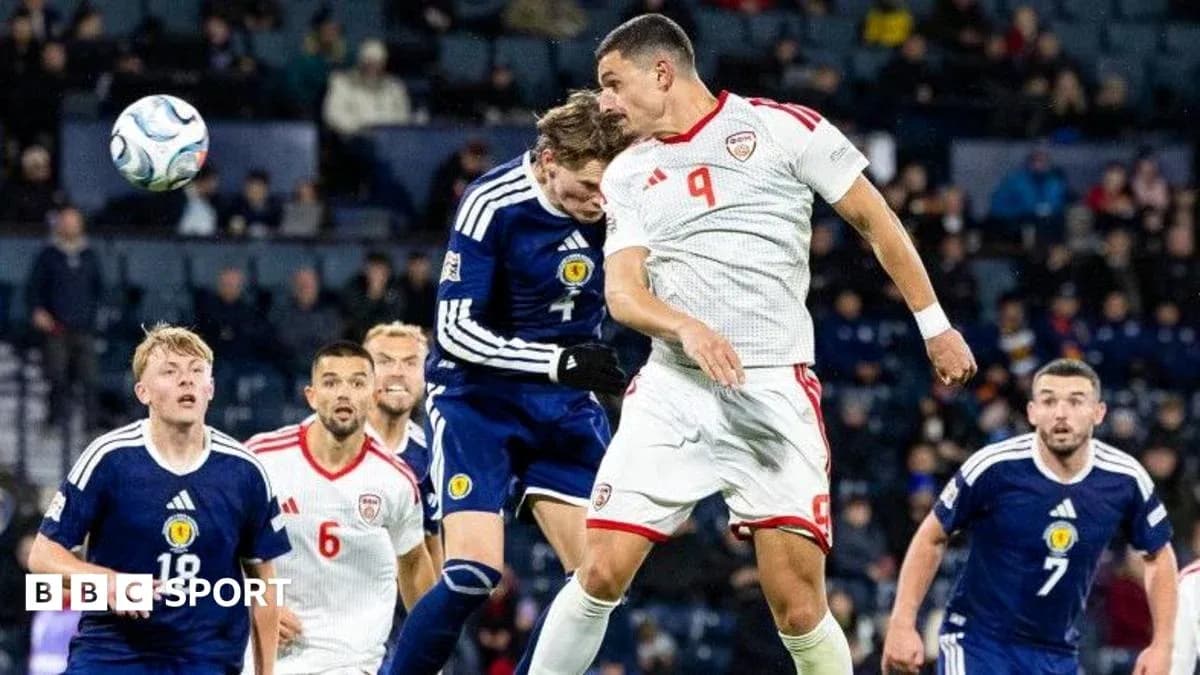
North Macedonia had offered nothing in the first half, just as they had offered nothing in Skopje against the same opposition. Then, out of nowhere, came the jolt. A near-post header from Elmin Rastoder, stealing in front of a dozing Scott McTominay, ripped through the quiet.
Rastoder’s celebration carried a hint of disbelief. A first goal in five Nations League games, and their first in nine matches overall. Their previous strike had come a year ago in a 7-1 defeat to Wales. From nowhere, Scotland were back in jeopardy.
Penalty, pressure and a confused identity
The response was messy but just about enough.
Ben Gannon-Doak, deployed as a wing-back, drove into the box and drew the penalty that saved Scotland’s night. His role summed up the broader confusion. At times he looked like a full-back. At others, an out-and-out winger. Occasionally, a player caught between instructions. A square peg in a tactical experiment that never truly convinced.
McGinn took the responsibility from the spot and hammered the ball straight down the middle. Relief, not elation, washed around Hampden. An ugly 2-1? They’d have grabbed it with both hands the moment Rastoder’s header hit the net. That is exactly what they got.
McGinn’s brace carried a personal milestone, too. He moved clear of Hughie Gallacher in Scotland’s all-time scoring charts and now sits just six behind Kenny Dalglish and Denis Law. It is a remarkable body of work from a midfielder who has become the team’s heartbeat and, increasingly, its finisher.
On another night, Andy Robertson’s 102nd cap would have framed the story. A landmark for a captain who has carried this side through lean and rich spells alike. Here, it felt like a footnote in a performance that raised more questions than it answered.
System doubts and a tightrope finish
Strip away the graft and the grit and what remains is troubling. Scotland’s chances came from individual endeavour, not a system dismantling a weak opponent. They stumbled over the line through sheer will rather than a clear idea of who they are and how they want to play.
Pocognoli, McGinn and Robertson all spoke afterwards. None pretended it was pretty. They were grateful, not satisfied. That in itself tells you where this team stands.
The table is unforgiving. Switzerland have already won the group. Scotland sit a point behind Slovenia with one game left. Slovenia head to North Macedonia on Monday, a fixture that looks, on paper, like a gift. Scotland must go to St Gallen to face a Swiss side with nothing to play for and, possibly, a rotated XI.
It may not matter. If Slovenia do what is expected, Scotland finish third.
That would leave them in pot three for the Euro 2025 draw in Belfast in December, staring at a tougher path and another summer of hoping rather than planning. Pot three is not where they want to be. It is where this level of performance will put them.
The honeymoon is over. The goodwill is thinning. Scotland have their win, and they still have a chance, but the sense of a team wrestling with its own identity grows stronger with every laboured display.
Heavy weather at Hampden. Switzerland away on Monday. The storm, you suspect, is still forming.





