
Scotland's Struggles Despite Victory Over North Macedonia
Sebastien Pocognoli’s honeymoon as Scotland manager is over. If the defeat by Slovenia in October felt like the first serious row, this scraped 2-1 win over North Macedonia at Hampden came close to plates being thrown.
Scotland won. They had to. But nobody inside the stadium will kid themselves that this was anything other than a fraught, joyless slog against a side that arrived with no points, no goals and 10 conceded in four games.
Effort? No issue. This Scotland team never shirks the running or the tackling. The problem lies elsewhere. In the gaps where composure should live. In the moments that demand clarity, not chaos. On Friday night, nous, technique, conviction and execution all came and went in fits and starts.
A must-win that never felt comfortable
Three points were non-negotiable. A commanding victory would have been a bonus, perhaps even a fantasy. A draw, though, would have been a catastrophe, and for a worrying spell before the half-hour, that nightmare loomed into view.
By then, the pattern was familiar. Scotland huffed and pressed, carved out some half-chances, but never truly imposed themselves. North Macedonia, timid and toothless in the group so far, barely crossed halfway with intent. Yet the longer it stayed goalless, the heavier the air at Hampden became.
The first real jolt to the senses arrived early in the second half, and it came from the unlikeliest of villains.
Billy Gilmour, usually the calmest man on any pitch, found himself staring at an open goal from point-blank range. The stadium braced for the net to bulge. Instead, the ball took off, ballooned over the bar, and Hampden inhaled as one.
It was a miss to haunt a career. The kind that instantly summoned memories of Chris Iwelumo’s infamous moment against Norway in 2008. Gilmour, now of Napoli, will hear about this for as long as he wears a Scotland shirt. The saving grace? Unlike Iwelumo’s, it did not end up costing points.
The groans were still echoing when John McGinn stepped in to rewrite the mood.
McGinn’s rescue act and a familiar North Macedonian story
McGinn’s first goal settled the nerves. A surge of relief rolled around the stands. The breakthrough had finally arrived, and against this North Macedonia, one goal has usually been all that’s required.
Recent history is brutal on the visitors. No shots on target against Switzerland in their opener. One against Slovenia. None against Scotland in Skopje. Another blank in their second meeting with the Swiss. A team with almost no attacking threat, drifting through this Nations League campaign.
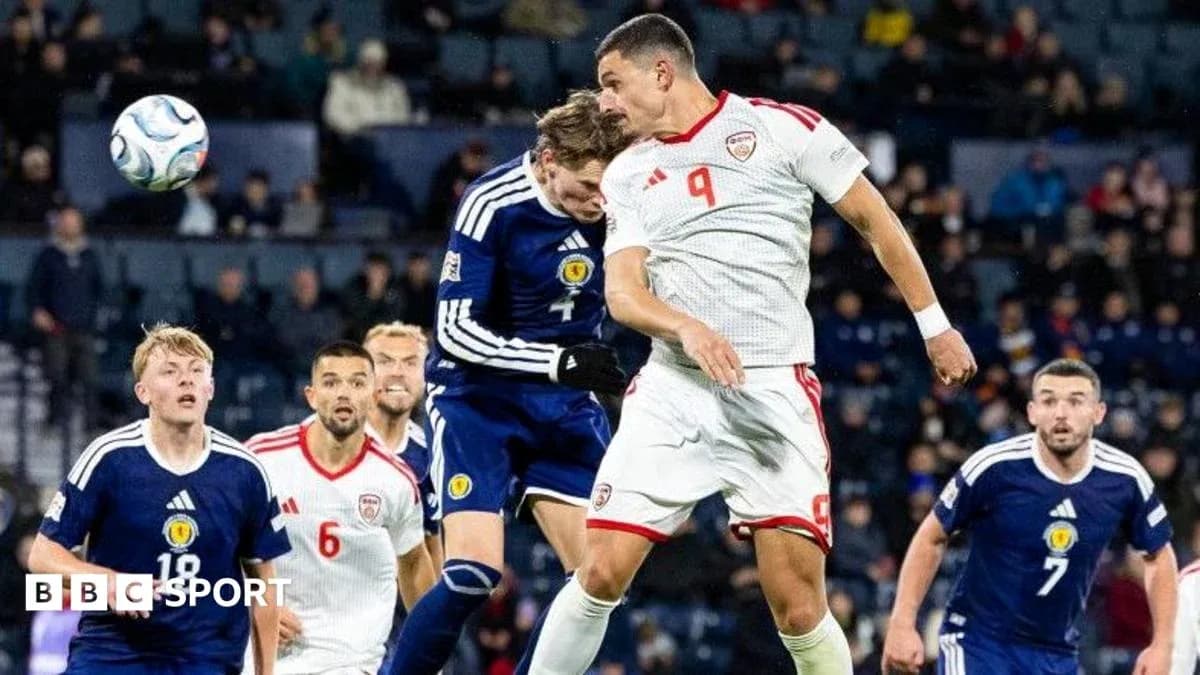
They offered nothing in the first half here either, so when Elmin Rastoder stole in at the near post to nod them level, Hampden was stunned. Scott McTominay switched off for a fatal second, Rastoder darted across him and guided his header home.
The celebration said it all. Rastoder tore away almost in disbelief. North Macedonia’s first goal in five Nations League games. Their first in nine matches in all competitions. Not since a 7-1 hammering by Wales a year ago had they found the net.
From nowhere, Scotland’s evening teetered on the brink.
Penalty, pressure and a record-chasing captain
The response was ragged but just about enough. Ben Gannon-Doak, deployed as a wing-back, drove into the box and drew the foul that changed the night. McGinn took the penalty, hammered it straight down the middle, and Scotland were in front again.
Relief, not elation.
McGinn’s double carried personal significance. Those goals took him past Hughie Gallacher on Scotland’s all-time scoring list, leaving him just six behind Kenny Dalglish and Denis Law. For a midfielder, it is an extraordinary body of work, a testament to his timing, nerve and enduring influence on this team.
There was another landmark in Andy Robertson’s 102nd cap, a remarkable number for a player who has spent his entire international career straining to drag Scotland upwards. Yet even that achievement felt like something you had to dig for amid the broader unease.
Because this performance did not convince. Not tactically, not structurally, not emotionally.
A system that still doesn’t fit
Pocognoli went with three at the back again, but the shape never looked settled. Scotland appeared caught between ideas, between eras, between the safety of what they know and the temptation to evolve.
Gannon-Doak’s role summed it up. Nominally a wing-back, he often looked unsure whether he was meant to be a full-back, a winger or something in between. A bright, willing runner turned into a square peg hammered into a round hole.
Most of Scotland’s chances came not from a coherent plan slicing open a weak opponent, but from sheer persistence. Pressing, second balls, individual graft. The victory owed far more to effort than to any sense of a team that understands exactly what it is trying to be.
They got there in the end, but they did so while wrestling with their own confusion.
McGinn said as much afterwards, his two goals matched by some plain speaking. Robertson, too, sounded more relieved than satisfied. Pocognoli, for all his gratitude at the result, knows this was not the performance of a side ready to stride into a major tournament with conviction.
The table, the trap and what comes next
The win drags Scotland to within a point of Slovenia with one game to go. Switzerland have already wrapped up top spot. The scrap is now for second place and a kinder route into the Euros.
On paper, Slovenia hold all the aces. They travel to North Macedonia on Monday, a fixture that looks like a gift. Scotland must go to St Gallen to face a Swiss side with nothing to play for, who may rotate heavily.
It might not matter. If Slovenia do what logic suggests they should, Scotland will finish third. That would leave next month’s Euro 2028 draw in Belfast as an exercise in hope more than expectation.
Pot three beckons. It is not where Scotland want to be. It is where this campaign, as it stands, says they belong.
There is still a sliver of room for late drama, for a final twist that spares Pocognoli and his players from that fate. But even if results fall kindly elsewhere, the deeper questions will not go away.
About systems that don’t quite fit. About players asked to operate in roles that blur their strengths. About a team that fights like mad, yet too often looks like it is fighting itself.
On Friday night, Scotland got the result they needed, but they made heavy weather of a game that should never have become a storm. The forecast for Switzerland? Dark clouds, and a manager who knows the next 90 minutes may define the tone of his tenure.





