The Spurs Are Back: 10 Straight Wins and Wembanyama's Impact
The Spurs have their edge back. Ten straight wins say so. The way they’re doing it says even more.
A week into the season, they looked wobbly. Now, in the afterglow of a 10th consecutive victory in Chicago, San Antonio suddenly resembles a fully formed contender that knows exactly who it is and where everything runs from.
Through Victor Wembanyama.
The Wemby System Takes Shape
Last year, the Spurs often played like they were waiting on a signal from their 7-foot-4 centerpiece. Possessions stalled while teammates tried to read his mind. The half court bogged down, especially when the pressure rose. It felt like a talented group improvising around a generational star, not a system built through him.
That’s gone.
Now, the offense moves with a clear idea: Wembanyama is the hub, and everyone else knows the routes. The ball finds him in spots where his decisions dictate the possession, not just his shot attempts. The cuts are sharper and better timed. Guards are slipping into cleaner angles to loft lobs. Wembanyama, working more often off two feet, looks balanced, patient and deliberate.
Nothing about the schedule so far screams gauntlet. Tougher defenses will jam the gears at some point. But the difference is obvious: this is no longer a team watching Wembanyama. It’s a team playing through him.
The only glaring gap is shooting. San Antonio still leaves points on the table from the perimeter. Yet the structure is there. The actions are coherent. They look like an optimized version of themselves, waiting only on the jumpers to catch up.
Three Guards, One Statement
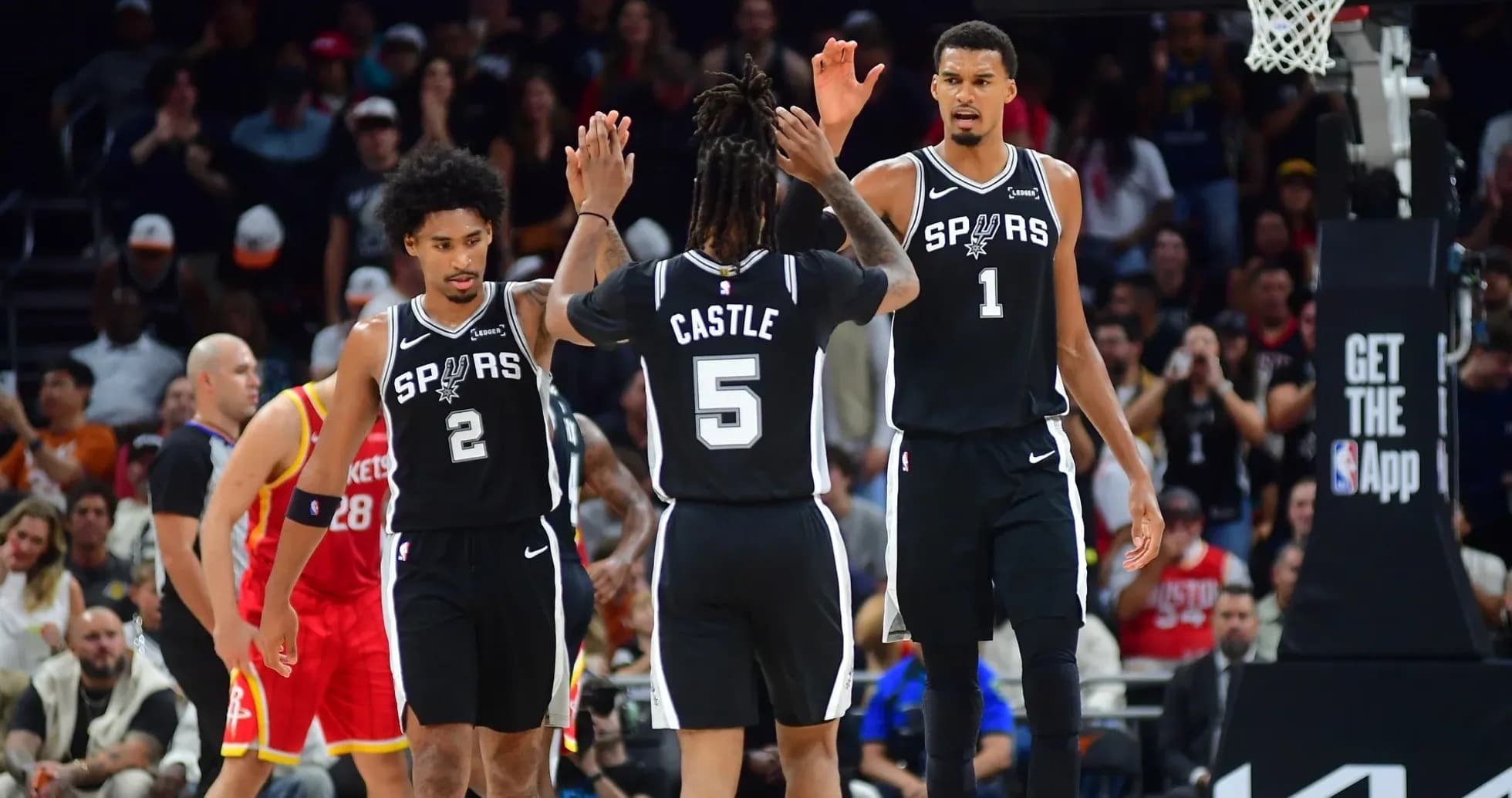
On paper, starting De’Aaron Fox, Stephon Castle and Dylan Harper together feels like a gamble. On the floor, it’s a problem — for everyone else.
Across the first 10 games, that trio’s starting lineup has posted a monstrous plus-30.3 net rating, seventh in the league among high-usage groups. The raw plus-minus is even louder: plus-68, well clear of the Los Angeles Lakers’ top unit. When those three share the court with Wembanyama, opponents look like they’re juggling knives.
Defensively, they squeeze the life out of the paint. Opponents are shooting just 32.4 percent on 2-pointers against that group, a number that almost looks like a typo. The pick-and-roll coverage is tight. The guards hold up in isolation. Wembanyama erases mistakes at the rim.
The cost? Shooting. This lineup doesn’t stretch the floor the way some modern groups do, and good defenses have already started testing that. They’re sagging, packing the lane, daring Castle in particular to beat them from deep. He’s been solid enough to keep the experiment firmly in the black, hitting just enough open looks to punish lazy rotations.
This isn’t a playoff-proof verdict yet. Ten games is a window, not a full report. But for now, the three-guard look doesn’t just survive. It controls games.
Mitch Johnson Finds His Rotation
The temptation with a hot start is to assume the coach is simply riding whatever works. Mitch Johnson insists that’s not what’s happening. The tweaks to lineups and substitution patterns, he explained in Chicago, aren’t reactive to opponents. They’re about building a rotation that can last.
The puzzle changed when Harper moved into the starting five. He had been the spark plug who entered in the middle of the first and third quarters, a scoring jolt that kept the offense from dipping when Wembanyama sat or the rhythm broke. Take that jolt and put it in the opening lineup, and suddenly the bench needs a new anchor.
The answer has been Fox.
Johnson now gives Fox an early first-quarter breather, then brings him back around the four-minute mark to run the second unit. From there, Fox stretches into the second and fourth quarters while Castle takes longer, more demanding shifts. Fox gets shorter, frequent rests; Castle gets fewer but heavier minutes.
Behind them, the second unit is starting to harden into shape: Fox, Julian Champagnie, Keldon Johnson, Luke Kornet and one of Harper or Castle. Carter Bryant and Harrison Barnes slide in during the early stages of the second and fourth quarters, particularly when Wembanyama returns, creating a familiar pressure point: Fox and Wembanyama working the short roll and punishing indecisive defenses.
It’s not flashy, but it’s functional. And it’s early. Once Tobias Harris is back, those combinations only get more dangerous.
Where Tobias Harris Fits
If anyone needed a reminder of why San Antonio went for Tobias Harris in the summer, the early-season second-unit struggles provided it.
This team badly needs another scorer who can live in different areas of the floor, someone who can post, face, pass and finish from awkward angles. Right now, the post is essentially Wembanyama’s territory, with Castle dipping in occasionally. Harper and Fox can use their bodies to shield and hold, but that’s more staging than true back-to-the-basket offense.
Harris changes the geometry.
Park him in the high post and the entire possession tilts. Defenders have to decide whether to dig, double or live with his midrange craft. The other wings on this roster are mostly straight-line drivers, operating within clear, structured lanes. Harris plays with more improvisation, more natural rhythm. He can be the second-unit hub that keeps everything from leaning too heavily on Fox or Wembanyama.
For a bench that has already shown how fragile it can look without that extra creator, Harris’ eventual return isn’t a luxury. It’s the missing piece to a group that wants to score in more than one way.
No Finals Hangover
The most surprising development might not be tactical at all.
Teams that ride chemistry to the NBA Finals often come back changed. Roles harden. Egos swell. The magic fades. San Antonio hasn’t blinked.
The locker room feels almost identical to last season’s playoff run. The jokes still fly. The honesty is still there. Johnson’s voice still booms, still lands. Harris, even while out, is organizing team outings — like the burger run he pushed for after the win in Chicago — and catching flak right back when he does.
The hierarchy hasn’t shifted. Wembanyama is still spoken about in the same terms, still treated as the franchise fulcrum without being isolated from the group. Barnes remains the steady veteran presence. The young guards move through the room like they belong, not like they’ve arrived.
Wembanyama admitted he expected some sort of emotional drag after the Finals. He hasn’t felt it. It certainly showed early — the preseason and the opener against Oklahoma City were rough — but the response has been emphatic. Ten straight wins. A defined identity. And the sense that only a handful of players have truly hit their stride.
The framework is in place. The rotation is close to settled. The star is growing into a system built around him instead of orbiting alone.
If this is what San Antonio looks like while still searching for top gear, what happens when the shots fall, Harris returns and the league’s defenses stop underestimating them?