Team USA's Journey in the 2026 FIBA Women’s Basketball World Cup
The wait is almost over. In Berlin, the next great test of American dominance in women’s basketball is less than a day away.
On Friday, Sept. 4, Team USA opens its 2026 FIBA Women’s Basketball World Cup campaign against China (8:15 a.m. ET, TruTV/TNT/HBO Max), the first step in a bid for a fifth straight world title. The tournament ends on Sept. 13. The United States expects to still be standing.
The rest of the world has other plans.
A different kind of stage
For Caitlin Clark, this is not just another stop on a crowded calendar. It’s a new frontier.
“Even getting to play here in the World Cup, that's special within itself, too,” the Team USA guard told FIBA. “Sometimes this is an even harder competition than the Olympics. I think one of the most fun parts is the international game and talent is growing and growing. These competitions are only getting harder to win.”
She’s right. The World Cup has become a pressure cooker. Deeper rosters. Sharper scouting. No easy nights. And this time, the United States walks in without two of its most reliable stars.
A’ja Wilson and Kelsey Plum are out injured. Two pillars gone from a program built on continuity and star power. That reality drops Kara Lawson into her first major international tournament as head coach with a challenge and an opportunity: keep everyone in their natural spots, lean into balance, and still find a lineup that scares everyone in the building.
On paper, she has one.
The projected starting five
PG: Chelsea Gray, Las Vegas Aces
Lawson’s first big decision sits at the point of attack. With a young guard group that has never navigated a World Cup or Olympics at senior level, she is expected to turn to experience.
That means Chelsea Gray.
The Aces star didn’t light up the stat sheet in March’s FIBA Qualifying Tournament — 5.6 points and 4.8 assists in limited minutes over five games — but those numbers barely scratch at her value. Gray is a tempo-setter, a late-clock problem-solver, a guard who sees the game two passes ahead. The question is not whether she starts. It’s how long Lawson rides her and how much control she hands over to her as the floor general.
SG: Jackie Young, Las Vegas Aces
Next to Gray, Jackie Young looks like the natural choice.
She has never played in a World Cup, yet she brings something this roster badly needs on the perimeter: elite two-way stability. Young is a three-level scorer, a willing facilitator and a defender who relishes tough assignments. For the 2024 U.S. Olympic team in Paris, she averaged 9.5 points, 2.3 rebounds, 2.3 assists and tied for the team lead in steals at 1.5 per game.
Those are not empty numbers. They speak to trust. When the ball finds Young, good things usually follow. When the opponent’s best perimeter scorer checks in, she tends to find Young waiting.
SF: Napheesa Collier, Minnesota Lynx
Here’s where Lawson may get creative.
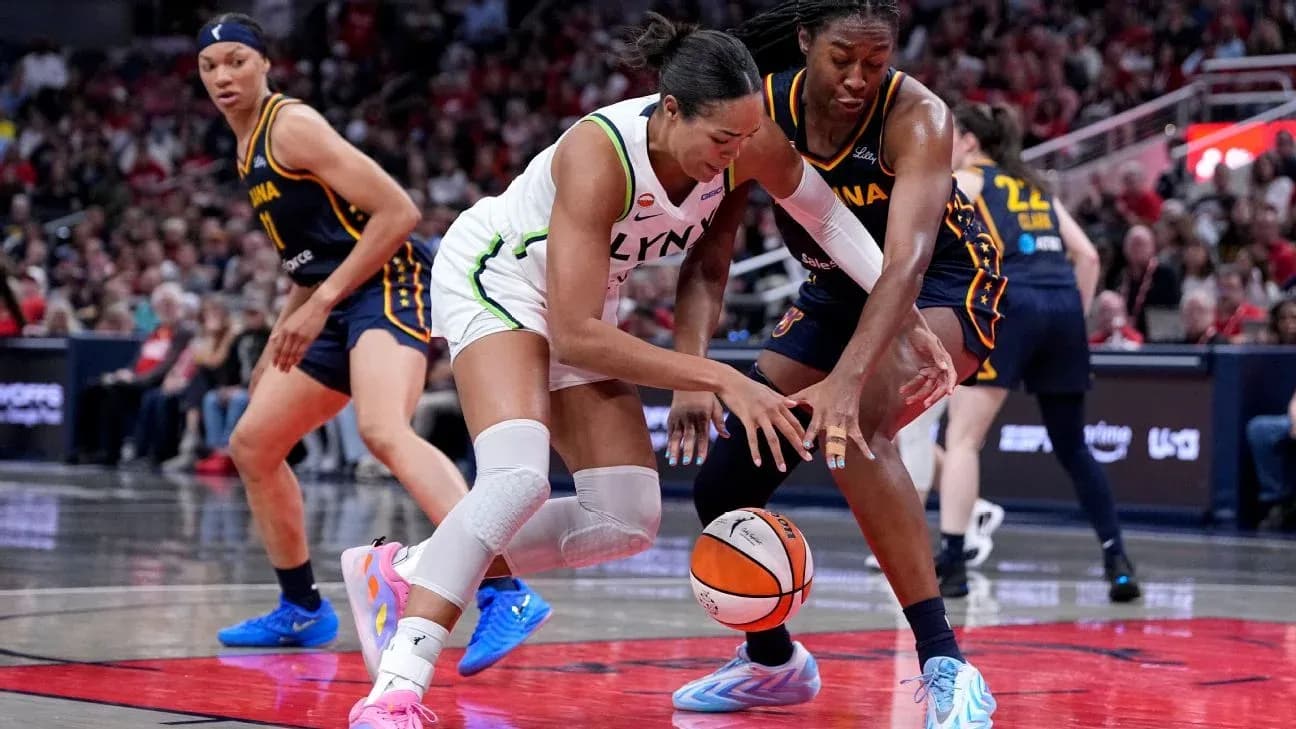
Napheesa Collier is a natural power forward, but the expectation is she’ll slide down to small forward in Berlin. It’s a subtle shift on paper, a big one in reality. Different matchups. More time in space. More responsibility guarding wings.
Collier, though, has the résumé and the game to handle it. She has yet to play in a World Cup for the senior national team, but she owns two Olympic gold medals, from Tokyo in 2020 and Paris in 2024. In Paris, she averaged 6.7 points, 6.5 rebounds and 1.3 assists, bringing the same quiet relentlessness she shows with the Lynx.
She doesn’t chase headlines. She just wins possessions.
PF: Breanna Stewart, New York Liberty
Every great tournament run needs an anchor. For Team USA, that remains Breanna Stewart.
No one on this roster knows the World Cup stage better. Three tournaments, three gold medals, and a starring role in 2022, when she averaged 12.8 points, 6.6 rebounds, 3.0 assists, 1.3 steals and 1.4 blocks on the way to being named to the tournament’s All-Star Five.
Lawson will likely ask Stewart to open at power forward and slide to center when needed. She’ll be asked to generate offense in the paint, protect the rim, and organize a defense that has to cover for new combinations and new roles. Stewart has spent her career doing all of that at the highest level. Berlin is another chapter, not a new test.
C: Aliyah Boston, Indiana Fever
The absence of A’ja Wilson creates a massive hole in the middle. It also clears the stage for Aliyah Boston.
Expect Boston to start at center, to be the defensive heartbeat around the rim, and to use her agility and footwork to punish slower bigs and outmuscle smaller ones. She wasn’t on the 2026 World Cup Qualifying roster after withdrawing before the competition, but she did feature in the 2024 Olympic Qualifying tournament, averaging 5.0 points, 5.5 rebounds, 1.0 steal and 1.0 block in nearly 23 minutes per game.
Those minutes showed what she can be in this environment: a wall on defense, a problem on the glass, and a steady presence when the game turns rugged.
Stewart and Boston together give Lawson a frontcourt that can both stretch the floor and control the paint. Without Wilson, that partnership becomes the spine of the team.
Firepower off the bench
The starters will set the tone. The bench might decide the tournament.
The rotation is still a mystery, but the early options are clear:
- Caitlin Clark, Indiana Fever in relief of Gray
- Paige Bueckers, Dallas Wings behind Young
- Kahleah Copper, Phoenix Mercury spelling Collier
- Kiki Iriafen, Washington Mystics backing up Stewart
- Angel Reese, Atlanta Dream rotating in for Boston
How Lawson distributes minutes among that group will shape everything.
Clark, fresh off being named MVP of the World Cup qualifying tournament in March, should see heavy time at point guard. She averaged 11.6 points and 6.4 assists there, carving up defenses with her vision and deep shooting range. When she checks in, the tempo will spike. The spacing will change. Opponents will have to pick her up a step or two beyond the arc, and that alone can tilt a game.
Next to her, Paige Bueckers offers a different rhythm. She’s a two-way guard who can slide between creator and scorer, a natural complement to Young. Bueckers won’t need the ball on every trip to influence the game; she does it with timing, anticipation and shot-making in big moments.
On the wing, Kahleah Copper gives Lawson a ferocious option behind Collier. Copper’s slashing and physicality form a sharp contrast to more methodical scorers. As a one-two punch with Collier, she can flip a game’s energy in a few possessions.
Then come the young bigs.
Kiki Iriafen and Angel Reese should both see meaningful minutes, even if their exact roles remain uncertain. Iriafen brings length, mobility and upside that coaches love in international play, where versatility can break scouting reports. Reese, meanwhile, has been logging time at center for the Atlanta Dream this season as injuries forced lineup changes. That experience could matter. She can slide to the five for stretches, crash the glass, and inject a physical edge that wears on opponents.
The combinations are tantalizing. Stewart with Reese in a switch-heavy look. Boston and Iriafen to overwhelm the boards. Clark and Bueckers sharing the backcourt in a pure skill lineup.
The puzzle is Lawson’s to solve.
A gold standard under threat
For years, the United States has treated the World Cup as its own domain, a place where depth and talent eventually crush resistance. This roster still carries that expectation, even with Wilson and Plum watching from the sidelines.
But the warning signs are right there in Clark’s words. The gap is closing. The international game has caught up in skill, in preparation, in belief.
Team USA still walks into Berlin as the favorite. The projected starting five has championship experience at every level, and the bench is loaded with rising stars who are used to carrying franchises, not just supporting them.
Now they have nine days to prove the standard still belongs to them. Or to find out just how much the rest of the world has changed.