Team USA Opens World Cup Defense with Dominant Win
Team USA didn’t just start their 2026 FIBA Women’s Basketball World Cup with a win. They set the tone.
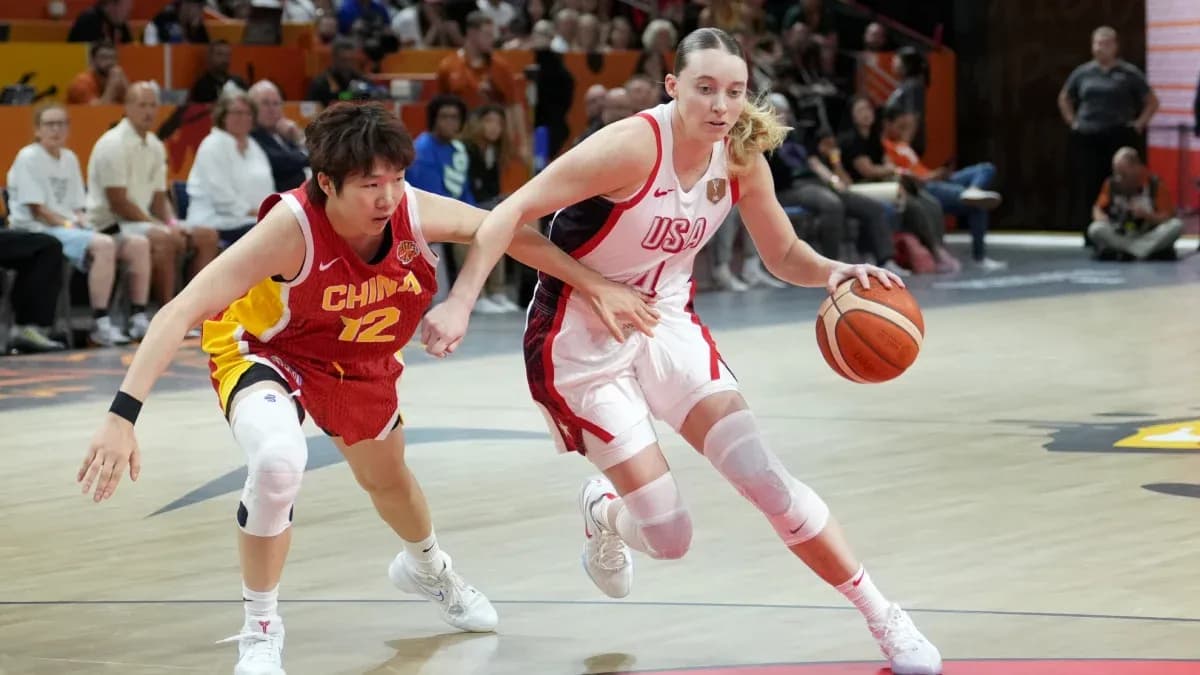
A 94–61 dismantling of China in Berlin on Friday was the kind of opening performance that quiets questions and sharpens expectations. This is a program chasing a fifth straight World Cup gold medal, a run that would stretch its dominance into something approaching mythology. The first hurdle? Cleared with authority.
But this new-look American roster hasn’t earned any shortcuts yet. Those still have to be won.
A new format, and a premium on first place
FIBA has reshaped the World Cup. Sixteen teams, four groups, three games each. It sounds simple, but the stakes at the top of each pool are brutal.
Finish first, and you walk straight into the quarterfinals.
Finish second or third, and you’re thrown into a single-elimination qualification game just to reach the last eight.
One bad night there, and the entire campaign can vanish.
That’s why Group D isn’t just about survival for the United States. It’s about control. The Americans sit alongside China, Italy and Czechia, and after one round they already have the upper hand: 1-0 with a +33 point differential, level with Italy on record but well ahead on impact.
Italy beat Czechia on opening day, leaving the group neatly split: USA and Italy at 1-0, China and Czechia at 0-1. The Americans face Italy on Sunday, then Czechia on Monday to close group play. The path is clear. Now they have to walk it.
What Team USA need to advance
Strip away the permutations and the picture is straightforward.
One more win, against either Italy or Czechia, and Team USA are mathematically in the knockout phase. A 2-1 record in a four-team group guarantees a top-three finish and a ticket out of Group D.
But this is Team USA. Just squeezing through is not the job description.
Three wins from three would lock up first place and send them straight into the quarterfinals, assuming they stay ahead on record. No qualification game. No extra minutes in tired legs. No chance of a one-off ambush before the business end of the tournament.
Even at 2-1, the Americans could still top the group, depending on how Italy, China and Czechia trade blows and how the tiebreakers fall. Still, the cleanest scenario is obvious: beat Italy, beat Czechia, and remove the dice roll from the equation.
The pressure is not about whether they advance. It’s about how efficiently they do it.
A revamped roster wastes no time
If the scoreline against China felt familiar, the faces delivering it did not.
This is not the exact roster many expected when preparations began. A'ja Wilson and Kelsey Plum, two pillars of recent American dominance, withdrew before the tournament with health and injury concerns. Their absence reshaped the depth chart and shifted responsibility.
Sonia Citron and Kiki Iriafen came in, adding youth and energy but also asking more of the established core. Veterans like Breanna Stewart and Napheesa Collier suddenly carried heavier expectation, both as anchors and as stabilizers for the younger group around them.
The response in Berlin was emphatic.
Caitlin Clark, on her World Cup debut, delivered 14 points and 11 assists, orchestrating the offense with the kind of pace and vision that forces defenses to choose which problem to solve first. Rhyne Howard matched her with 14 points. Paige Bueckers added 14 of her own. Multiple perimeter threats, all humming in rhythm, stretched China until the game broke open.
The Americans didn’t just out-talent China; they outpaced and outspaced them. Against an enormous Chinese frontcourt that can make life awkward for anyone, the U.S. turned the game into a race they were always going to win.
The final margin – 33 points – underlined what the eye already knew: this revamped group still carries overwhelming firepower.
The wider field, and why Group D matters
The Americans arrived in Berlin as FIBA’s No. 1-ranked team and the clear favorite. ESPN had already circled them and France as the headline contenders. Nothing that happened on opening day changed that.
But this is not a procession.
France sit as the most obvious threat, the team that pushed the United States to the brink in the 2024 Olympic final, falling by just a single point. Belgium and Australia lurk as well, both capable of playing deep into the tournament and turning a semifinal or final into a genuine contest.
China, even in defeat, showed why they’re still a team to respect. Their size can tilt matchups, clog driving lanes and punish any lapse in physicality.
All of that makes winning Group D more than a box to tick. It’s a strategic weapon.
Avoiding the qualification game means an extra day of recovery and preparation, while potential rivals spend energy just to reach the same stage. It also removes the volatility of a do-or-die night before the quarterfinals, where a cold shooting spell or foul trouble can overturn months of planning.
From the quarterfinals onward, the World Cup reverts to a more familiar shape: straight knockout, four games left to decide medals and history. Getting there in the best possible condition is part of the job.
The prediction, and the real question
Right now, the numbers and the narrative point in the same direction.
Team USA should win Group D. They already hold a 1-0 record, a commanding point differential and a roster that, even without Wilson and Plum, still runs deeper than most of the field. Beat Italy or Czechia and they’re safely through. Beat both, and they stroll into the quarterfinals with the bracket tilted in their favor.
The safer call is that they do exactly that: take care of business, top the group and stay on course for a fifth consecutive FIBA Women’s World Cup title.
The more compelling question sits beyond Group D.
When the knockout rounds arrive and the margin for error disappears, can anyone – France, Belgium, Australia or anyone else – actually push this retooled American team off its golden line?