Team USA’s World Cup Win Cuts Through NFL Noise
Team USA’s women didn’t just win a World Cup in France. They cut through one of the noisiest sports weekends on the American calendar and still pulled in an audience that would have been unthinkable a few years ago.
The numbers landed on Tuesday, and they are loud.
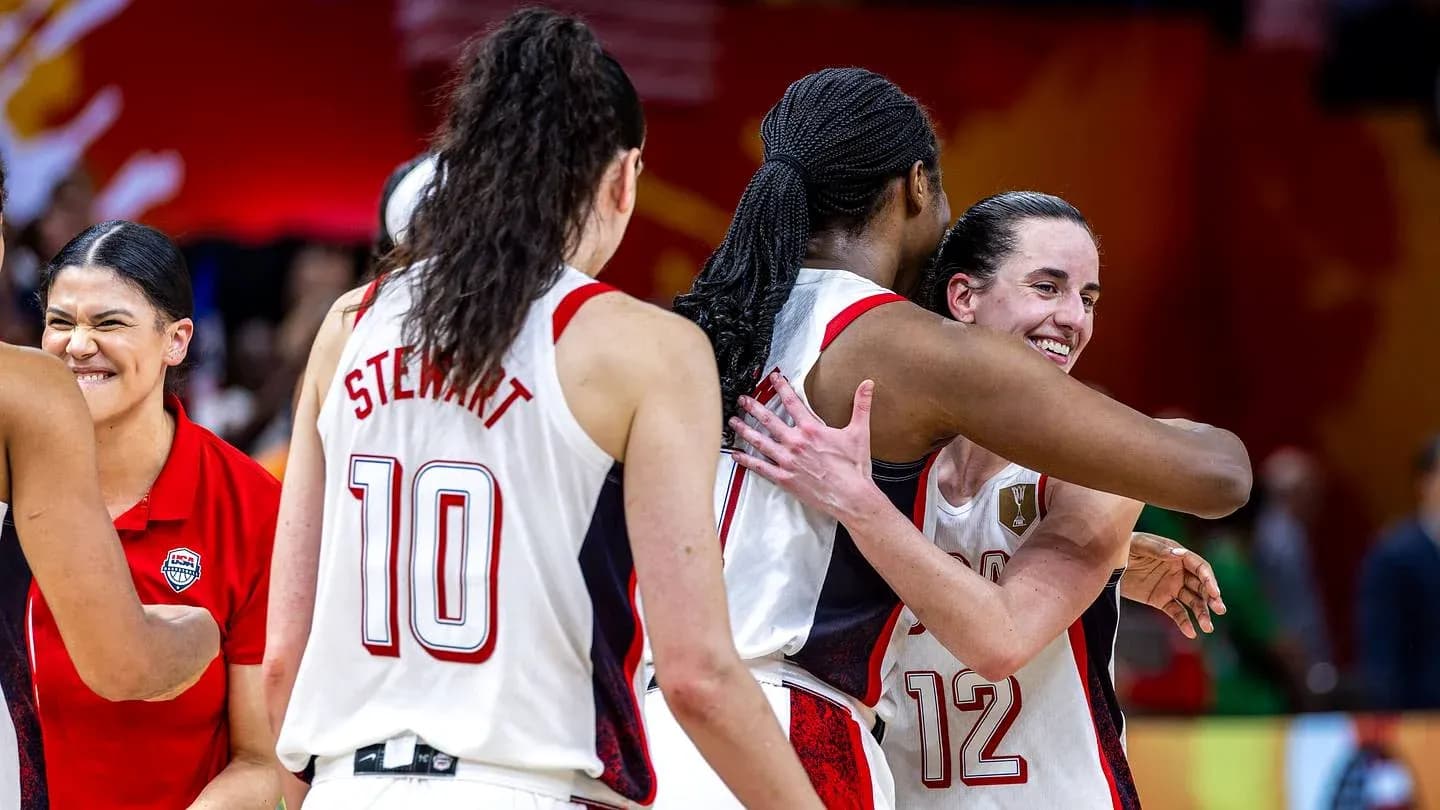
The 97-79 win over France in Sunday’s FIBA Women’s World Cup final averaged 1.2 million viewers across HBO Max, TNT and truTV. That’s not a gentle bump. That’s a 158% jump from the 2022 final and a staggering 750% surge compared to the 2018 title game.
In a landscape dominated by helmets and hash marks, a women’s basketball game held its ground.
A Final in the Eye of the NFL Storm
Context matters here. The World Cup final tipped off in the teeth of Week 1 of the NFL regular season, the single most powerful ratings engine in American sports. At the same time, the U.S. Open men’s final, featuring American Ben Shelton, fought for eyeballs on another channel.
On paper, that’s a scheduling nightmare.
On the screen, it still worked.
Despite going head-to-head with the NFL and a Grand Slam tennis final, USA–France still became the third most-watched game in FIBA Women’s World Cup history.
Only two games from this very tournament beat it: Team USA’s nail-biter against Italy, which drew 1.3 million viewers, and their final group-stage matchup with Czechia, which matched the 1.2 million mark.
So yes, the final was technically only the third biggest draw of the event. But it did its work in the most hostile TV environment imaginable.
Semifinal Heat in a College Football Saturday
The semifinal told a similar story.
On Saturday, with no NFL yet on the slate, the USA–Spain clash still had to share oxygen with a full slate of college football. Even so, it averaged 938,000 viewers, good enough to become the fourth most-watched FIBA Women’s World Cup game ever.
Higher stakes, better opposition, but slightly lower numbers than some group games. At first glance, that might feel upside down. In reality, it’s a broadcast traffic problem, not a demand problem.
College football owns Saturdays in the fall. The semifinal went straight into that buzz saw and still delivered one of the biggest audiences the tournament has ever seen.
No wonder several media voices bristled at the timing. The World Cup’s showcase games — semifinal and final — were essentially thrown into a ratings cage match with America’s two dominant football properties and a marquee tennis final. The product deserved cleaner air.
It didn’t get it. It still thrived.
A Different Kind of Power Ranking
Strip away the helmets and the scheduling missteps, and the trend line is obvious.
Women’s basketball is climbing.
A women’s World Cup final averaging well over a million viewers in the heart of an NFL Sunday is not a niche story. It’s a signal. It speaks to the growth of the women’s game, the pull of the USA jersey, and the magnetism of a new generation of stars.
Caitlin Clark sits at the center of that storm, the headline name in a team full of them. Paige Bueckers and Angel Reese bring their own massive followings and distinct styles, turning every USA game into an event, not just a fixture.
This tournament felt like a preview — not the finished product, but a trailer. A look at what happens when college megastars step onto the global stage with a flag on their chest and millions willing to find them even on the busiest sports weekend of the year.
The ratings don’t just measure who watched France and Spain. They measure anticipation.
Because if this is what the audience looks like now, with the NFL roaring and the calendar working against them, what happens when Clark, Bueckers, and Reese walk into an Olympic arena in Paris in 2028, in prime time, with the world watching?