Tiffany Teo Wins Singapore's First Gold Medal at Asian Games
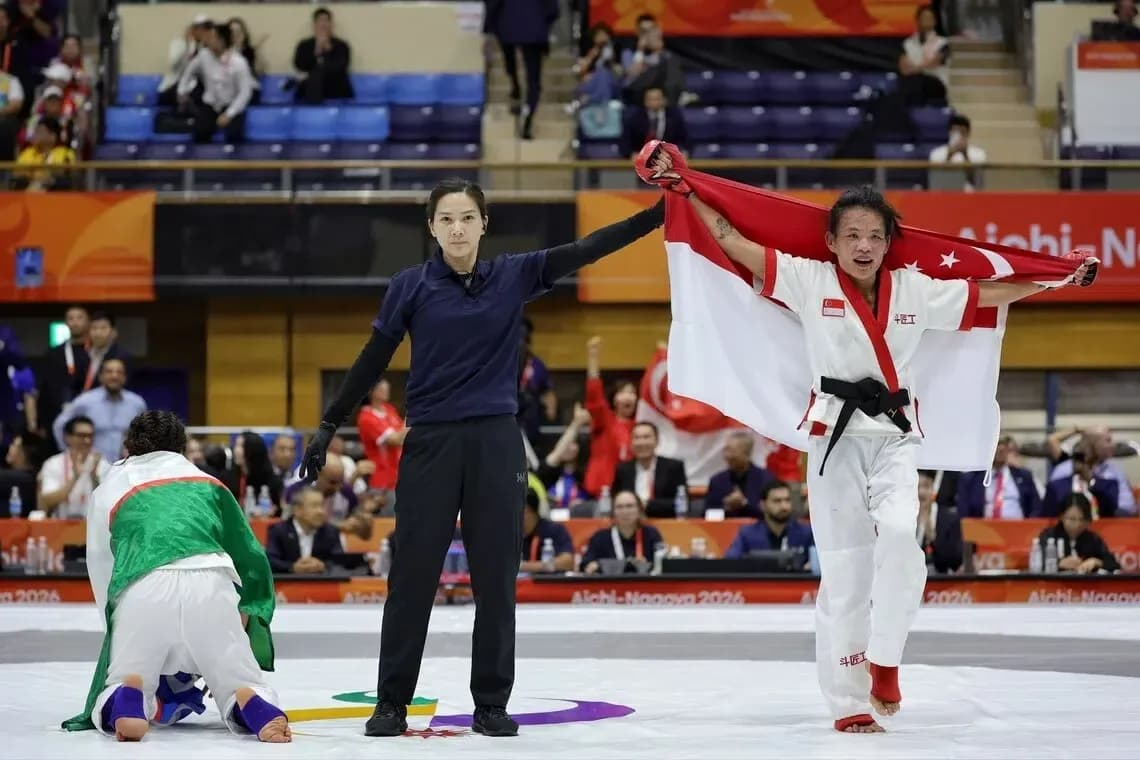
NAGOYA – By the time Tiffany Teo sank to her knees in the centre of the mat, the blood on her uniform told one story. The tears told another.
Singapore’s 36-year-old mixed martial artist had just delivered the nation’s first gold medal of the Asian Games on Sept 22, winning the women’s traditional 60kg final at the Nagoya City Inae Sports Centre. Across from her, Khilola Sobirova of Uzbekistan – the woman who had denied her continental glory just four months earlier – now watched as Teo’s long, winding road finally ended in redemption.
This was not just a debut. It was a statement.
Overtime, blood and release
The final went the distance and then some. One round to Teo. One to Sobirova. Nothing between them on the judges’ scorecards. So it went to overtime, a final stretch of nerve and will, where every exchange carried the weight of a medal and the memory of that loss in the 2026 Asian Mixed Martial Arts Championships final.
This time, Teo refused to blink.
When the decision was read in her favour, the composure she had held through three draining rounds vanished. She broke down, the emotion pouring out in sharp, uncontrollable bursts. Her husband and coach, Sim Kai Xiong, rushed in, lifting her onto his shoulders as the significance of the moment sank in.
She had never cried after a fight before. Representing Singapore at the Asian Games changed that. The pressure, the expectations, the years in the shadows – all of it crashed over her in that instant, turning the blood on her gi into a badge rather than a blemish.
These were tears of joy, and of release.
A gold with a purpose
Teo’s victory was more than a personal milestone. It was a flag planted for a sport still fighting for recognition in Singapore.
She has been in MMA for more than a decade, long enough to see waves of hype rise and fall. Long enough to feel like a pioneer and yet watch the sport stall in popularity back home. Her decision to enter the Asian Games was not just about medals; it was about visibility.
She wants MMA to be seen as a legitimate pathway, the way boxing, wrestling and judo already are. Those sports have clear routes into national teams, clear targets for young athletes. Teo’s gold, she hopes, can help MMA claim that same structure – and with it, a new generation of fighters who see more than just a cage; they see a career.
If Singapore needed a symbol that MMA belongs on the same stage as the rest of Asia’s combat sports, it has one now.
A chaotic semi-final and a razor-thin edge
The road to gold was anything but straightforward.
Teo opened her campaign on Sept 20 with a composed, unanimous-decision win over Iranian fighter Arezou Salimighalehtaki in the quarter-finals. That alone made history: Singapore’s first Asian Games medal in MMA, a sport making its continental debut.
With both losing semi-finalists guaranteed bronze, Teo walked into the last four already assured of a place on the podium. She refused to settle for that.
Her semi-final against India’s Suchika Tariyal on Sept 21 turned into a tangle of drama and procedure. They split the first two rounds, forcing yet another overtime. Teo edged it, or so it seemed, with the judges initially awarding her the win.
Then came the twist.
Suchika’s camp lodged a challenge. The overtime round went to video review, handled by a different set of referees. The original decision was overturned and ruled a draw. Under Asian Mixed Martial Arts Association rules, that meant one thing: the scales would decide.
On paper, it is the coldest of tiebreakers. On this day, it was Teo’s lifeline.
At the morning weigh-in, she had come in at 58.8kg. Suchika was 59.85kg. By a little over a kilogram, Teo advanced to the final. A fraction on the scale, a gulf in consequence.
From wilderness to Nagoya gold
Her presence in Nagoya might have seemed unlikely not long ago.
From 2016 to 2022, Teo built an 8-2 professional record with One Championship, carving out a reputation as one of Singapore’s most durable and technical fighters. Then came nearly three years without a fight – a spell that can bury careers in a sport that moves quickly and forgets even faster.
She resurfaced only in June 2025 with Chinese promotion JCK MMA, a quiet return for a fighter who once headlined major cards. That comeback now looks less like an epilogue and more like the prologue to this week in Aichi-Nagoya.
The wiry veteran, written off by some as yesterday’s news, has become the face of a new chapter: MMA on the Asian Games stage, and Singapore on top of the podium.
A medal that changes the conversation
Teo’s gold lit up the third day of action for a 304-strong Singapore contingent that has already begun to punch above its weight. Swimmer Gan Ching Hwee has delivered a historic silver in the 1,500m freestyle. Wushu exponent Zeanne Law has added a bronze in the women’s taijiquan-taijijian.
At the last Asian Games in Hangzhou in 2023, Singapore finished with 16 medals – three gold, six silver, seven bronze. Teo’s triumph slots into that ongoing story but carries a different kind of weight.
This one doesn’t just sit in the medal table. It asks a question.
If a 36-year-old pioneer, back from years in the wilderness, can turn a fledgling sport into gold on Asia’s biggest stage, how long before Singapore builds the structures to ensure she is not the last?