Tiffany Teo's Historic Gold Medal Win at the Asian Games
In Nagoya, the gold medal around Tiffany Teo’s neck weighed just 265 grams. The journey behind it felt a lot heavier.
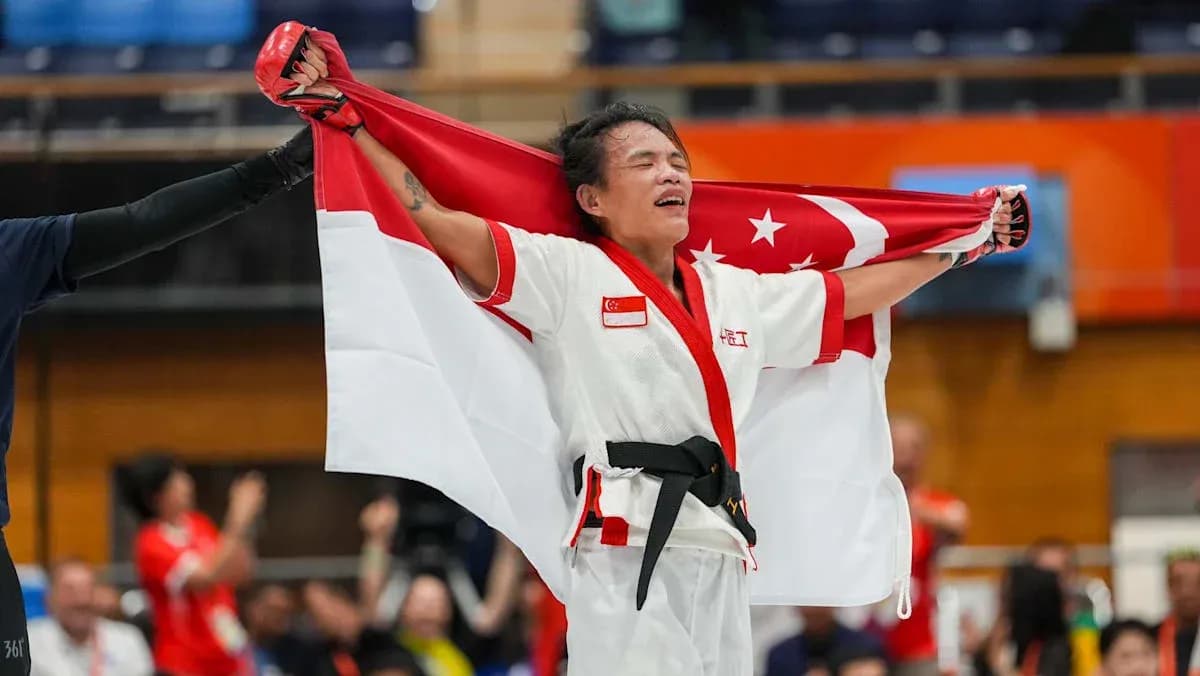
Singapore’s mixed martial arts pioneer stood in the glare of the lights at the Nagoya City Inae Sports Center on Tuesday (Sep 22), having just delivered the country’s first gold of the 20th Asian Games. On paper, it was a split decision settled in an extra round. In reality, it was a decade’s worth of unseen graft finally breaking the surface.
“I feel like this entire journey kind of led up to this moment,” she said, eyes still red from the tears that came the instant her hand was raised. “It’s not just the past couple of months of fight camp, it was the hours people didn’t see when I started, when I was a total beginner.”
Overtime, and overdue
Teo’s final against Uzbekistan’s Khilola Sobirova in the women’s traditional 60kg division never threatened to be straightforward. Both fighters took a round each, forcing an overtime stanza to separate them. One more round. One more chance to prove she belonged at the top of the podium she had imagined for years.
This time, Teo refused to let it slip. When the judges sided with her after the extra round, the release was immediate.
“I was so overwhelmed when I won the fight,” she admitted. “I just started crying; it was just tears of joy.”
The opponent, the stage, the stakes — all of it carried a familiar sting. In May, at the Asian Mixed Martial Arts Championship, Sobirova had beaten Teo in the final. That defeat stayed with her. It also sharpened her.
“In retrospect, I’m glad that I lost to her,” Teo reflected. “I feel like with losses it makes you reflect more. When you win, you reflect a little bit because it doesn’t hurt that much.”
The pain from that earlier loss gave Tuesday’s victory an edge that numbers on a scoreboard can’t capture.
A semi-final decided by a scale
If the final was about redemption, the semi-final was about survival.
On Monday, Teo’s route to gold almost came undone in a chaotic, nerve-shredding bout against India’s Suchika Tariyal. The two traded rounds, finishing level after the regulation two. Teo thought she had done enough in overtime. So did the officials, initially. Her arm went up; the result flashed; Singapore had a finalist.
Then the challenge came.
Tariyal’s camp lodged a protest, forcing a review of the bout. The decision was overturned. The fight was declared a draw. For a few tense minutes, Teo’s fate hung not on a punch or a takedown, but on a rulebook line few outside the sport knew existed.
Under Asian Mixed Martial Arts Association regulations, a tied contest can go to a weight tiebreaker. The lighter athlete at the morning weigh-in advances.
Teo edged it by the narrowest of margins: 58.8kg to Tariyal’s 59.85kg. A fraction on the scale kept her gold-medal dream alive.
“We realised that in retrospect, I was hesitating a lot in yesterday’s fight and honestly, I was pretty disappointed with my performance yesterday,” she said, blunt in her self-assessment. “I felt like I could have dominated a lot more and a big part was my fault.”
Her corner, she explained, had laid out a clear game plan. In the heat of the moment, she strayed from it.
“My cornerman gave me the game plan, and I was overly eager to grapple and I kind of didn’t follow the game plan in the first round, which led the match to a very close call.”
The scare sharpened her focus for the final. There would be no repeat of that hesitation against Sobirova.
A pioneer chasing more than medals
This is the first Asian Games to feature MMA, one of six sports making their debut at Aichi-Nagoya 2026 alongside freestyle BMX, padel, surfing, teqball and virtual taekwondo. For Teo, that context matters. She is not just fighting opponents; she is fighting for the place of her sport in Singapore.
“I’ve been doing it for a decade and I see myself as a pioneer in the sport,” she said. “I feel that it’s quite sad to see that it’s kind of not as popular now; I would like more people to take up this sport.”
So while she came to Nagoya with a clear target — “I definitely deserved the gold medal,” she said without flinching — the podium was never the end of the story. The medal is a symbol, a conversation starter, a reason for the next wave of fighters to walk into a gym and try.
On Tuesday night, as she clutched Singapore’s first gold of these Games, the veteran of a still-young sport looked less like someone closing a chapter and more like someone kicking a door open.
The question now is who will follow her through it.