Uefa's Legal Battle Against Fifa President Infantino
The language is incendiary, even by football’s often brutal political standards.
“Criminal mismanagement.”
“A stunning dereliction of duty.”
“A fraudulently off-market price promoted by Infantino for his own benefit.”
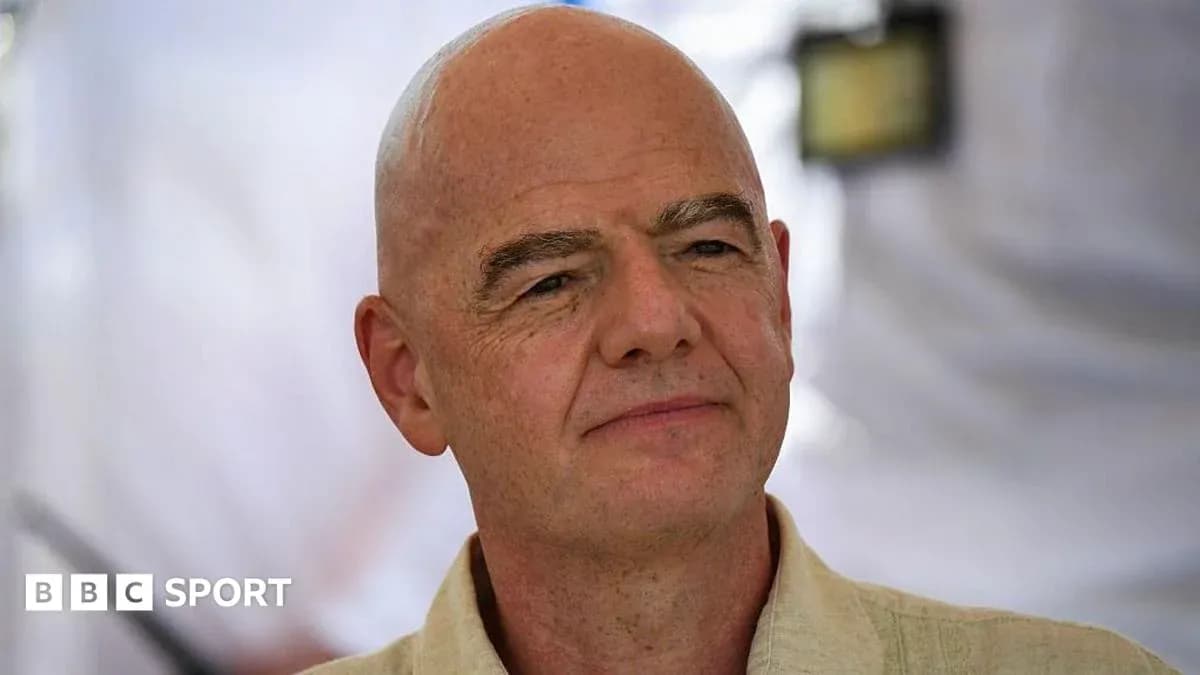
These are not the words of activists or anonymous briefings. They come from Uefa’s own lawyers, laid out in legal filings in the United States, aimed squarely at Fifa president Gianni Infantino and his now-abandoned Fifa Forward Enterprise (FFE) scheme.
At stake is not just a disputed commercial plan. It is the control, credibility and future direction of the sport’s global governing body.
A civil war with court papers and subpoenas
Uefa’s submission paints a stark picture. The FFE proposal, it argues, handed the World Cup an “absurdly low enterprise value” of about £15bn – a figure it says was neither tested by an independent valuer nor exposed to an open, competitive auction. The deal, in Uefa’s telling, sat “under a veil of secrecy” and “inflicted direct and concrete injury… to the detriment of Fifa as well as its 211 members”.
The documents go further, referencing Infantino’s “cronies” and “co-conspirators” and even setting out “the enduring history of corruption among Fifa officials”. This is not just a legal dispute over numbers; it is a frontal assault on the integrity of the president and the culture around him.
Uefa is asking US courts for access to evidence and documents for use in potential criminal proceedings in Switzerland. The move escalates a feud that has been simmering since the FFE plan surfaced more than a month ago and then collapsed almost as quickly under intense backlash.
In that time, pressure on Infantino has surged in public view. Former players, politicians and fan groups have lined up with stinging statements. Personal allegations have been thrown into the mix, including a leaked claim – categorically denied by Infantino – that an alleged lover received a severance payment during his time at Uefa.
Now the battle has left the court of public opinion and is heading towards actual courts.
Infantino’s best week in his worst crisis
The timing is striking. Just as Uefa sharpened its legal knives, Infantino enjoyed something close to a political rebound.
On Thursday, the Saudi Arabian Football Federation issued what it called “qualified” backing, stating that “at this time [it] supports the continued efforts of Gianni Infantino to restore unity”. For a president under siege, support from such a powerful modern player in world football matters.
He also survived a major tactical confrontation. Uefa had threatened to boycott Fifa competitions over FFE. That threat was dropped after assurances the scheme would not return. In the brutal arithmetic of football politics, many read that as another win for Infantino: he stayed put; the boycott vanished.
But Uefa was only changing its weapon, not abandoning the fight. The news that it was preparing criminal legal proceedings marked a dramatic escalation and made clear it still wants Infantino out.
For now, the Fifa president and his organisation have declined to engage with this latest turn, insisting their focus is on staging the U20 Women’s World Cup in Poland next week. Infantino himself has kept moving. Fresh from trips to the Dominican Republic and Paris, he surfaced in Vietnam, posting video of what he called a “wonderful” visit – another stop on what looks increasingly like a global campaign trail.
He will not have been blindsided. Uefa signalled almost a month ago that legal action was on the table, instructing Fifa to preserve all “relevant materials” linked to the FFE plan.
The American front: Thrive, Kushner and a battle over disclosure
The next key move may not come in Zurich or Nyon, but in a US courtroom.
Uefa wants disclosure of documents and testimony related to the FFE deal. Its targets include Fifa, venture capital firm Thrive Capital, Thrive founder Josh Kushner and former Formula 1 chief Greg Maffei, described in the filings as “the key commercial adviser” on the proposed transaction.
For Thrive and Kushner, Uefa’s lawyers are seeking subpoenas covering “the production of documents and communications and for deposition testimony”. Kushner, brother of Jared Kushner – the son-in-law of former US president Donald Trump – has not commented. Legal observers, though, believe he could mount a robust challenge, arguing that the details must remain confidential to protect business interests and future investments. Kushner has just agreed a record £9.3bn deal to buy the Los Angeles Lakers, underlining the scale of his portfolio.
How long this will take is anyone’s guess. Uefa needs enough evidence to sustain its claim that the World Cup was knowingly undervalued. It also has to decide whether it will actually file a criminal complaint in Switzerland, and if so, on what basis.
Even then, success is far from guaranteed.
History’s warning from Zurich
Football has been here before, at least in outline.
Back in 2002, amid a different wave of internal turmoil, several Fifa executive committee members lodged a criminal complaint against then-president Sepp Blatter in Zurich. The public prosecutor took no action; Blatter denied any wrongdoing and stayed in office.
More recently, the Swiss Attorney General’s Office spent years trying to prosecute Blatter and former Uefa president Michel Platini. The case ended in 2022 with both men fully cleared of corruption charges.
That backdrop hangs over Uefa’s strategy. To even get close to criminal proceedings against Infantino, it must first persuade a court that there is an arguable case and that it is entitled to wide-ranging disclosure.
“What Uefa have to show is that they have an arguable case for criminal proceedings to be brought against Infantino,” says leading sports lawyer Nick de Marco KC. If it can do that, he argues, it “ought to be given disclosure of a lot of the documents”.
De Marco believes the chances of winning that initial disclosure battle are “high”, but he is blunt about the distance still to travel. The Swiss prosecutor would then have to study the material and decide whether a case exists. That will take time. His prediction? Not an imminent trial, but “very interesting documents” and “more light shone onto this plan”.
For Uefa, that alone might be a powerful outcome.
Reform pledges and a presidency under siege
Perhaps aware of the legal headwinds, Uefa has wrapped its offensive in the language of reform.
It has pledged to “secure fundamental reform, restore proper limits on presidential authority and ensure that Fifa is once again governed as an institution – not around one individual”. It also wants “a genuinely independent external review of FFE”.
Infantino, though, remains entrenched. He still commands strong backing in South America, Africa and parts of Asia. He has ridden out weeks of hostile headlines and institutional fury from Europe. Many insiders expect him not just to survive, but to seek a fourth term when the election window opens in the spring.
Uefa has already fired a warning shot: if he stands again, it will “join forces with its partner confederations to ensure that member associations are offered a credible alternative – one committed to integrity, accountability, development and genuine institutional change”.
That is a bold promise. Delivering it is another matter.
The search for a unifying challenger
Can world football actually produce that “credible alternative”?
Speaking in Monaco, Uefa vice-president Laura McAllister outlined the profile of the candidate Europe wants to rally behind. Someone who will “champion” modern governance, embrace transparency, independence and “critical challenge”, and command enough respect across continents to unite a fractured landscape.
“We would want to have a candidate, obviously, who would champion that agenda and be committed to a process of reform and change,” she said. “I think there are lots of credible candidates out there, but it has to be a candidate that can unite that standpoint and somebody who has the credentials and the credibility and the buy-in to really champion that agenda.”
The principles sound clear: transparency, independence, due diligence. The politics are anything but. Uefa knows this will not be quick or clean. “We knew this wouldn’t be a simple process and we knew that change wouldn’t happen overnight,” McAllister admitted.
The calendar, though, is unforgiving.
A volatile road to October – and beyond
In October, Infantino will sit across the table from some of his fiercest critics at the first Fifa Council meeting since the FFE rebellion. It promises to be a charged occasion, a rare moment when the president and his opponents share the same room with the stakes this high.
By November, presidential candidates must be formally nominated. Then comes March, and an election that could either cement Infantino’s grip on power or trigger a dramatic reset of football’s global governance.
Between now and then, Uefa’s legal gambit in the US, its potential complaint in Switzerland, and the behind-the-scenes hunt for a challenger will all run in parallel. Each development will feed into the same question: who really controls the game?
The rancour and mistrust unleashed by the FFE saga have already scarred relationships at the top of football. They show no sign of easing. The world’s most popular sport is watching its rulers fight over money, power and principle – often in that order.
Reunification, from this vantage point, feels a long way off. The real test is whether the sport can emerge from this crisis with a system strong enough that it never comes to this again.