VfL Osnabrück's Rollercoaster Tifo Redefines Fan Culture
In a country that treats tifos like high art, VfL Osnabrück just rewrote the script.
Germany has given us the Yellow Wall at Borussia Dortmund, the choreographed colour storms at Bayern Munich’s Allianz Arena, and a long list of mosaics, banners and pyrotechnic masterworks. But on Wednesday night at the Bremer Brücke, a freshly promoted second-division club produced something that felt closer to theatre than terrace display.
They built a rollercoaster.
A live tifo, not just a picture
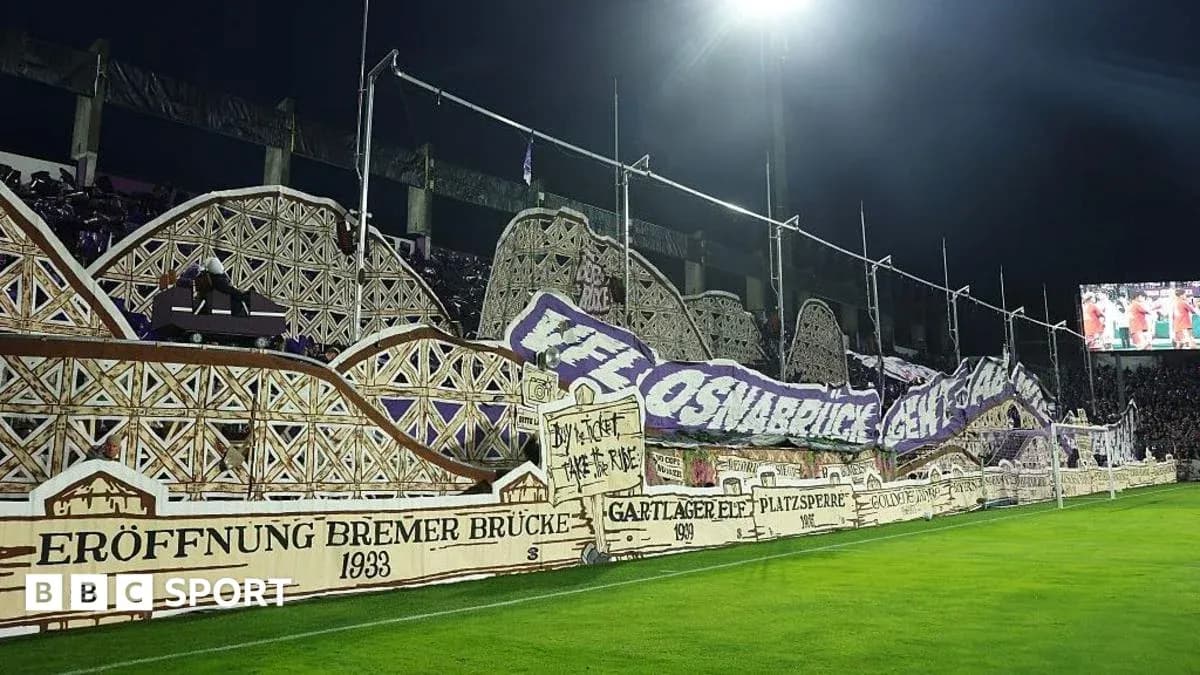
Before Osnabrück’s German Cup first-round tie against Bayern Munich – a game they would eventually lose 4-1 – the East Stand came alive with a moving installation more at home in an amusement park than a football ground.
Across the stand, a vast banner declared: “VfL Osnabrück – a rollercoaster ride!” In front of it, a wooden track snaked along the touchline, looping and bending in front of the home fans. On that track, a cart rolled, clattered and climbed, carrying dummies dressed as passengers, circling again and again through a simple push-and-pull system.
This wasn’t an illusion painted on fabric. It moved. It had weight, sound, rhythm. It turned a cliché – the “rollercoaster ride” of a club’s history – into something tangible.
A history built into the track
The club said the tifo was designed to symbolise its turbulent story, a journey supporters themselves call a “rollercoaster ride full of ups and downs”. The structure didn’t just nod to that idea; it mapped it.
Sections of the display highlighted major moments from Osnabrück’s past. Among them, the cherished 1978 victory over Bayern Munich, a result that still glows in the club’s folklore, stood proudly on the track. Alongside it came references to “scandals and bitter defeats”, the darker dips that every long-suffering fan knows too well.
This wasn’t a sanitised history lesson. It was a reminder that promotion, relegation, controversy and redemption all run on the same rails.
Months in the making
The scale of the project underlined the ambition. Osnabrück revealed that the tifo took “several months” of planning and building, an extraordinary investment of time and effort for a display that would debut before a single cup tie.
The rollercoaster itself, positioned in front of the East Stand, was crafted from wooden slats, plastic piping and fabric, designed in modular sections so it could be rolled out and assembled piece by piece. The cart was built primarily from wood and styrofoam, sturdy enough to travel the track repeatedly, light enough for the push-and-pull mechanism to haul it back to the start.
It was engineering as fandom – DIY, improvised, but strikingly effective.
A tifo with its own “photo finish”
Just when it seemed the spectacle had peaked, the club added one more flourish.
Osnabrück explained that as the cart rattled along its route, it passed a “photo station” where a flash fired, mimicking the camera burst on a fairground ride. Moments later, the “photo” of that cart appeared on the right side of the grandstand, completing the illusion.
It turned the crowd into visitors at an attraction, watching their own club’s chaos captured as if it were a day out at the theme park.
Defeat on the pitch, a statement in the stands
On the scoreboard, Bayern Munich did what Bayern Munich usually do. A 4-1 win, progress to the next round, another routine step in a season loaded with bigger targets.
But the night belonged to Osnabrück’s imagination.
Recently promoted to the 2. Bundesliga, they chose the visit of Germany’s dominant force not just to celebrate their return to the second tier, but to announce themselves as something else entirely: a club whose supporters can turn their lived experience – the joy, the pain, the scandals and the shocks – into a living, breathing work of art.
In a land famed for its tifos, the bar has just been raised by a rollercoaster at the Bremer Brücke. Where does fan culture go after this?