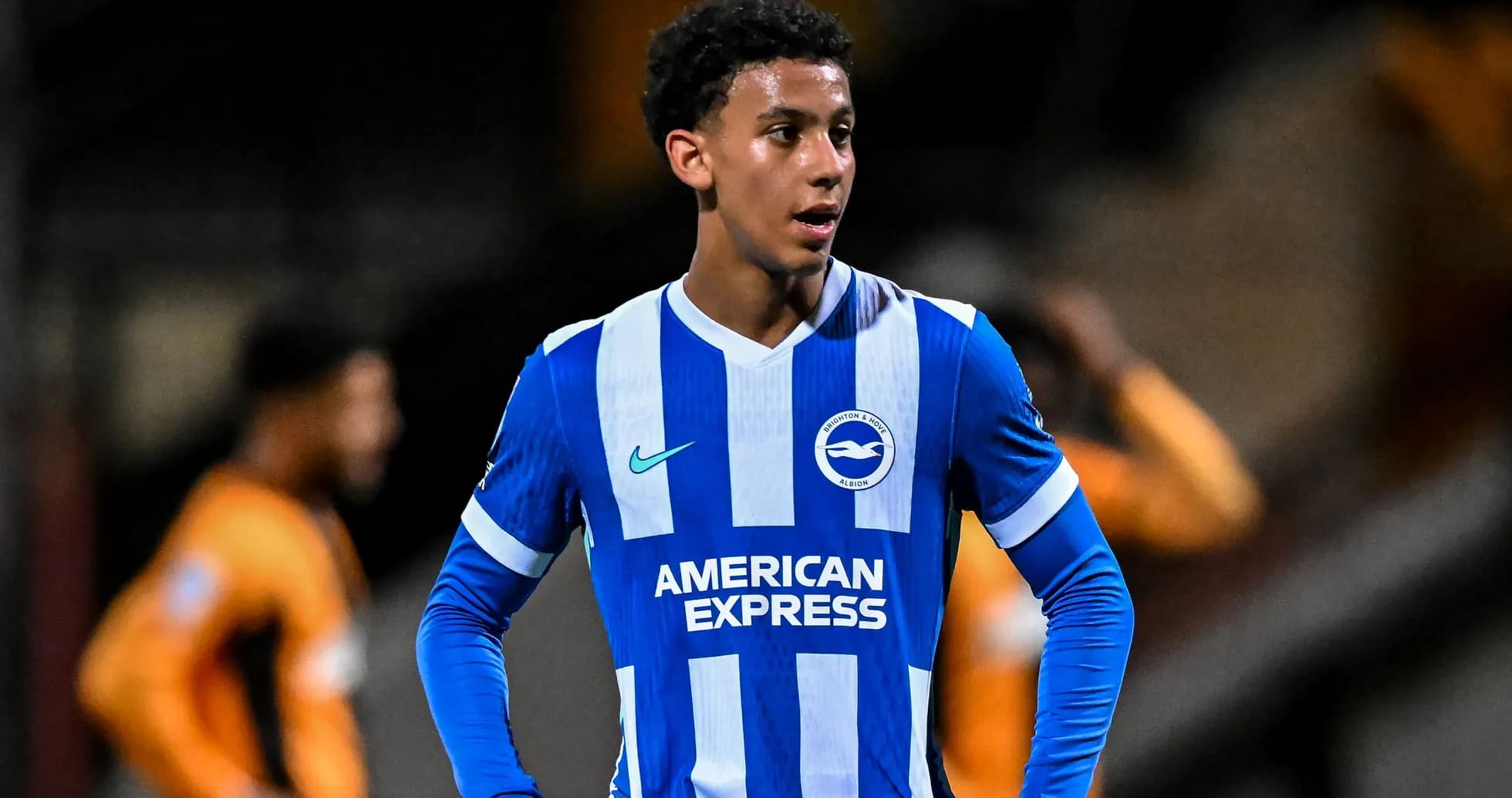
Younes Ibrahim: Brighton's Rising Star in Academy Football
Last Sunday did not feel like academy football.
Forty-eight hours earlier, Younes Ibrahim had been just another bright prospect lighting up youth-team clips online, his latest under-21 goal ricocheting around Brighton’s academy channels. Then his phone rang.
You’re with the first team tomorrow.
For some clubs, that kind of call can be a pat on the head. A token gesture. Not at Brighton. Not under Fabian Hürzeler.
This is a club that has turned ruthless clarity into an operating model, a club that sold Moisés Caicedo for £115 million, moved on Alexis Mac Allister and Marc Cucurella at exactly the right time, and rarely misjudges when a player is ready for the next step. If you sit on Brighton’s bench in an official match, you are no mascot. You are a plan.
So when Ibrahim’s name appeared among the substitutes against Coventry, it carried a message: we’re not waiting long for you.
A numbers game – and a lot more
The statistics for this season’s youth campaign are modest at first glance. Three matches across academy competitions, one goal, one assist. A neat contribution, nothing more.
The real story sits in last year’s ledger.
Nine goals. Five assists. A season in which his name kept reappearing on internal reports and opposition whiteboards, not just as a finisher but as a problem. Coaches saw a forward who did not stay still, who slipped between the lines, who could stretch a defence from the wing or drop into pockets as a false nine.
He became one of the most influential figures in Brighton’s youth system, not because of one dazzling trait, but because he kept ticking boxes that matter at the professional level: movement, intelligence, versatility, resilience.
None of it came out of nowhere.
From Luton to London, then the south coast
Ibrahim’s journey does not fit the fairy-tale of a kid discovered in a park and fast-tracked to stardom. His path has been slow, deliberate, sometimes unglamorous.
He started at Luton Town’s academy, a modest setting with a hard edge, where the fundamentals of English discipline are drilled in early. From there came the leap: Chelsea. One of Europe’s great talent factories. A different world.
At Cobham, the pace quickened. Technical standards rose. Competition sharpened. Training sessions turned into auditions, every day, for the right to stay in the building. Ibrahim rubbed shoulders with different footballing cultures, learned to cope with high pressing, high tempo, high scrutiny.
Then came the move that raised eyebrows.
Leaving Chelsea’s academy for Brighton’s under-15s looked, to some, like a step down. Smaller badge. Smaller stadium. Less glamour.
It was nothing of the sort.
Brighton have built something unique in England: a clear, visible pathway from academy pitch to Premier League grass. It is not a slogan. It is a conveyor belt. Under-15 to under-18 to under-21 to the Amex. The line is straight, and the club does not hesitate to use it.
Ibrahim walked that line. Under-15. Under-18. Under-21. At each level he did more than survive. He grew, physically and mentally, adding strength without losing mobility, adding responsibility without losing freedom.
Last July, the first formal reward arrived: his first professional contract. For the player, a signature. For the club, a statement.
Brighton academy director Ian Buckman framed it in typically measured terms: “It is an exciting moment for the players and their families alike,” he said, underlining that the deal recognised “the great efforts they have made during their time at the academy so far,” and stressing the need to “seize the opportunities available to them to ensure that their development and learning continue, as they have proven their ability to do up to this moment.”
In Brighton’s world, that is not window dressing. It is the job description.
Four nations, one decision
If Ibrahim’s rise has energised Brighton’s academy, it has also flicked on lights in offices far beyond the south coast.
He was born in Australia. That alone puts him on the radar of a national team hunting for its next long-term striker, a new face to carry the Socceroos’ attack into the next cycle.
Eight years in England add another layer. Residency rules now make him eligible for the Three Lions, a system that tracks every promising player in the Premier League ecosystem with forensic detail. If he breaks through at Brighton, he will not go unnoticed.
Then there is blood. Egyptian roots. Moroccan roots. Two federations that have turned the recruitment of dual-nationality talent into a strategic priority, scouring Europe for players who can raise the ceiling of already ambitious squads. The Pharaohs. The Atlas Lions. Two different footballing cultures, one shared determination not to let quality slip away.
Four national teams. One teenager.
For now, Ibrahim is not choosing. That restraint may be his most mature decision yet. At eighteen, the real battle is not on international stationery but on the training pitch at Brighton’s first-team base.
His task is simple and brutal: turn one appearance on the bench into a debut. Turn that debut into minutes that matter. Turn those minutes into a first Premier League goal. Only then will the real tug-of-war begin, with federations knocking on his door, not the other way around.
From Sydney to Coventry – and beyond
That afternoon against Coventry will not go down in record books as a turning point for Brighton. No goal, no assist, no highlight reel clip with his name on it.
Yet for Ibrahim, it marked something far more important than a cameo.
It was the moment his story stopped belonging solely to academy match reports and started to edge into the wider game. The moment a long-term project stepped into public view: an international footballer in the making.
The project began in Sydney, took shape in Luton, hardened in London, and now gathers momentum on England’s south coast. From here, the line runs in two directions: towards the Amex, and out into the world.
Which badge he wears on his chest when that world finally calls is a question for another day. The more urgent one now is simpler, and far more demanding.
How quickly can he turn Brighton’s promise into Brighton’s reality?