Alex de Minaur's Grand Slam Struggles Continue
Alex de Minaur’s season of promise is suddenly on the brink.
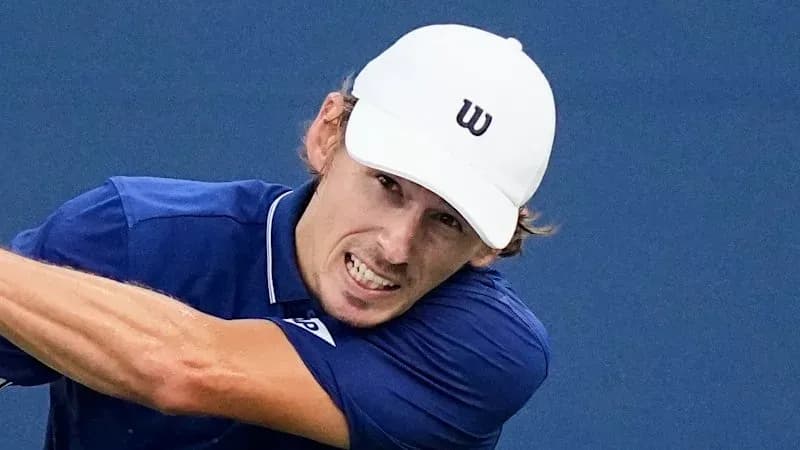
The world No.7 walked off Louis Armstrong Stadium staring at a 6-4, 7-5, 6-2 scoreline and a hard truth: his least successful grand slam year in three seasons now threatens his hard-earned top-10 status. Botic van de Zandschulp, the streaky Dutchman with a history of wrecking big names in New York, was simply too heavy with his hitting, too sure of his game, and far more settled than the Australian on a scratchy Friday at Flushing Meadows.
“My level today wasn’t good enough. It’s pretty straightforward,” de Minaur said, not reaching for excuses.
He didn’t need to. The numbers told the story. Seven double faults, just four aces, 11 break points faced, five service games surrendered. The serve that has been under the microscope for months buckled again, and with it went his composure.
A season turning sour
This is not the Alex de Minaur who tore through the early months of 2026, the one who looked ready to plant himself among the game’s elite and stay there. He reached a second Australian Open quarter-final in January, but the climb stalled. Third round at Roland-Garros. Fourth round at Wimbledon. Now, out in the second round in New York, where he had made the quarter-finals in each of the past two years.
Across his past 13 majors, he has fallen this early only twice. This one stings more than most.
The form line coming in offered a warning. Since February, de Minaur has gone beyond the quarter-finals at any event just once. The Wimbledon loss to Flavio Cobolli in July cut deep; he admitted then that failing to rise on that stage “breaks me inside”. The reaction in Washington weeks later hinted at a player wrestling with more than just forehands and footwork.
Here, the struggle was immediate. The ball never sat right on the strings. He sprayed errors from both wings, looking more like a man fighting himself than the opponent across the net.
“I was making a lot of errors, which is not really my normal game style,” he said. “It felt like the more I tried, the more intensity, the more fired up I was getting, I just kept on making unforced errors … [it was] a tough day at the office.”
Van de Zandschulp’s moment, de Minaur’s slide
On paper, this was an upset. Van de Zandschulp came in unseeded, ranked well below his opponent, and 0-4 in their head-to-head. On court, it felt nothing like a surprise.
The Dutchman has history here. Two years ago, he knocked out Carlos Alcaraz in this very round. He arrived this time in better touch than de Minaur, swinging freely, leaning into his power game, and forcing the Australian to absorb heavy ball after heavy ball.
The match’s hinge came late in the second set. De Minaur had already double-faulted to drop the opener and fall behind 4-3 in the second. Then, a rare slice of luck: after a spell of desperate defence, a backhand from the Australian clipped the net cord and flashed past van de Zandschulp for a winner, giving him 15-40 and a way back into the set.
The crowd stirred. De Minaur broke, then held to edge ahead. The familiar fighter’s script threatened to return.
It didn’t. Serving at 5-5, he was dragged into a marathon game. He saved four break points with gutsy hitting and scrambling, only to falter on the fifth. Van de Zandschulp apologised after a mishit landed short, dragging de Minaur forward and opening the court for a forehand pass, but the Australian had chances in the rally and couldn’t close it.
Two sets down, history sat against him. In 27 previous attempts, he had never recovered from that deficit.
He left the court, tried to reset, and came back swinging. The intent was there. The execution wasn’t. A flayed forehand long in the third game cost him his serve again. Two break-back chances vanished in the next game, and when van de Zandschulp broke once more, the contest was effectively over.
For the first time in five years, de Minaur exits the US Open before the second week. For the first time in a while, his ranking – and his momentum – look vulnerable.
Sweeny steals the spotlight
On a turbulent day for Australian tennis, the main draw’s unlikely survivor wears a very different story.
Dane Sweeny, a 170-centimetre wildcard ranked 123 in the world, is into the third round of a grand slam for the first time. He’s done it by taking down Lorenzo Musetti, a dual major semi-finalist and top-20 seed, in four sets: 3-6, 6-1, 6-2, 6-2.
This was no fluke. Once Sweeny settled after dropping the opening set, he ran the show. His legs never stopped. His hitting stayed bold. Musetti, by contrast, unravelled physically. For most of the final three sets, the Italian looked spent – hunched in corners, sluggish between points, clearly under the weather. He took an off-court medical timeout after falling 3-0 behind in the third and produced the odd flash of resistance, but Sweeny refused to ease off.
The underdog twice fell behind a break in the fourth set, only to snatch it back immediately each time. Musetti, struggling to find any rhythm, gifted an early break that left him chasing again. He never caught up.
For Sweeny, this is all happening fast. His only previous match at this level came in January, a straight-sets loss to Ben Shelton in the second round of the Australian Open. Now he is guaranteed more than $400,000 in prize money, sits at a provisional career-high live ranking of No.109, and faces another seeded Italian, Luciano Darderi, next.
“I’m so grateful to be able to even compete in grand slams,” Sweeny said. “I put a lot of work in. The tennis journey is such a rollercoaster, and I’m so incredibly grateful to play in front of an awesome crowd and to soak up this moment. To win, and to get a couple of wins, is awesome.”
From hiatus to hard courts
The scale of this breakthrough sharpens when you rewind two years. Back then, Sweeny stepped away from the sport for several months, worn down by a form slump just as he felt close to cracking the next tier.
“That’s the beautiful thing about pursuing something so hard like tennis,” he said. “Tennis can change on the flip of a coin. You’ve just got to keep persevering, and that’s what I did. I wasn’t getting results for a long while, but there’s a law of probability. I knew it was somehow going to swing in my favour if I just kept going, and I did.
“Now I’m here, and it’s the best decision I ever made to come back after that two months.”
Even his route into this US Open carried a twist of fortune. Sweeny was initially slated to grind through qualifying. Late withdrawals nudged Alexei Popyrin into the main draw cut-off, which in turn shifted Tennis Australia’s reciprocal wildcard into Sweeny’s hands.
He grabbed it. His first-round opponent, Corentin Moutet, retired with an arm injury while trailing 7-6 (7-4), 6-4, 3-0, handing the Australian his first grand slam victory outside Melbourne Park. Against Musetti, there were no favours. Just a relentless, career-defining performance.
Kyrgios banned, Aussies fall away
Away from the court, another Australian headline cut through the draw.
The International Tennis Integrity Agency confirmed that Nick Kyrgios has accepted a one-month suspension for out-of-competition use of cocaine, reduced from an initial three-month ban after he agreed to enter a treatment program. The penalty covers a provisional suspension already served; his ban officially ended on Thursday, contingent on completing that program.
Kyrgios admitted to using cocaine socially on a night out before competing in Mallorca, forfeiting his prize money and ranking points from that event. He apologised publicly last month to his family, friends and fans for what he called a “huge mistake”. Stefanos Tsitsipas, his former doubles partner and long-time rival, said after his own first-round win in New York that the news did not surprise him and that he had been aware of the situation.
On court, the Australian contingent thinned quickly.
Qualifier Tristan Schoolkate briefly threatened to follow Sweeny’s lead when he snatched the first set from Roland-Garros finalist Flavio Cobolli, only for the No.5 seed to steady and win 3-6, 6-3, 6-4, 7-5.
Popyrin, who benefitted from those late withdrawals to skip qualifying altogether, started brightly against 25th seed Alejandro Tabilo but faded badly. After taking the opening set 6-2, he dropped two consecutive tiebreaks 7-6 (7-4), 7-6 (7-3) and then the fourth 6-2, leaving the court looking dispirited.
By day’s end, Sweeny stood alone as the last Australian singles player left in the draw.
Big names fall, giants advance
It wasn’t just Australians feeling the turbulence.
Third seed Felix Auger-Aliassime departed in four sets to Karen Khachanov, another jolt in a men’s field that has started to fray around the edges. On the other side of the ledger, the established stars did their job. Coco Gauff advanced. So did Iga Swiatek, Taylor Fritz and Naomi Osaka, all easing through and keeping the tournament’s marquee lights burning.
For de Minaur, those stages are where he believes he belongs. For now, they feel a little further away.
The 27-year-old has built a career on defiance, on squeezing every last drop from his game and his frame. He has clung to the top 10 through resilience and relentless work. But with his grand slam season now closed and his ranking under threat, the next few months will ask a sharper question.
Is this just a dip in form, or the start of a tougher climb back to where he thought he was headed?