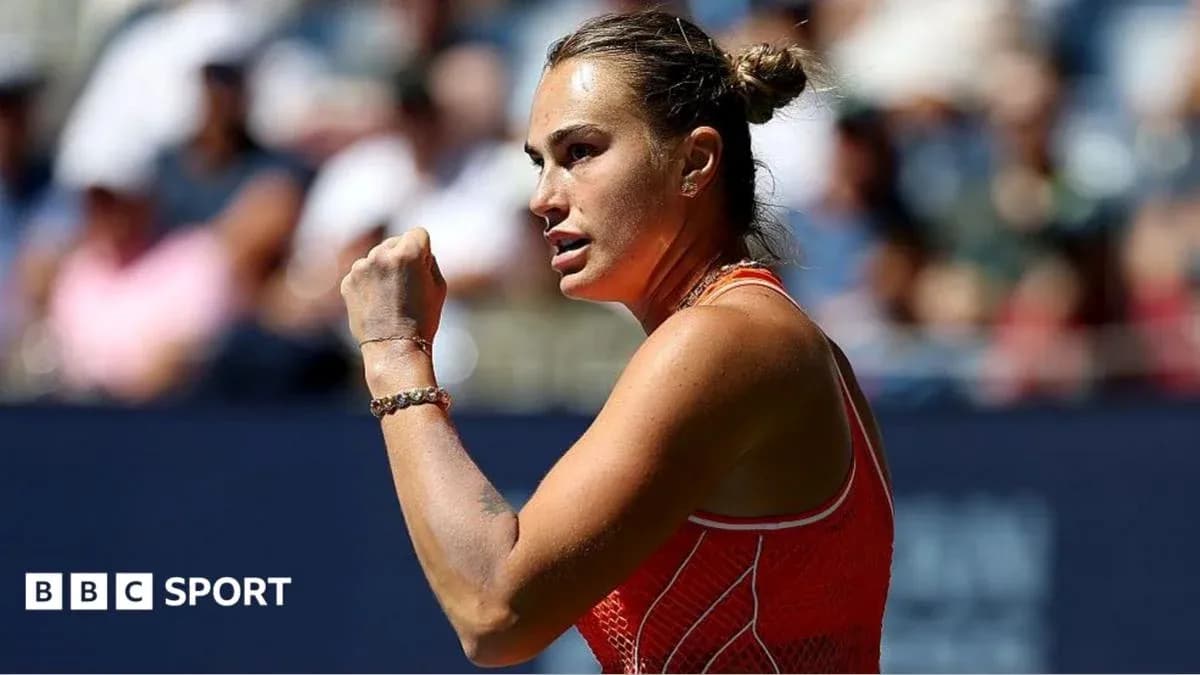
Aryna Sabalenka Survives US Open Quarter-Final Thriller
Aryna Sabalenka had already given up on her title. Or so she thought.
Two points from defeat, trailing in the deciding tie-break, the two-time defending US Open champion looked ready to hand over her crown to Wimbledon winner Linda Noskova. Instead, she tore up the script, clawed back control, and forced Arthur Ashe Stadium to witness another of her increasingly familiar escape acts.
After two hours and 26 minutes of turbulence, Sabalenka walked off with a 7-6 (7-1) 3-6 7-6 (10-7) victory, a place in a sixth straight US Open semi-final, and her 19th consecutive win in New York.
The champion survives. Just.
A champion on the brink
For the first time this fortnight, Sabalenka was dragged into a third set. For the first time this fortnight, she looked vulnerable.
Down 4-2 in the decider, broken three times, her serve fraying at the edges, the match was tilting Noskova’s way. The Czech had the cleaner numbers: more winners, fewer unforced errors, seven of nine break points saved. She was holding her nerve while the top seed’s most familiar demons – double faults and squandered chances – circled again.
Then came the tie-break.
Noskova surged 2-0 ahead. Sabalenka stared at the scoreboard, at the prospect of her reign ending before the weekend, and let go.
"I honestly thought that that's it, the match is over," she admitted afterwards. That resignation, oddly, freed her. She started swinging without fear, ripping through the final points and closing out the breaker 10-7, sealing the win with a bold second-serve ace that belonged to a player utterly convinced, not one who had been doubting moments earlier.
Fast start, frayed edges
This match did not begin like a drama. Sabalenka opened in full front-runner mode, breaking Noskova’s first service game and racing to a 5-2 lead. The sixth seed looked rushed, Sabalenka dictating with heavy first strikes and stepping inside the baseline at will.
Serving for the set, though, the first crack appeared. A double fault – one of four across the night – helped Noskova break back. Sabalenka still stormed through the tie-break 7-1, but the wobble on serve hinted at trouble ahead.
It grew louder in the second set.
Sabalenka created three early break points and burned them all. At 3-2 down, she double-faulted on break point again, handing Noskova the initiative. The Czech held firm, punished short balls, and dragged the match into a decider as Sabalenka’s frustration simmered.
This was the version of Sabalenka that has cost herself big matches before. The one who let a French Open quarter-final slip from a set up. The one whose power occasionally gets tangled with her emotions.
On Tuesday night, she found a way to cut through that.
Turning the tide
The third set almost ran away from her completely. Two more double faults, a third break conceded, and Noskova cruising to 4-2 with a love hold. Sabalenka looked stranded.
Then the match flipped.
Sabalenka tightened her margins just enough, but not at the cost of aggression. She began to lean on her forehand again, to step into returns, to take time away from Noskova. Three games in a row went her way. The pressure, which had been building on the top seed, suddenly shifted to the underdog serving to stay in the contest.
Noskova refused to fold. She kept swinging, kept finding lines, kept making Sabalenka hit one more ball. It dragged the match to that final super tie-break, where Sabalenka’s record in New York kicked in.
She has now won 10 straight tie-breaks at the US Open, a streak stretching back to 2021. This one may prove the most important of the lot.
History, and what comes next
The numbers around Sabalenka’s run in New York are beginning to sound historic. Nineteen consecutive wins at the US Open. Six straight semi-finals at Flushing Meadows, a feat last achieved by Serena Williams in 2016. Still unbeaten in quarter-finals here – six played, six won.
This is also just her second quarter-final victory since March, a reminder of how uneven the middle of her season has been. The hard courts of January and March brought titles in Brisbane, Indian Wells and Miami. Clay and grass were far less forgiving. So were the North American tune-ups, where she exited in the last 16 in both Toronto and Cincinnati.
Here, though, the familiar version of Sabalenka has re-emerged: flawed, volatile, but ferociously hard to put away.
Her reward is a semi-final against either Jessica Pegula, the American third seed, or fellow Belarusian Emma Navarro, seeded 26th. She will also, for now, cling to the world number one ranking, though Elena Rybakina can overhaul her if the world number two beats Zheng Qinwen on Wednesday.
For Noskova, this defeat halts an 11-match Grand Slam singles winning streak, but not the momentum of a player who has already collected a Wimbledon title and now pushed the US Open’s dominant force to the edge.
Sabalenka, meanwhile, walks on, still chasing a fourth straight final in New York, still daring opponents to finish the job when they have her on the ropes.
Noskova couldn’t. Will anyone?