Aryna Sabalenka vs Elena Rybakina: US Open Final Showdown
Aryna Sabalenka walked into New York knowing the maths. Win the US Open, and she might – might – keep Elena Rybakina behind her in the rankings. Anything less, and the number one spot was gone.
In the end, even that wasn’t enough. By the time the two women booked their places in Saturday’s final, the calculation was over. Rybakina, the cool-eyed Kazakh with the heavyweight baseline game, had already done enough by reaching the semi-finals to guarantee she will replace Sabalenka at the top of the world.
So the final at Flushing Meadows is not just about a trophy. It is a handover.
A rivalry with real edge
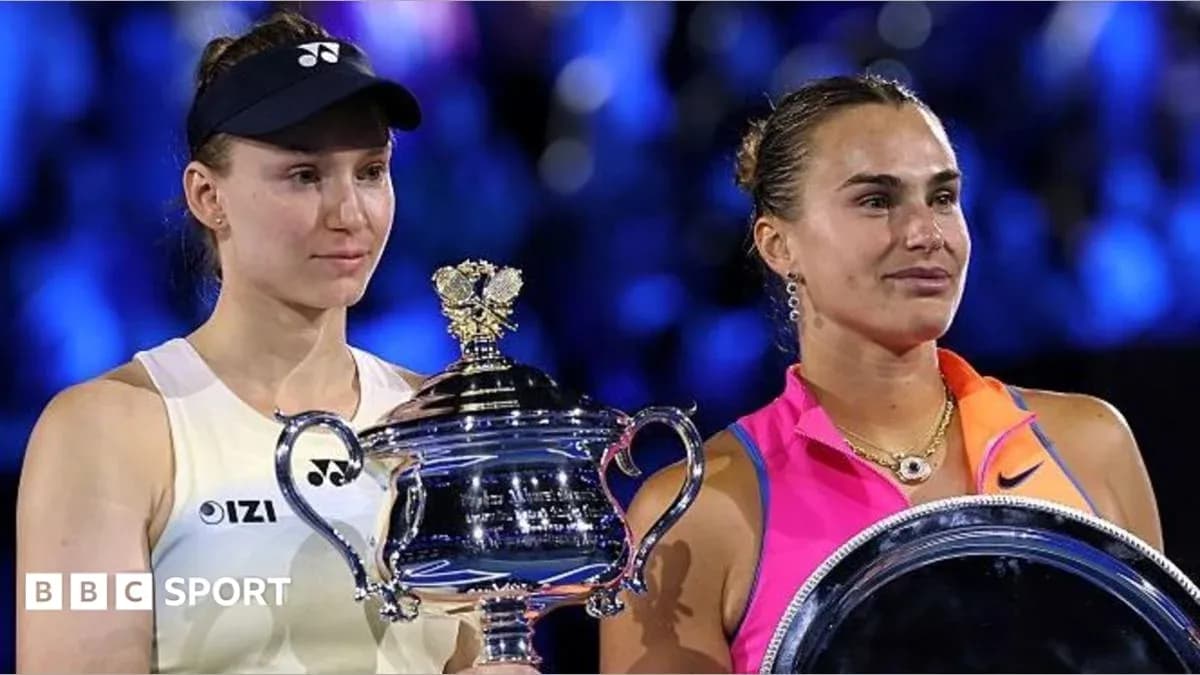
This is not a gentle passing of the baton. Rybakina has already struck one of the year’s biggest blows, beating Sabalenka to the Australian Open title in January and snapping the Belarusian’s aura in Melbourne.
Now she has the chance to twist the knife: a first US Open crown, and confirmation of her new status as the sport’s leading force.
That prospect alone would sting Sabalenka. Add the ranking element, and the emotional charge becomes obvious.
“It is going to be red rag to a bull for her – she is not going to be happy,” former British number one Annabel Croft said on BBC Radio 5 Live. “Now she has the opportunity to end this year on a high.”
Sabalenka has not simply absorbed the blows. She has hit back in the hard-court season, beating Rybakina at Indian Wells and Miami since that Melbourne defeat. Their meeting in New York will be their fourth of the year, a rivalry growing in real time at the sharp end of the sport.
Chasing history as the crown slips
Sabalenka arrives as a reigning queen of Queens. Two-time defending champion, four-time Grand Slam winner, and chasing a slice of history: only two women in the Open era have won the US Open singles title three years in a row. She is one victory from joining that club.
Her semi-final performance against American third seed Jessica Pegula suggested she is ready for it. This was Sabalenka at her snarling best, unleashing the kind of controlled aggression and liberated shot-making that has been missing for months. The tension that had crept into her game during the season seemed to evaporate under the lights.
Afterwards, she brushed off questions about the ranking, joking that she didn’t care. The smile said one thing; the season’s story says another.
Her coach Anton Dubrov did not bother with the pretence.
“I actually like this [losing the ranking] happened. It’s ended and it’s extra fuel,” he said. “There is no more extra draining [of mental energy] or thinking about it. There’s a next chapter right now. You have to chase again. It’s extra motivation for you. Just go and get it.”
The hunted has become the hunter again. Sabalenka seems ready to lean into that role.
Cracks, collapses and a test of nerve
For all her pedigree, Sabalenka’s path to this final has not been a smooth march. Over the past five months, doubts have crept in – not about her power, but about her poise.
She has lost a string of matches from dominant positions against players she was expected to beat. The most brutal collapse came in Paris. In the French Open quarter-finals, she led 25th seed Diana Shnaider by a set and a double break, only to disintegrate in a 3-6 7-5 6-0 defeat that left observers stunned.
The clay swing had already thrown up warning signs. In Madrid, she squandered six match points against Hailey Baptiste. In Rome, she let a first-set lead slip against Sorana Cirstea. These were not just tactical lapses; they were mental stumbles from a player who had built her rise on a new-found steel.
The wobble continued into the North American hard-court stretch. At the Cincinnati Open, she held a clear advantage over 20-year-old Czech Sara Bejlek and still lost in straight sets. A pattern was forming: big leads, tightening shoulders, matches drifting away.
From the outside, it looked like a champion unravelling. Inside Team Sabalenka, there was no sense of panic.
Space, freedom and one more shot
High performance coach Jason Stacy described a different approach – not crisis meetings, but trust.
“We all understand that this is just part of the thing,” he said. “We just give her space to be herself, help her figure out what might work for her right now.
“Giving her that freedom, but also knowing that she has the guidance of all of us, I think that just gives her a power that few are lucky enough to have.”
That balance – space to be volatile, structure to be dangerous – has started to reappear in New York. Against Pegula, Sabalenka played as if she had finally stopped looking over her shoulder at the rankings and started looking straight ahead at the court in front of her.
She knows the number one beside her name is gone. She knows the woman who took it will be standing across the net in the final, with a chance to underline the shift in power.
Rybakina will walk out as the incoming world number one. Sabalenka will walk out as the two-time defending champion, chasing history and revenge in the same breath.
Only one of them will leave Arthur Ashe Stadium with the last word on this season.