
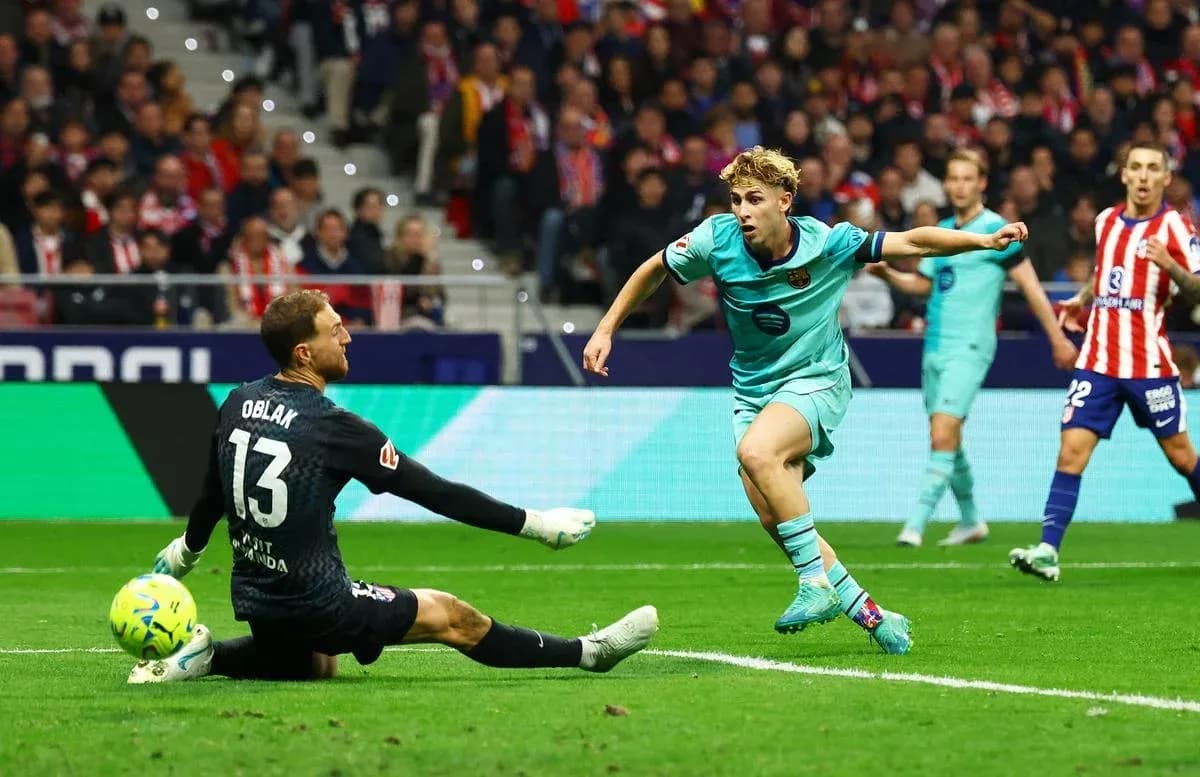
Atletico Madrid vs Barcelona: Tactical Insights from La Liga Clash
Under the lights of the Metropolitano Stadium, this was billed as a collision of identities: Atletico Madrid’s hard-edged efficiency against Barcelona’s free-scoring surge at the top of La Liga. It ended 2-1 to the visitors, a result that subtly reshapes the title narrative as much as it exposes the fault lines and strengths in both squads.
I. The Big Picture – Clash of structures and streaks
Heading into this game, Atletico were third with 28 points from 12 matches, built on a balanced return of 23 goals for and 10 against overall. Their goal difference of 13 underpinned a campaign defined by control: 1.9 goals scored per match in total, just 0.8 conceded both at home and on their travels. At the Metropolitano specifically, they had 4 wins, 1 draw and 1 defeat, scoring 12 and conceding 5.
Barcelona arrived as league leaders, 33 points from 12, powered by an outrageous attacking output: 48 goals scored and 13 conceded overall, a goal difference of 35. They were perfect away from home: 6 wins from 6, with 24 goals scored and 6 conceded on their travels, averaging 4.0 goals both home and away. This fixture was the acid test of that away invincibility against one of Spain’s most disciplined defensive machines.
On the tactical board, Diego Simeone went with his trusted 4-4-2. J. Oblak anchored a back four of Marcos Llorente, Marc Pubill, D. Hancko and Álex Grimaldo. The midfield band of four blended graft and guile: G. Simeone wide, Koke and Pablo Barrios inside, and Álex Baena as the creative needle. Up front, Lee Kang-In and J. Álvarez offered movement between the lines rather than a classic target man.
Hansi Flick answered with a 4-1-4-1 that morphed easily into a 4-3-3 in possession. Joan García started in goal behind a back four of B. Farinas, Pau Cubarsí Paredes, Gerard Martín and João Cancelo. Marc Bernal sat as the single pivot, with an advanced quartet of Lamine Yamal, Fermín, Pedri and A. Gordon supporting lone forward Raphinha.
II. Tactical voids and disciplinary shadows
Neither side had official absentees listed, allowing both coaches to lean into their strongest current patterns. Yet the squads carried their own internal tensions.
For Atletico, Robin Le Normand’s season tells a story of risk at the back. He came into the round as one of La Liga’s top red-card recipients, with 1 red and 1 yellow in just 385 minutes. Simeone’s choice to start with Hancko and Pubill instead of Le Normand underlined a desire for mobility and composure against Barcelona’s fluid front line. In midfield, Baena’s presence was double-edged: he arrived as one of the league’s most-booked players with 4 yellows, his aggression an asset in breaking rhythm but also a disciplinary time bomb in a match where fine margins matter.
Team-level card data reinforced Atletico’s volatility. Their yellow cards spike in the 31-45 and 76-90 minute windows, each accounting for 25.00% of their cautions, with a red card also arriving in the 76-90 range this season. That late-game surge in bookings mirrors the emotional crescendo of Simeone’s football—and risks turning tight contests chaotic.
Barcelona, by contrast, have been relatively clean. Their yellows cluster heavily between 46-60 minutes (44.44%), suggesting a side that often has to foul to reset after the break when pressing intensity dips. Crucially, they had no reds in the league to this point. The one blemish in their otherwise ruthless penalty record—5 taken, 4 scored, 1 missed—was a reminder that even this machine has a human edge. Lamine Yamal, who has both scored and missed from the spot, embodies that duality.
III. Key matchups – Hunter vs shield, engine vs enforcer
The headline duel was Raphinha against an Atletico defence conceding just 0.8 goals per match in total. Raphinha entered as La Liga’s top scorer with 15 goals and 3 assists from 11 appearances, averaging nearly a goal and a half-chance created every time he stepped on the pitch. Against a back four that had kept 6 clean sheets overall and conceded only 5 at home, his movement between full-back and centre-back channels was the sharpest knife Barcelona possessed.
Flanking him, Lamine Yamal was both creator and secondary scorer: 10 goals and 8 assists, with 42 key passes and 49 successful dribbles. His duel with Grimaldo and Hancko was less about isolated one-v-ones and more about how often Atletico’s block could be forced to tilt and break shape.
On the other side, Atletico’s attacking “hunter” was more collective. G. Simeone, with 4 goals and 2 assists plus a ferocious defensive work rate (28 tackles, 8 interceptions), represented Simeone-ball in human form: a forward who is also a first defender. Baena added 5 goals and 3 assists, threading 30 key passes at 81% accuracy. Their challenge was to exploit the modest vulnerability of a Barcelona defence conceding 1.0 goal per game on their travels, especially in transition.
Engine Room – Playmakers vs Enforcers
In midfield, the contrast was stark. Atletico’s core of Koke, Barrios and Baena is built for compactness and verticality. Koke’s role as metronome, Barrios’ energy and Baena’s line-breaking passing aimed to compress the pitch, deny Pedri and Fermín time, and spring Lee Kang-In and Álvarez quickly.
Barcelona’s engine was more expansive. Marc Bernal as the single pivot had to screen counters while circulating possession into Pedri and Fermín. Fermín, with 7 goals and 5 assists and 22 key passes, arrived as one of the league’s most productive midfielders. His late runs into the box and ability to shoot from the edge were designed to exploit any hesitation from Atletico’s second line.
A. Gordon, with 4 assists and a strong dribbling profile, operated as the connector on the left, stretching Marcos Llorente and forcing Atletico’s wide midfielder on that side—often G. Simeone—to constantly track back, diluting his offensive output.
IV. Statistical prognosis and what the result tells us
On paper, this was Barcelona’s 4.0-goals-per-game attack on their travels against Atletico’s 2.0 goals scored and 0.8 conceded at home. The underlying numbers pointed to a narrow edge for the visitors: their offensive ceiling is simply higher, while Atletico’s edge lay in game-state management and defensive structure.
A 2-1 away win fits that balance almost perfectly. Barcelona’s attack was inevitably going to regress slightly from its four-goal average against a defence of this calibre, but still had enough to pierce a back line that has occasionally been stretched late in games. Atletico’s ability to score once against a side conceding 1.0 goal per away match aligns with their home average of 2.0 goals for, trimmed by the quality of opposition.
Tactically, the match underlined that Barcelona’s 4-1-4-1, with Raphinha as the primary finisher and Lamine Yamal as the creative axis, is robust enough to win in hostile environments without abandoning its attacking DNA. Their missed penalty earlier in the season remains a footnote rather than a flaw.
For Atletico, the defeat doesn’t shatter their profile but exposes the limits of their current 4-4-2 when forced to chase a game against elite possession. The squad’s spine—Oblak, Hancko, Koke, Baena, G. Simeone—remains strong, but the reliance on emotional surges, as reflected in their late-card patterns, can tilt tight contests away from them rather than in their favour.
Following this result, Barcelona’s status as title favourites hardens, while Atletico leave the Metropolitano with a reminder: against this version of Barcelona, structural discipline is not enough—you need an attacking gear they only showed in flashes.