Coco Gauff Advances at US Open Amidst Mixed Fortunes for American Players
Coco Gauff steadied herself, then surged. Under the lights and under the weight of a nation’s expectations, the defending US Open champion punched her ticket to the second week in New York, while two of her compatriots fell away in brutally different fashion.
Gauff settles, then strides
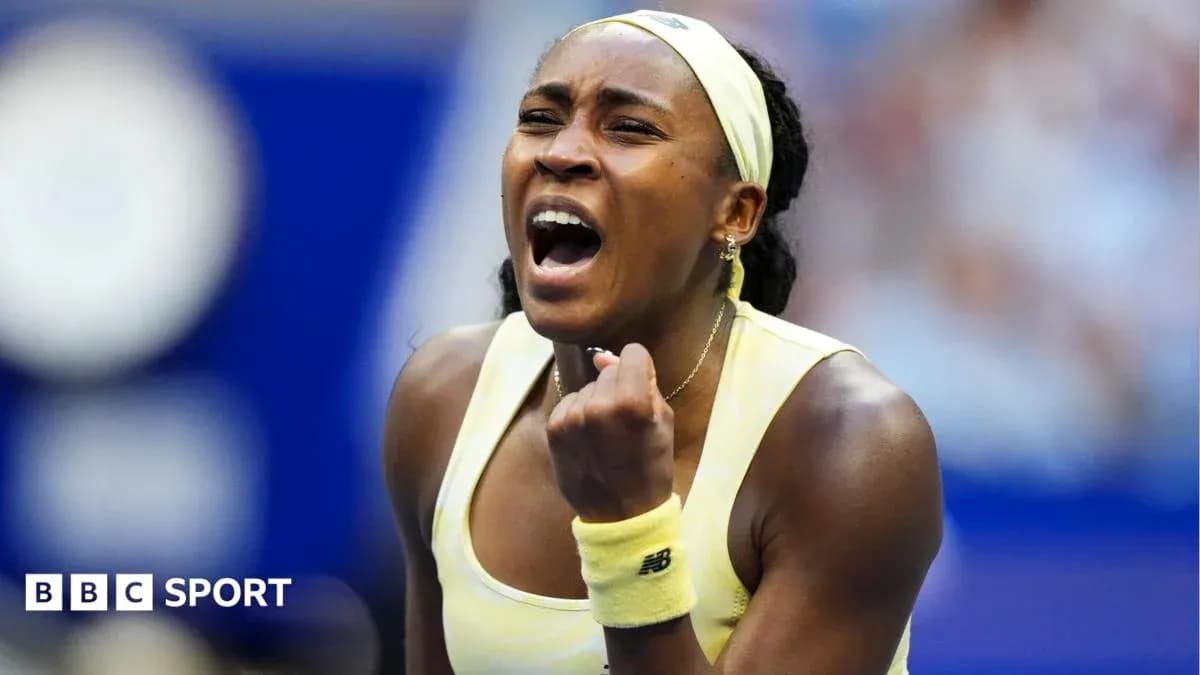
It was not flawless from Gauff, but it did not need to be. The 22-year-old, already the standard-bearer for American tennis, recovered from an early wobble to beat Spain’s Cristina Bucsa 6-3 6-4 and reach the fourth round for a fifth consecutive year.
Down 3-1 in the opening set, Gauff tightened her patterns, found more first serves, and began to bully the rallies. The pressure told quickly. She reeled off five straight games to snatch the set, the kind of ruthless swing that has become routine since her breakthrough title in New York in 2023 and her French Open crown earlier this season.
The second set brought another test. Broken to love, Gauff stared at the danger and hit back immediately, snatching back control before the match could drift. No panic. No fuss. Just a firm reset and a straight-sets win that extended her run of WTA Tour-level victories in straight sets to eight.
“I feel like I'm used to getting to the second week now,” she said afterwards. “I woke up today and I was like, ‘oh we're already in round three’.” The line was light, but the subtext was not. This is a player who has lived with expectation at Flushing Meadows since her teens and now wears it with a looser grip.
“There's expectations, being American, and I want to do well in front of the fans,” she added. “Last year, I put so much pressure on myself. I'm enjoying the experience out here.”
That enjoyment is wrapped around a hard edge. The fourth round has been her ceiling at this event in each of the past two years. The way she shrugged off both an early deficit and a mid-match jolt suggested a player better equipped to push beyond it.
Keys’ collapse stuns Ashe
On the other side of the draw, the mood turned sharply darker.
Madison Keys stood on the brink of her first US Open second-week appearance since 2023, up 5-0 in the deciding set against Olympic champion Zheng Qinwen. She had a match point. The crowd could feel the finish line.
She never crossed it.
Zheng, the reigning Australian Open champion, clawed her way back with a mix of defiance and clean hitting, but the story of the final act belonged to Keys’ unraveling. From 5-0 up, she lost seven straight games and the match, 1-6 7-6 (7-3) 7-5, in a collapse that left Arthur Ashe Stadium stunned.
The 31-year-old did not sugarcoat what happened.
“I obviously got off to a really good lead, and then I got really scared, like I couldn't swing [the racquet],” Keys admitted. “I felt like I couldn't play tennis anymore. It just felt like it was a much bigger deal than just playing a tennis match all of a sudden.”
It was a raw description from a former finalist here, beaten by Sloane Stephens in 2017, and a player who has quietly been grinding through the majors. She reached the fourth round at all three other Grand Slams this year, but this one cut deeper.
“I feel like I've been struggling for a while now. I'm going to have to make some sort of changes,” she said. “I just kind of keep putting it off because that's how the tennis world works. It's just to the point where I actually need to do something about it.”
For Keys, this was not just a loss. It felt like a reckoning.
Anisimova’s frustration boils over
Amanda Anisimova’s exit came with less drama on the scoreboard but plenty of visible frustration.
Last year’s runner-up, beaten by world number one Aryna Sabalenka in the 2025 final, went out in straight sets to 24th seed Anastasia Potapova, the Russian-born Austrian who refused to let the American settle.
Anisimova’s serve deserted her at key moments. She was broken twice in the first set, then four times in a chaotic second, her body language darkening with each missed opportunity. The 25-year-old argued with herself more than with her opponent, a portrait of a player unable to find the level that carried her so deep here 12 months ago.
Potapova did not need to produce a masterpiece. She just had to stay solid, absorb the pace, and let Anisimova’s errors pile up. That was enough.
American hopes still swelling
For all the bruises, this remains a US Open with a distinctly American shape.
Gauff leads the charge, but she is far from alone. Jessica Pegula, Taylor Townsend and Emma Navarro have already joined her in the last 16, with teenager Iva Jovic aiming to swell that number to five. If the draw breaks a certain way, home players could fill six of the eight fourth-round matches in the men’s event as well, with Ben Shelton, Frances Tiafoe, Tommy Paul and Alex Michelsen already through and Learner Tien and Michael Zheng still to come.
The weight of expectation has not gone away. It has simply shifted shoulders.
On Gauff, it now sits like a familiar jacket rather than a heavy coat. On Keys and Anisimova, it lingers as something more complicated, a reminder of what once seemed inevitable and what now feels uncertain.
New York will move on quickly. The night sessions, the roars, the relentless churn of matches will blur one storyline into the next. But Gauff’s calm recovery, Keys’ haunted confession, and Anisimova’s simmering frustration offered a snapshot of where American tennis stands in this moment: one star in full stride, others searching for answers, all under the same unforgiving lights.