Elena Rybakina's Remarkable Comeback to Reach US Open Final
Elena Rybakina walked to her chair at the end of the first set looking as if she had barely arrived. One set down, outplayed, and drowned in the noise of an Arthur Ashe Stadium crowd desperate for Coco Gauff to run away with it, the No 2 seed seemed stuck in neutral.
She did not stay there for long.
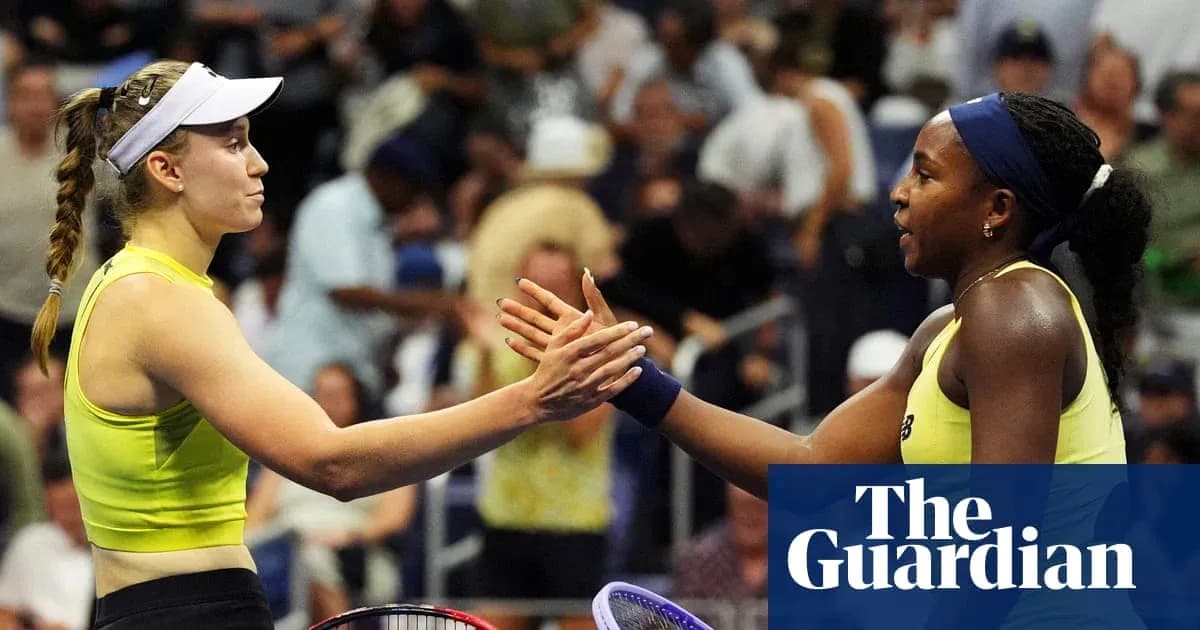
From a position of apparent vulnerability, Rybakina pieced together one of the most stubborn, quietly ruthless comebacks of her career, subduing Gauff 3-6, 6-4, 6-4 to reach her first US Open final and keep alive a season that is starting to look historic.
Gauff starts like a storm
For half an hour, this was Gauff’s night. She flew out of the blocks, chasing down everything, turning defence into counterpunch, and feeding off the 22,000 voices roaring for every sprint, every sliding get. The teenager’s serve, once her tormentor on this very court, held firm. Under pressure, it even shone.
The problems came elsewhere.
Rybakina, by contrast, looked nothing like the cold-eyed closer who has become one of the sport’s most feared front-runners. Her usually immaculate serve misfired. Her groundstrokes sprayed. Gauff’s athletic defence and depth teased out error after error as the American wrapped up the opening set 6-3 and looked in complete control.
Given Gauff’s recent wobble on serve in her quarter-final escape against Mirra Andreeva, when she coughed up 12 double faults and survived two match points, the first set felt like a reassuring reset. She landed big deliveries at key moments and trusted her legs to do the rest.
Then the match changed.
Rybakina solves the puzzle
Rybakina has spent this fortnight winning without ever truly catching fire. What she has done, relentlessly, is manage chaos. Six matches in, she still had not produced her best tennis, but she had answered every awkward question the draw posed.
She found another answer here.
At the start of the second set, Rybakina stopped trying to hit through Gauff and started hitting around her. She widened the court, carving out angles, especially off the backhand. Those flat, skidding backhands began to drag Gauff into uncomfortable positions, opening space for the first strikes that had been missing.
The scoreboard responded quickly. Rybakina surged to a 4-1 lead, not because either player had suddenly become flawless, but because the battle had shifted to Gauff’s weakest link. The American’s forehand, remodelled and improved over the past year, simply cracked under the weight of Rybakina’s pace and depth. The hitch in the swing resurfaced at the worst possible time.
By the end of the night, that wing would account for 15 unforced errors. The second set turned on it.
Serving at 4-5 to stay in the set, Gauff produced her poorest game of the match: three forehand errors and a double fault. Rybakina did not need to be spectacular; she only needed to be solid and present. She was. The match was level.
The serve finally arrives
For two sets, Rybakina had clawed and calculated without her most devastating weapon. Her rise to the top of the women’s game has been built on one of the most destructive serves in tennis, yet it had largely deserted her early on.
In the decider, it finally showed up.
At 1-1, she thundered down two aces to close out a hold for 2-1, a small moment that felt like a turning point. From there, her service games became cleaner, quicker, more authoritative. With the serve now “singing”, as it so often does on hard courts, the pressure swung squarely back onto Gauff.
The American clung on at first. Facing two break points at 2-3, she dug deep, found a couple of big serves of her own and scrambled to 3-3. The crowd roared, sensing a momentum shift, willing her to turn that hold into something more.
Rybakina refused to budge.
At 3-4, Gauff’s resistance finally cracked. The rallies shortened, the errors crept in, and Rybakina broke to stand one game from the final. She stepped up to serve for the match at 5-3, the arena humming with tension.
Gauff, as she so often does, refused to go quietly.
A final twist, and a ruthless finish
Down 3-5, 30-30, Gauff lasered a backhand passing shot of outrageous quality, then completed the break to claw back to 4-5 and ignite Arthur Ashe once more. It was a surge worthy of her reputation as one of the game’s fiercest competitors, a last stand that demanded a response.
Rybakina delivered it immediately.
Shaking off the disappointment of failing to serve it out, she marched forward on the return, stepping inside the baseline, taking the ball early, and ripping into Gauff’s serve. The Kazakhstani forced the issue, turned defence into attack, and sealed the decisive break with a final, ruthless return game.
No nerves. No drift. Just a clean, hard close from a player who has learned how to win ugly as well as beautifully.
A new No 1, and a familiar rival
This run has already altered the shape of Rybakina’s career. She arrived in New York with a poor US Open record and a worrying Achilles problem, yet also with a clear target: the No 1 ranking. She has hit it. Her tense quarter-final win over Zheng Qinwen locked in the summit, one of the sport’s great milestones.
She treated that achievement as a checkpoint, not a destination. The title, she insisted, was the only acceptable end point.
Now she stands one match away from it, in her fourth grand slam final and her third on hard courts since lifting Wimbledon in 2022. After waiting four years for a second major, she has given herself a chance to collect two in the same season.
She will have to go through a familiar force to do it.
Across the net in the final will be Aryna Sabalenka, the outgoing No 1 and the rival who has shaped this season’s narrative. Their meeting will reprise the Australian Open final, won by Rybakina, and will cap a US Open that delivered a rarity: all four top seeds in the women’s semi-finals, something this tournament had not seen in 51 years and no major had witnessed since Wimbledon 2009.
The women’s game has depth. It also has a clear, hardened elite. On Thursday night, Elena Rybakina proved again she belongs at the very top of it, walking out of a storm on Arthur Ashe with the scoreline, the ranking, and another shot at a major trophy in her hands.