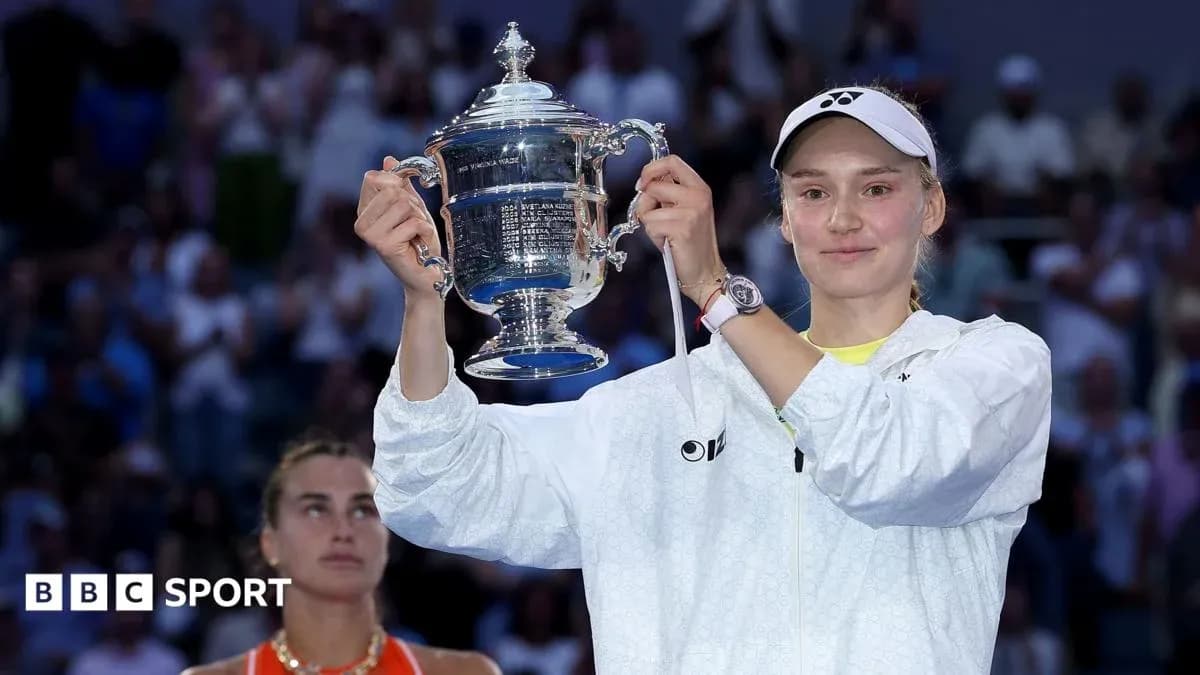
Elena Rybakina Claims US Open Title with Victory Over Aryna Sabalenka
Elena Rybakina walked into Arthur Ashe Stadium already assured of the number one ranking. She left with something far more tangible – the US Open trophy and a statement win over the woman she has just deposed.
The Kazakh star subdued two-time defending champion Aryna Sabalenka 6-4 5-7 6-2 in a bruising, momentum-swinging final, sealing her first title in New York and the third Grand Slam crown of a career that is starting to look era-defining.
She did it her way: calm, cold, and utterly ruthless when it mattered.
Ice against fire
This rivalry has become one of the defining duels of the women’s game. Sabalenka, all noise and fury, against Rybakina, who can look as if she is playing a practice set on a back court even when serving for a major.
On this night, that contrast decided the title.
Rybakina’s first serve misfired early. For most players, that spells trouble against Sabalenka’s ferocious return. Instead, the new number one turned the weakness into a challenge, digging into her returning game and repeatedly driving the Belarusian back with flat, heavy strikes off both wings.
Sabalenka’s frustration grew with each missed opportunity. Rybakina, expression barely changing, picked her spots and stole the opening set 6-4, absorbing pace and sending it back with interest.
The defending champion finally found her range in the second. Her groundstrokes straightened, the errors dipped, and she began to bully Rybakina’s second serve. The tension tightened around Ashe. Rybakina’s level dipped just enough, Sabalenka’s aggression rose just enough, and the match cracked open.
Serving at 5-6, Rybakina blinked. Sabalenka surged over a series of short second serves, pouncing on her third set point to drag the final into a decider. The roar, the fist pumps, the glare to her box – it felt like a shift.
It wasn’t.
The world number one takes charge
Just as Sabalenka seemed ready to roll, the loose swings returned. So did the self-criticism, the muttering, the negative energy that has always shadowed her brilliance.
Rybakina sensed it immediately.
She stepped inside the baseline, drove her returns deep and heavy, and broke for 2-1 in the third. That single game changed the air in the stadium. From there, the incoming number one grew taller with every point. Her serve, unreliable at the start, suddenly looked like the weapon that has terrorised the tour all year.
Sabalenka, pinned to the baseline, found fewer and fewer chances to dictate. Rybakina’s first-strike tennis – that penetrating serve, those thunderous, flat groundstrokes – took the racquet out of the champion’s hands.
The pressure mounted, game by game. At 5-2, Rybakina stood at the line to serve for the title. One double fault on her first championship point offered a glimpse of nerves, the only real crack in the façade all night. She paused, reset, and then thundered down an ace to finish it – a fitting exclamation mark from the best player in the world.
For once, the mask slipped. Rybakina allowed herself a brief smile as the ball flashed past Sabalenka and the stadium erupted. It was small, but it said everything.
A New York story rewritten
That smile carried years of frustration in this city.
“I was coming here for the last 10 years and it was never successful. I’m falling in love with New York more and more,” the 27-year-old said afterwards. It has long puzzled observers that a player with such a hard-court-friendly game had never truly clicked at Flushing Meadows.
The conditions suit her. The surface rewards her flat pace. The big stadiums amplify her serve. Yet the results never quite matched the tools. Perhaps the chaos and swagger of New York never seemed to fit her understated personality.
This fortnight changed that.
The run almost never started. An ankle injury in the Cincinnati Open quarter-finals left Rybakina unable to walk for several days, her participation in New York in serious doubt. She and her team went “day by day”, as she put it, unsure whether the joint would hold up to two weeks of Grand Slam strain.
It did more than hold.
She breezed through her first four matches, her serve so dominant that opponents barely had a look at extended rallies. Then came the tests: Zheng Qinwen and Coco Gauff, both matches in which she dropped the opening set, both matches that demanded resilience rather than just raw firepower.
Rybakina answered those questions too, grinding through the gears, showing she could suffer as well as strike. By the time she reached Sabalenka, she had proven she could win ugly and win big.
This final required both.
She bullied from the baseline when the chance was there. She dug in when Sabalenka threatened to overwhelm her. She managed the storm across three sets, and when the decisive moments arrived, she played like a player who knew – not hoped, knew – she was the best in the world.
“Some magic is happening,” she said. “We didn’t know how it was going to be so I’m super happy and still can’t believe it.”
Magic, perhaps. But also something more concrete.
With Wimbledon 2022, the Australian Open earlier this year, and now the US Open in her collection, Rybakina stands one French Open title away from the career Grand Slam. The question no longer is whether she belongs at the very top.
It’s how many of these nights she has left in her.