Elena Rybakina Withdraws from WTA Finals Due to Illness
Elena Rybakina’s season of supremacy has ended not with a trophy lift, but with a withdrawal slip.
The world number one, who has spent 2026 bending women’s tennis to her will, has pulled out of the WTA Finals in Indian Wells on the eve of the tournament because of a viral illness. The defending champion will not hit a ball this week, and a field built around stopping her suddenly opens up.
“I am really sad to inform all my fans and supporters that I unfortunately have to withdraw from the WTA Finals this year,” Rybakina said, confirming what had become an increasingly ominous doubt. “I've had an incredible season but my body is just not physically ready to compete. I'm going to spend some time resting and recovering at home and getting myself ready for the 2027 season.”
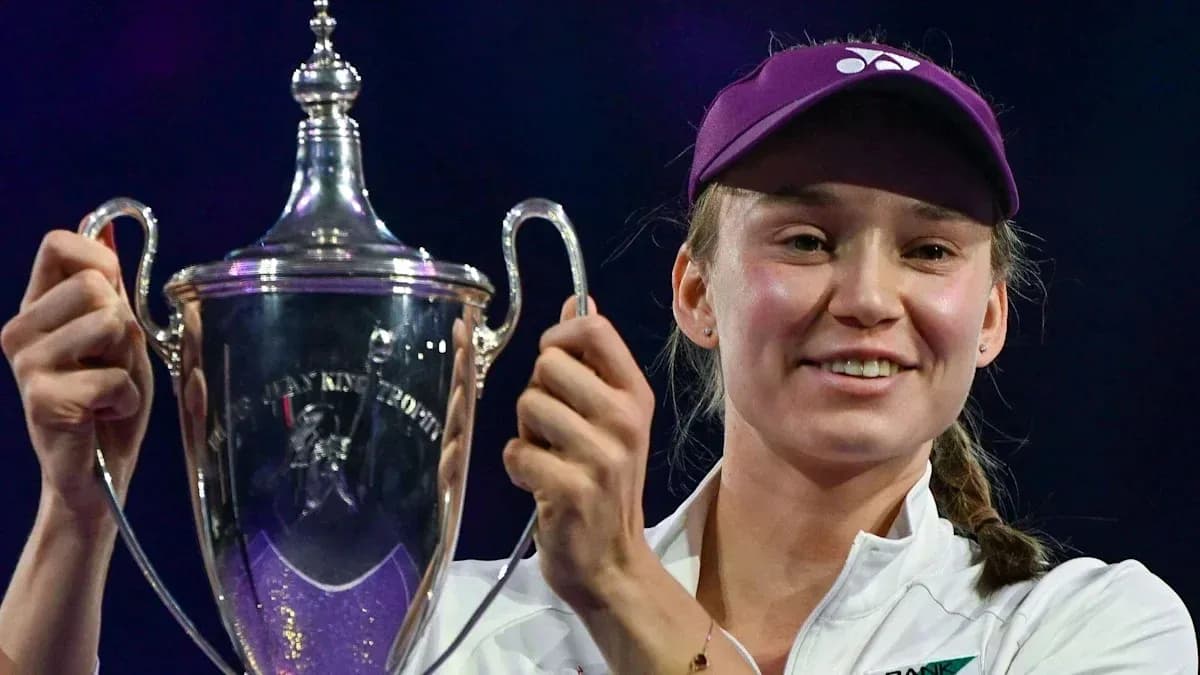
For a player who has spent the year redefining dominance, the timing is brutal. Rybakina arrived at this point as the undisputed force of the tour: Australian Open champion, US Open champion, year-end world number one, and the woman who finally wrenched the top ranking away from Aryna Sabalenka.
She did it with a season that felt relentless. Titles in Melbourne and New York framed a campaign that also brought trophies in Stuttgart and Ningbo, plus runner-up finishes at Indian Wells and Toronto. Six of her 15 career titles have come since last October, a surge that turned her 2022 Wimbledon breakthrough from isolated triumph into the foundation of an era.
The numbers tell the story as starkly as any highlight reel. Rybakina closes the season with a 54–14 record, winning 17 of 19 matches at Grand Slam level. Her serve has been the tour’s most feared weapon: 438 aces, a staggering 140 more than second-placed Sabalenka. When the ball came back, it often didn’t come back a second time. She finished the year with 1,775 winners, more than anyone else, and 10 victories over top-10 opponents – again, unmatched.
That sustained excellence brought a symbolic breakthrough in New York. By beating Sabalenka in the US Open final six weeks ago, Rybakina ended the Belarusian’s 99-week hold on the number one ranking. The confirmation came in Tokyo in October, where she locked in the year-end top spot, a status that once seemed the preserve of only a handful of names in the modern game.
Indian Wells was supposed to be the crowning stage. Rybakina was set to begin her campaign on Sunday, chasing history by becoming the first woman since Serena Williams in 2014 to win the WTA Finals in back-to-back years. Instead, the tour’s showpiece event will go ahead without its leading figure, and without the duel many had hoped would define the week.
For Rybakina, the decision underlines the cost of such a ferocious schedule. The viral illness arrives at the end of the most physically and mentally demanding stretch of her career, one in which she finally backed up that first major in London with a haul that places her firmly at the centre of the sport.
The season now ends not with another statement performance, but with enforced silence. Yet the balance of power has already shifted. Rybakina has the ranking, the majors, the statistics and, crucially, the aura of a player who expects to decide the biggest matches on her own terms.
The WTA Finals will move on without her this week. The real question is who, if anyone, will be ready to face her when she returns in 2027.