Elina Svitolina's Call to Action Amidst US Open Turmoil
Elina Svitolina’s voice carried a different kind of weight in New York.
While the US Open raged on in Queens, the Ukrainian star revealed that the war she has spoken about so often had landed directly on her doorstep. A Russian attack, she said, had struck the SVITO Padel Club she owns in Kyiv.
“As of today, 776 Ukrainian athletes and sports officials have been killed as a result of Russian aggression,” Svitolina posted on Instagram. “942 sports facilities across Ukraine have been damaged or completely destroyed. Today, my club, SVITO Padel Club, became one of them.”
The numbers are stark. The personal blow is sharper.
“Ukrainian athletes and our young generation do not have the opportunity to train and prepare for international competitions on equal terms with athletes from other countries,” she wrote, turning a private loss into a broader indictment of what the sporting community in her country now faces.
Her message was not just a lament. It was a call.
“With this message, I want to reach out to our international partners and friends who support and cheer for us, Ukrainian athletes, on the international stage, and ask for your support and concrete actions that can help stop the aggressor.”
While Svitolina spoke of destruction and survival, the sport itself played out in all its brutal, exhilarating detail in New York.
Sabalenka survives Noskova in a classic
On Arthur Ashe Stadium, Aryna Sabalenka needed every ounce of her champion’s nerve to stay alive.
The world No 1 and two-time defending US Open champion was dragged into a three-hour street fight by Linda Noskova, the Wimbledon winner who came within a handful of points of a seismic upset. Sabalenka eventually clawed through 7-6(1) 3-6 7-6(10-7) in a match that never loosened its grip on the crowd.
Noskova led by a break in the deciding set. She had the edge again in the final tiebreak. Sabalenka, rocking on the ropes, found a way to swing back.
“What a battle. What an incredible player she is and I’m speechless right now because I was pushing myself to the limit in this match, especially in the third set,” Sabalenka said on court. “I honestly thought that that’s it, the match is over and probably that’s what helped me to kind of like, I don’t know, feel loose and just go after my shots.”
The turning point came when Sabalenka, having flirted with defeat for most of the decider, finally embraced the risk. She stepped in, ripped her returns, and trusted her power. The pressure told. Noskova blinked first.
Sabalenka finished it with a second-serve ace, a bold, almost defiant flourish to close one of the matches of the tournament and book a sixth straight semi-final in Flushing Meadows.
Noskova, 21, had pushed the top seed to the brink. She had also pushed herself to the edge emotionally.
“I’m going to stay for, like, three more days. I’m going to get drunk and forget about this, I guess,” she told reporters with a wry laugh. “I’m old enough to do that, thankfully. I love New York. I have so many places I want to go. I have a lot of great friends here. They will show me around and, you know, I will forget about it hopefully in the next couple of hours.”
There was plenty she will want to forget: the lost leads, the missed chances, the tiebreak that slipped away. There was also plenty that will stay with her — the knowledge that she went toe to toe with the most dominant force in the women’s game and nearly toppled her.
Michelsen, Tiafoe and a four-hour rollercoaster
On the same court, earlier in the day session, another American drama unfolded.
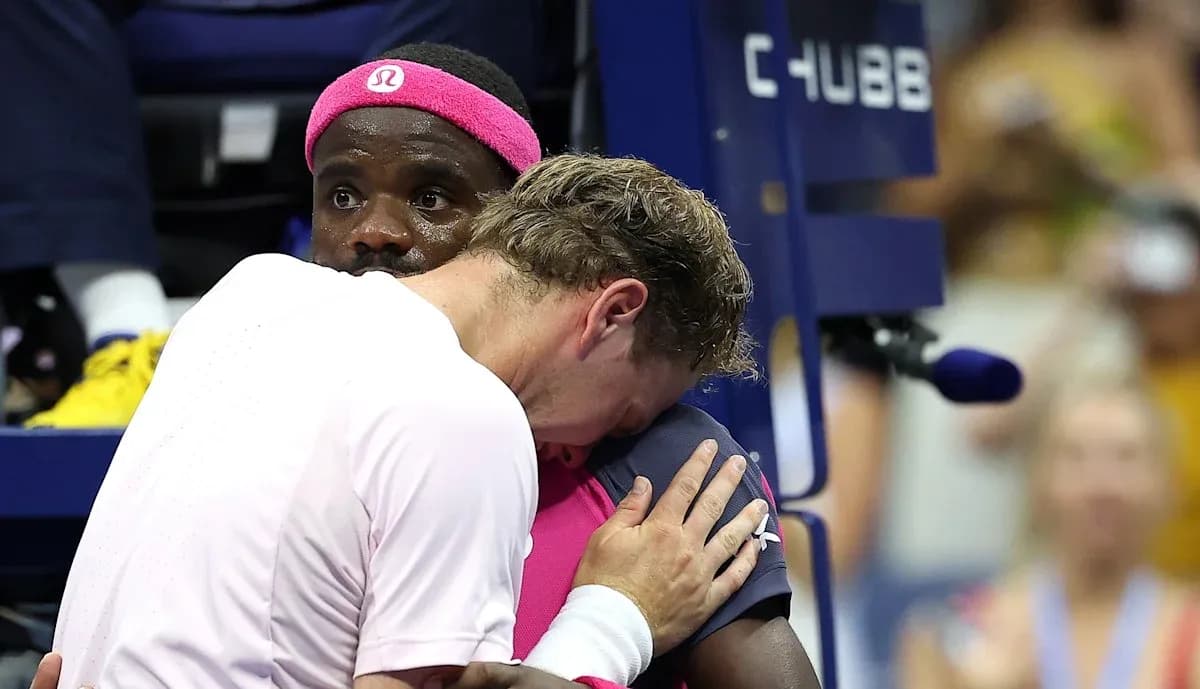
Alex Michelsen, the 22-year-old American, had Frances Tiafoe on the ropes in their quarter-final. For two sets, he cruised. He handled the moment, the stage, and the noise, and he handled Tiafoe, too. The scoreboard reflected it: two sets up, with the third only slipping away 7-5.
Then the match turned. Slowly at first. Then violently.
Tiafoe, seeded 11, began to claw back. Michelsen, so composed early, started to fray. From 3-0 up in the deciding set, he suddenly found himself under siege as Tiafoe dragged it back to 3-3. The comeback felt inevitable.
At 3-3, Michelsen stood on the brink of collapse. Tiafoe pressed, hunting the break that would complete the turnaround. Michelsen dug in and held, stopping the bleeding just in time. The match, already stretching deep into the New York afternoon, refused to let go.
By then, Arthur Ashe was running on fumes. This was still only the second afternoon match. It was already 6.35pm in the city, with the night session — Jessica Pegula v Emma Navarro followed by Ben Shelton v Carlos Alcaraz — still to come. Anyone holding a ticket for the evening might have been wise to reach for an energy drink.
The fifth set swung again. Michelsen surged to a 3-0 lead. Tiafoe, staring at a double break down, trailed 15-30 on his serve. Jim Courier, on commentary, called it “a crisis moment”. Tiafoe survived it, held, and then broke back.
“We’re closing in on four hours in this match,” came the call from the booth, the tension mirrored in the commentary as much as in the stands.
“He’s hanging in there with everything he’s got now,” Nick Lester said of Tiafoe, as the American refused to yield.
The emotional temperature on court climbed with every point. Michelsen, who had kept a tight lid on his emotions for most of the afternoon, finally boiled over after being broken early in the fourth set. Serving, he turned and barked at a fan behind him. A couple of points later, his racquet hit the court and his voice rose towards his box.
“First real visible signs of irritation from Michelsen,” Courier observed. “He has been pretty buttoned up, with only positive emotion coming out of him, until now.”
From there, the match became a test of nerve as much as talent. Michelsen had been “absolutely cruising,” as the narrative went, but now he was fighting his own frustration as much as Tiafoe’s forehand.
For Tiafoe, a victory from that position would rank as a stunning comeback. For Michelsen, whatever the final scoreline, it marked a brutal lesson in how quickly a big lead can evaporate on the sport’s biggest stages.
On a single day, tennis showed its full spectrum: a champion clinging on by her fingernails, a rising star learning heartbreak in real time, an American veteran digging himself out of a hole, and, far from New York, a former world No 3 watching her own club reduced to rubble.
The matches will move on, the draw will narrow, the stadium will fill again tonight. For Svitolina and for Ukraine’s athletes, the battle goes nowhere.