Frances Tiafoe's Epic Comeback Against Alex Michelsen
Frances Tiafoe didn’t just win a classic on Arthur Ashe. He walked through a storm, dragged his friend with him, and then held him up when it was over.
Down two sets, down a break in the third, staring at the exit door of his home slam, the 11th seed somehow clawed his way back to beat Alex Michelsen 5-7, 3-6, 7-5, 6-3, 7-6(10/6) and reach the US Open semifinals for the third time. Four hours and 38 minutes of chaos, tension and noise ended with a forehand passing shot down the line and a roar that shook Arthur Ashe Stadium.
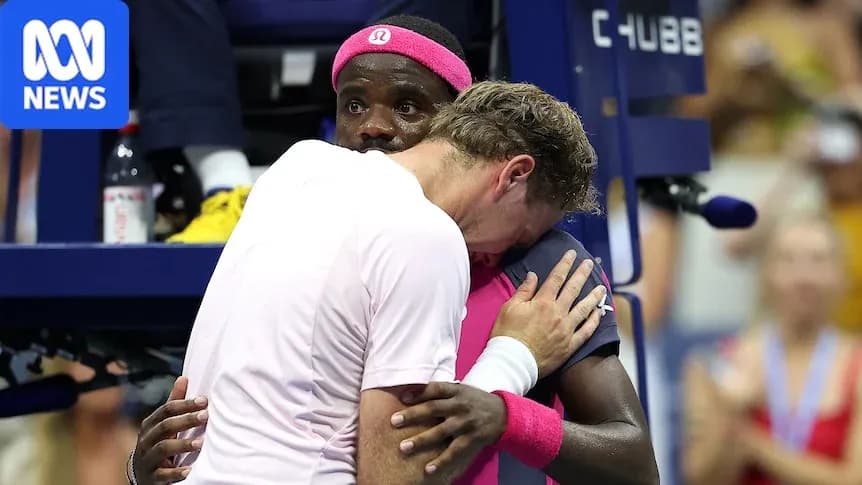
Then Tiafoe stopped. The celebration died on his lips. He turned and wrapped Michelsen in a long embrace as the 22-year-old, playing his first major quarterfinal, cried into his shoulder.
“As soon as I hugged him I saw he was crying already,” Tiafoe told ESPN. “I was like ‘Man I know. I’ve been there twice, lost in five.’ … He’s young and he hasn’t been there.”
This was supposed to be Tiafoe’s night. In truth, it belonged to both of them.
A Match That Wouldn’t End
Michelsen, unseeded and ranked No. 46 in the world, arrived at this tournament with little fanfare. His previous best at a slam was a fourth-round run at the 2025 Australian Open. In New York, he played like he’d been here for years.
He took the first set 7-5, then the second 6-3, serving big, striking clean, and refusing to blink in the face of the partisan crowd. He hit 21 aces, 55 winners, and for long stretches he dictated the terms of the fight. Tiafoe, so electric in the early rounds, looked flat, out of rhythm, almost emptied out.
Michelsen went up a break in the third and served for the match at 5-4. The stadium grew restless. Tiafoe looked cooked.
That’s when the match turned.
Tiafoe began to dig in, point by point, game by game. He broke back, then broke again, ripping forehands, feeding off the noise, dragging himself into rallies he had no business winning. He strung together seven straight games, stealing the third set 7-5 and racing to a commanding lead in the fourth, which he closed out 6-3.
“I slowly, slowly started getting my rhythm there,” he said later. The crowd had already sensed it: the veteran of big New York nights had finally arrived.
Michelsen Won’t Go Quietly
The younger American, though, refused to fold.
Just when it seemed Tiafoe had the match in a headlock, Michelsen punched back, racing to a 3-0 lead in the deciding set. His serve re-ignited, his forehand started to crack lines again, and the tension returned with a vengeance.
Tiafoe had to climb the mountain a second time.
He steadied. He tightened his patterns. He trusted the forehand that had abandoned him early. The decider wound its way to a 10-point tiebreak, the kind of coin flip that exposes nerves, lungs, and belief.
Tiafoe owned it.
He surged through the breaker 10-6, sealing it with that forehand pass down the line, a shot struck more in defiance than celebration. The roar came, the arms went up, Arthur Ashe shook—and then he saw Michelsen.
The joy stopped. The humanity took over.
“We’re super tight. We’ve always had a great relationship. We laugh and joke all the time. He’s one of my good buddies on tour,” Tiafoe said. “I know how much that hurts. I know how much he wanted that today. It’s something that you dream about.
“I just told him, ‘You’re going to be here so many more times, man. And I’m going to be in a rocking chair when you do.’”
Respect Earned on the Biggest Stage
Michelsen may have lost, but he left a mark.
He finished with those 55 winners, but also 61 unforced errors, the raw edge of a player still learning how to close on the biggest stage. He had Tiafoe on the ropes, served for the match, led in the fifth. On another night, against another opponent, he walks off a US Open semifinalist.
“He’s a hell of a player. I mean, he easily could have won today,” Tiafoe said.
Michelsen knew he’d let a huge chance slip, yet he still found perspective. After his fourth-round win he’d talked about improving, about trying to change things in his game. Now he’d tested all of that against a friend in one of the sport’s loudest arenas.
“He’s also an unbelievable guy and a very good friend of mine,” Michelsen said.
When it was over, he left Arthur Ashe with a towel over his head, arm raised to acknowledge the crowd that had just watched him grow up in real time. The ovation followed him all the way down the tunnel.
Tiafoe Marches On
Tiafoe, who had seemed to lose all the magic of his early campaign for two and a half sets, leaves this epic with his belief fully restored and his body tested to the limit. He will face either eighth seed Ben Shelton or defending champion Carlos Alcaraz next, a brutal assignment after such an emotional and physical drain.
He won’t care.
Nights like this are why he plays. Nights when a home crowd roars, when a friend stands across the net, when a match swings on courage as much as skill.
Tiafoe survived. Michelsen announced himself. And somewhere down the line, when that “rocking chair” prediction comes true, this quarterfinal may be remembered as the night American tennis passed a torch, even if the scoreboard said only one man moved on.