Coco Gauff Stages Comeback Against Andreeva, Prepares for Rybakina
For half an hour, Arthur Ashe Stadium watched a defending champion unravel.
Coco Gauff’s serve misfired, her forehand sprayed, and Mirra Andreeva – the 17-year-old French Open champion playing with the freedom of youth – ripped through the opening set in 26 ruthless minutes. Gauff managed just three winners, bled 14 unforced errors and dropped it 6-2. The scoreline flattered her.
The 2023 US Open winner looked tight, rushed, almost disconnected from the ball. Andreeva, by contrast, saw a court the size of a football pitch. Every Gauff second serve invited an attack. Every short forehand got punished. The crowd, ready for a coronation, got a shock instead.
Gauff needed a reset. She took it in the only quiet place left in the stadium: the bathroom.
There, she later admitted, she thought of Frances Tiafoe and his own comeback the previous night. Another American, another escape act. If he could turn chaos into victory, why couldn’t she?
When she walked back on court, the tennis didn’t suddenly become perfect. But the body language changed. The feet moved faster. The shoulders loosened. She stopped donating free points and started asking questions.
The match tightened. So did Andreeva.
The Russian fifth seed, who had been swinging so freely, now had to close. That’s different pressure. The second set turned into a knife fight, games stretching, rallies lengthening, both players struggling with their serves and their nerve. As Tim Henman put it on Sky Sports, two brilliant ball-strikers suddenly became “so tight and so nervous” that the ball speed dropped and dropped again.
It all funneled into a tiebreak that will haunt Andreeva for a long time.
Twice she stood within a point of the semi-finals. Twice she blinked. The forehands that had pierced the lines in the first set drifted long, the backhand lost its depth, and Gauff – stubborn, gritty, almost running on willpower alone – dragged the breaker to 9-7 and the match into a third set.
The pressure finally broke Andreeva’s composure.
As the second set slipped away, she hurled her racket toward her chair in frustration. It skidded and spun dangerously close to a camera operator, who had to move quickly to avoid being hit. For a moment, the spectre of a default hovered over the court. She escaped punishment, but not the momentum shift.
From there, only one player looked like a defending champion.
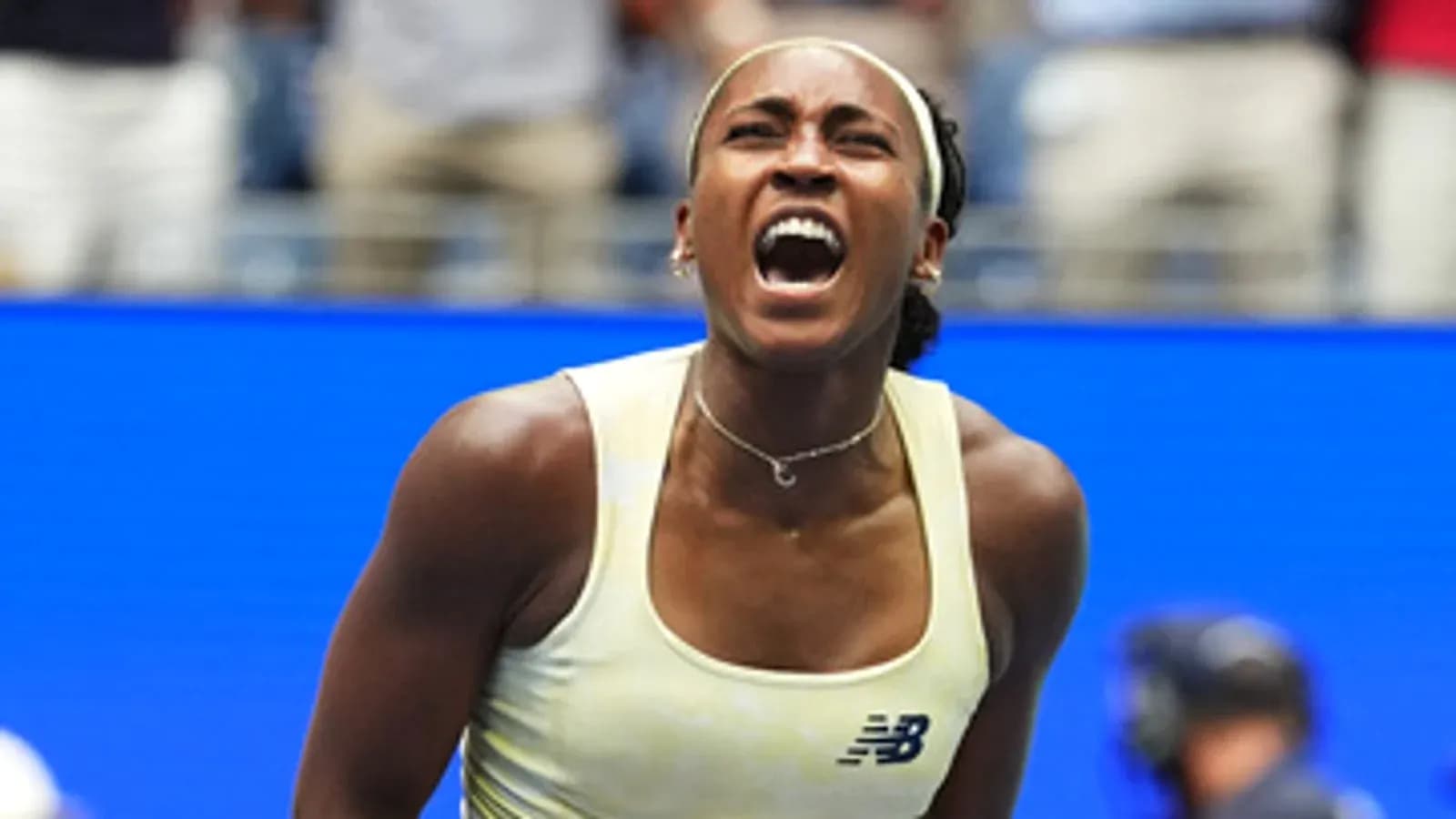
Gauff surged through the decider 6-2, her game at last resembling the version that lifted the trophy here a year ago. The serve found its spots. The forehand, while still streaky, held up when it mattered. The crowd, which had spent most of the night anxious and subdued, finally roared in full voice.
She closed it out 2-6 7-6 (7) 6-2, a scoreline that tells only a fraction of the story.
“I just had to reset,” Gauff said on court. She spoke of not feeling the ball at the start, of gifting Andreeva too many cheap points, of thinking of Tiafoe in that bathroom break and deciding she wanted to leave the court with no regrets. She also pointed straight at the stands: the crowd, she said, helped pull her through.
From the commentary box, Marion Bartoli didn’t bother dressing it up. “Pure heart,” she called it. The level came and went, the numbers were messy, but Gauff found a way. That, Bartoli argued, is what separates the very few. “Coco Gauff is one of the only players in the world capable of winning a match like that.”
For Andreeva, the pain will linger. Two match points at the US Open, against the reigning champion, and a semi-final on her racket. Henman predicted a “very difficult defeat” to process, but also a rich lesson. At 17, she has time. Nights like this cut deep, then harden champions.
Gauff, though, doesn’t get long to dwell. Her reward for surviving the teenager is a semi-final against the new world No 1.
Rybakina rises to the summit
Earlier in the day, Elena Rybakina walked off court with a different kind of milestone.
By beating Qinwen Zheng 3-6 6-1 6-4, the 27-year-old from Kazakhstan guaranteed she will take over as world No 1 on Monday, ending Aryna Sabalenka’s 99-week stay at the top. It doesn’t matter what Sabalenka does from here, even if she completes a hat-trick of titles. The ranking belongs to Rybakina now.
She treated it like a checkpoint, not a destination.
“It’s just a number right now, I’m only in the semis and the goal is to win every tournament I play,” she said. The message was clear: enjoy the moment, but don’t get lost in it. “I feel like I just need to focus on my game and enjoy tomorrow.”
Her path against Zheng wasn’t smooth. For the first time this fortnight, Rybakina dropped a set. She started flat, negative by her own admission, bleeding unforced errors as Zheng – running on adrenaline after nearly 12 hours on court through qualifying and the main draw – pounced to take the opener 6-3.
Rybakina’s response was emphatic. She ripped through the second set 6-1, the weight of shot returning, the forehand finally dictating. The match settled into a straight fight from the baseline. When the third set tightened, the new No 1 played like one.
Henman praised the way she raised her aggression from the back of the court and “showed her class” when it mattered most. Zheng, whose Emma Raducanu-style run from the qualifiers had lit up New York, finally ran out of fuel. The 23-year-old Chinese player leaves with her ranking surging back toward the top 50 after elbow surgery had dragged her down to 121.
Rybakina leaves with something more: a first US Open semi-final, the No 1 ranking, and a shot at the woman who refuses to lose on this court.
Gauff, the defending champion who just escaped a teenager’s ambush. Rybakina, the new world No 1 with a Grand Slam title already in her pocket and a game built for the big stage.
One playing with the roar of home behind her. The other playing with the weight – and confidence – of being the best in the world.
Only one will still be standing on Saturday.