Germany Dominates Serbia 3-1 in UEFA Nations League
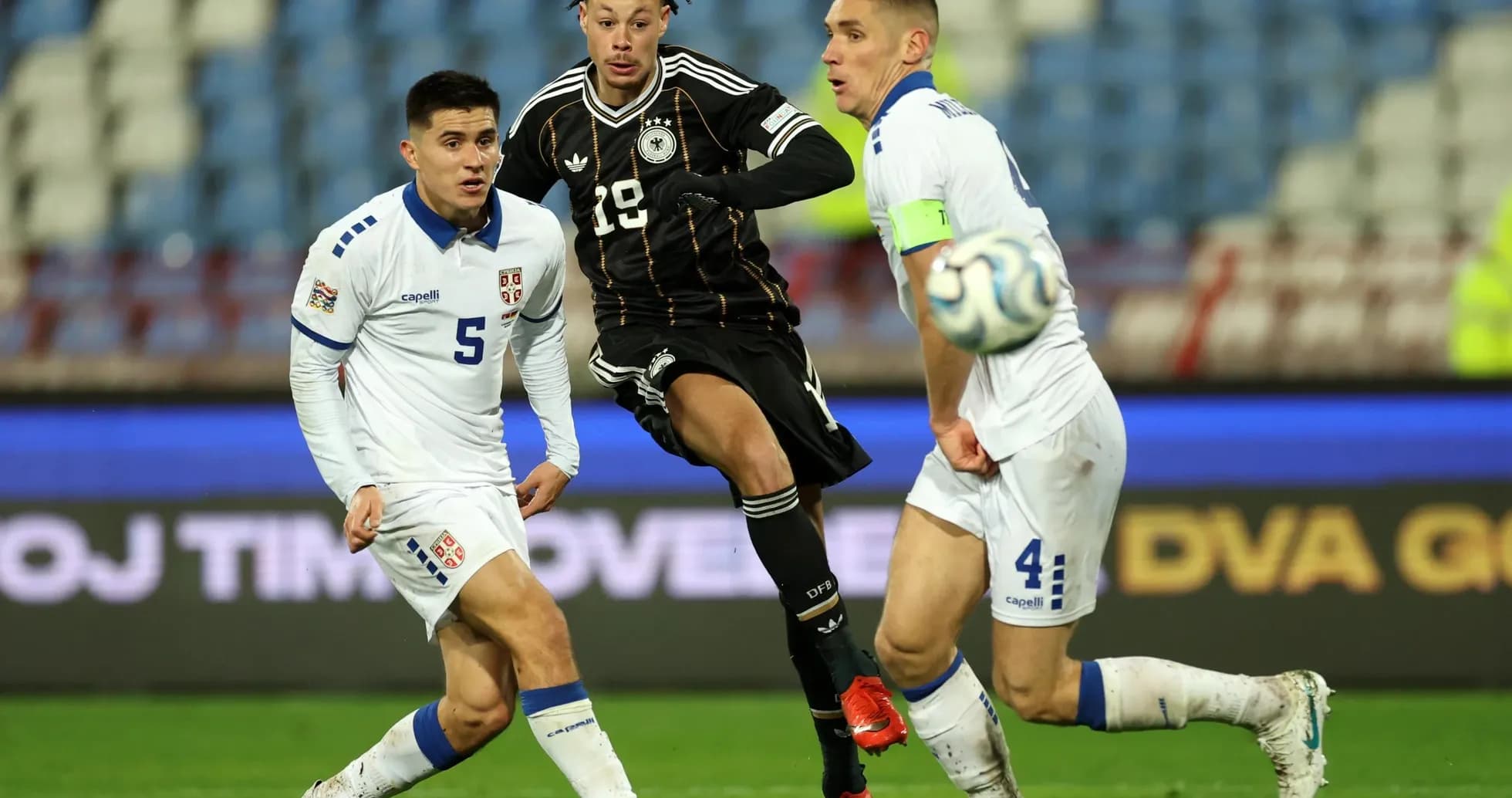
Serbia 1-3 Germany at Rajko Mitić Stadion in Belgrade, UEFA Nations League League A - 5. Goals came via a Srdjan Babic own goal credited to Germany (3'), Florian Wirtz (14'), Brajan Gruda (50') for Germany, and Srdjan Babic (56') for Serbia, while Serbia finished with two reds shown to Vanja Dragojević (76') and Andrija Živković (89'). The result leaves Serbia stranded on 0 points in 4th place in League A - Group B, while Germany move to 11 points and remain 3rd in the group’s possible play-off zone.
Match Results & Key Stats
- Result: Serbia 1-3 Germany
- xG: 1.32 vs 2.73
- Possession: 21% vs 79%
- Shots on Target: 3 vs 6
- Goalkeeper Saves: 3 vs 2
- Blocked Shots: 1 vs 6
Germany’s three-goal win broadly reflected the underlying numbers: they generated higher xG (2.73 vs 1.32), far more total shots (22 vs 5) and dominated possession (79%), while Serbia’s threat was largely limited to set pieces and isolated moments rather than sustained pressure.
Goals and Highlights
- 3' — Srdjan Babic (own goal, credited to Germany) — unassisted
- 14' — Florian Wirtz (Germany) — unassisted
- 41' YELLOW CARD — Brajan Gruda (Germany) — Foul
- 50' — Brajan Gruda (Germany) — assisted by Joshua Kimmich
- 56' — Srdjan Babic (Serbia) — unassisted
- 62' YELLOW CARD — Srdjan Babic (Serbia) — Foul
- 75' VAR — card upgrade confirmed involving Vanja Dragojević (Serbia)
- 76' RED CARD — Vanja Dragojević (Serbia) — Serious Foul
- 87' YELLOW CARD — Petar Sukacev (Serbia) — Foul
- 89' YELLOW CARD — Andrija Živković (Serbia) — Dissent
- 89' RED CARD — Andrija Živković (Serbia) — Abusive Language
Germany seized control almost immediately. On 3' a deep German delivery caused chaos in the Serbian box, and Srdjan Babic inadvertently diverted the ball into his own net, handing Germany a 1-0 lead without any real creative work required from the visitors. Serbia, set up in a 5-3-2, tried to settle into a compact block, but Germany’s 4-2-3-1, with Florian Wirtz floating between the lines, kept pulling the back five out of shape.
The structural superiority told again on 14', when Germany doubled their advantage. 14' Germany — Florian Wirtz broke into the left half-space, collected a loose ball and drove at the retreating defence before finishing with a precise strike, unassisted, for 2-0 Serbia 0-2 Germany. With Serbia struggling to string passes together against Germany’s press and enjoying just 21% possession overall, they were largely reduced to long clearances and hopeful transitions. Germany were comfortable enough that Brajan Gruda’s 41' yellow card for a foul came from an aggressive counter-press rather than any defensive desperation.
At half-time, Serbia sought to inject more attacking impetus. On 45' Andrija Živković replaced Lazar Samardzic, and simultaneously Vanja Dragojević came on for Stefan DŽodić, signalling a shift towards more energy in midfield and wide areas. Yet Germany resumed after the interval with the same control. On 50' Germany — Brajan Gruda, fed on the edge of the box by Joshua Kimmich, stepped inside and finished clinically, Kimmich’s assist capping a well-worked move through midfield to make it Serbia 0-3 Germany and effectively kill the contest.
To their credit, Serbia responded quickly. On 56' Serbia — Srdjan Babic rose highest to meet a set-piece situation and powered home unassisted, pulling the score back to Serbia 1-3 Germany and briefly reviving the crowd. The centre-back’s goal partly atoned for his early own goal, and for a short spell Serbia pushed higher, looking to turn the match into a more direct, aerial battle. However, Babic’s increasing involvement at both ends also carried risk, and on 62' Srdjan Babic (Serbia) received a yellow card for a foul as he stepped out aggressively to halt a German break.
Paunović continued to chase the game with further changes. On 64' Vladimir Lucic replaced Dušan Tadić, adding legs in midfield at the expense of Serbia’s most creative forward, while on 71' Aleksandar Mitrović came on for Mihajlo Cvetkovic to give Serbia a more traditional penalty-box target. Germany, sensing the match could become stretched, turned to their bench to stabilise. On 73' Ridle Baku replaced Philipp Treu at right-back, adding fresh running on the flank, and on 74' Tom Bischof came on for Aleksandar Pavlović while Niclas Füllkrug replaced Kai Havertz, providing a focal point up front and preserving energy in midfield.
The game’s decisive disciplinary flashpoint arrived in the 75'-76' sequence. On 75' a VAR review checked a challenge by Vanja Dragojević, with the on-field decision upgraded after video inspection. 75' a VAR intervention confirmed a card upgrade involving Dragojević, and on 76' Vanja Dragojević (Serbia) was shown a red card for a serious foul, leaving Serbia down to ten men and effectively extinguishing any realistic comeback prospects. Germany, already dominant in possession and shots, now enjoyed even more space to circulate the ball and manage the tempo.
Klopp used the advantage to rotate his attacking midfielders. On 81' Felix Nmecha replaced Florian Wirtz, and on 86' Said El Mala came on for Brajan Gruda, both changes aimed at maintaining control rather than chasing further goals. In the same 86' minute, Serbia withdrew Sergej Milinković-Savić, introducing Vasilije Kostov as legs in a now damage-limitation exercise. With Germany content to keep the ball and Serbia pinned deep, frustrations grew in the hosts’ ranks.
The closing minutes were increasingly ill-tempered. On 87' Petar Sukacev (Serbia) was booked for a foul as he tried to halt yet another German attack down the flank. Two minutes later, tension boiled over around the referee. On 89' Andrija Živković (Serbia) first received a yellow card for dissent after protesting a decision, and in the same minute he was shown a straight red for abusive language, reducing Serbia to nine men and encapsulating their collapse in discipline. Germany saw out the remaining time without alarm, relying on their 79% share of the ball and 22 total shots to keep Serbia at arm’s length and close out a controlled 3-1 away victory.
Standings Update & Seasonal Impact
Serbia remain bottom of League A - Group B in 4th place and stay locked on 0 points, with their goals for tally now at 5 and goals against at 14, worsening their goal difference from -7 to -9 and leaving them firmly in the “Possible Relegation” zone. Germany’s win moves them from 8 to 11 points in 3rd place, with their goals for rising from 6 to 9 and goals against from 3 to 4, improving their goal difference from +3 to +5 and consolidating their position in the group’s “Possible Play-off” bracket while keeping pressure on the sides above them.
Starting Lineups
Serbia Starting XI
- GK: V. Milinković-Savić
- DF: K. Nedeljković, N. Milenković, S. Babić, S. Gudelj, P. Sukacev
- MF: L. Samardžić, S. DŽodić, S. Milinković-Savić
- FW: M. Cvetković, D. Tadić
Germany Starting XI
- GK: M. ter Stegen
- DF: P. Treu, M. Thiaw, J. Tah, M. Mittelstädt
- MF: J. Kimmich, A. Pavlović, B. Gruda, F. Wirtz, D. Scherhant
- FW: K. Havertz
Post-Match Verdict
Germany were dominant (79% possession, 22 shots to 5, xG 2.73 to 1.32), using their 4-2-3-1 structure to overload central zones and pin Serbia’s back five deep, while sustained pressure forced the early own goal and created repeated high-quality chances. Serbia were reactive and vulnerable (conceding 22 shots and 6 shots on target), relying on set pieces and Babic’s header for their main threat, and once reduced to ten and then nine men — reflected in their tally of 3 yellow cards and 2 reds — they lacked the control or discipline to mount any sustained response. Germany’s midfield axis of Kimmich and Pavlović/Bischof dictated tempo (844 total passes with 786 accurate), allowing the visitors to manage the game after going 3-0 up and to close out a controlled, tactically assured away win that underlined the gulf in both execution and composure between the sides.