Harriet Dart's Journey from Drought to Victory at US Open
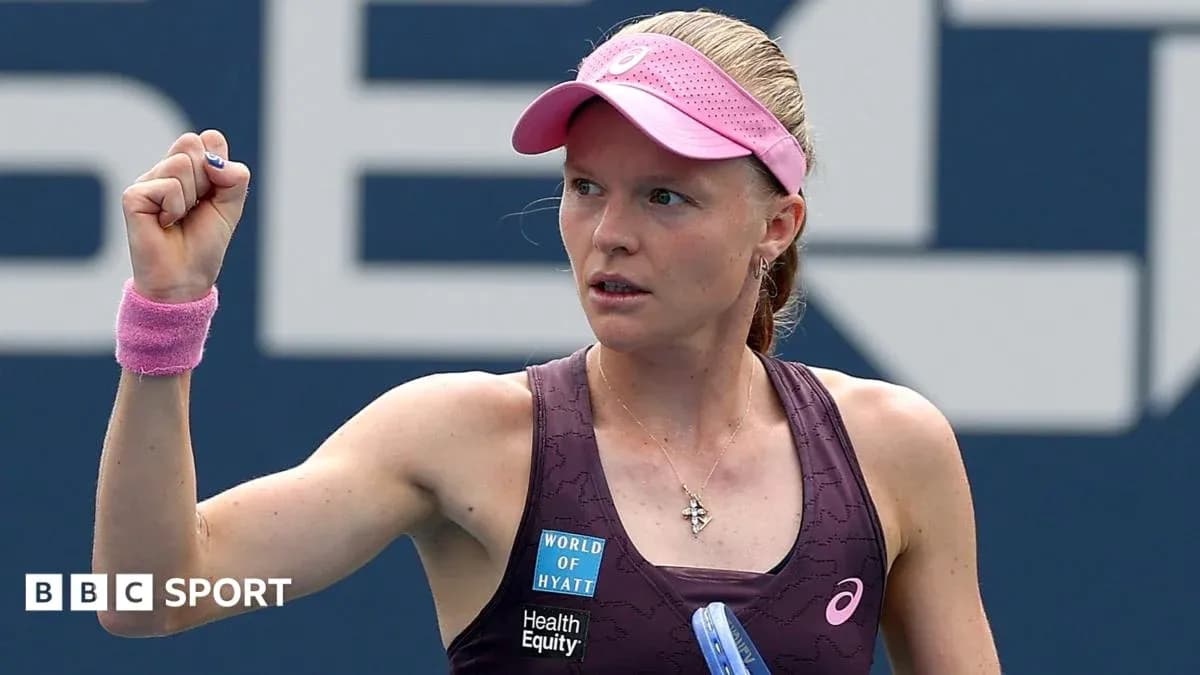
Harriet Dart had waited 19 long months for this feeling. On a muggy New York afternoon, with her own pocket of Britain roaring her on from the stands, she finally got it back.
The 30-year-old Briton, flanked by parents, uncle and a scattering of cousins in what she calls her “home away from home”, clawed her way from the brink to beat American Peyton Stearns 3-6 6-3 6-2 and reach the US Open second round.
From drought to defiance
This is not a player who has cruised through the calendar. Dart had not won a main-draw singles match at a Grand Slam since the 2025 Australian Open, where she also reached the second round. Since then, the majors have mostly shut their doors.
She failed to qualify for four of the next six Slams. At Wimbledon, where she was twice handed wildcards, she exited at the first hurdle both times. The stage she craves kept spitting her out.
Even her path to New York’s main draw hinted at more toil. Three qualifying rounds, three-set epics every time, and in two of them – against Kristina Penickova and Heather Watson – she lost the opening set. Dart didn’t so much arrive at Flushing Meadows as stagger in, battle-scarred but still swinging.
So when Stearns, ranked more than 75 places above the world number 131, came out firing, it felt like a familiar script.
A brutal start, a stubborn response
The match opened with a chance. Four break points in the very first game for Dart. Four chances missed. Stearns slammed the door and didn’t open it again in that set.
The American then went to work on Dart’s serve, leaning on it, testing it, stretching every service game. The pressure broke in the eighth game; Stearns took the break, then the set, 6-3, without offering another look at her own delivery.
When Dart was broken again in the opening game of the second set, the situation looked bleak. One set down, a break down, the home player rolling, the crowd ready to surge behind her.
That’s where Stearns blinked.
Her aggression, so effective early on, began to spill over the lines. She finished with 40 winners, but they came wrapped in 47 unforced errors. Dart, who has never been shy of a scrap, started to make those numbers hurt.
She steadied. She dug in. She began to drag Stearns into longer rallies, forcing the American to hit one more ball, then another. The errors came. One break back, then another. The set flipped. Dart took it 6-3 and suddenly the match belonged to the player who simply refused to go away.
The Bartoli influence and a turning tide
Dart’s reaction at the end told its own story. As soon as the final point landed, she sprinted towards her team, where a familiar Grand Slam champion now sits in her corner.
Marion Bartoli, the 2013 Wimbledon winner, joined Dart’s camp in January. This result slots neatly alongside a quarter-final run at July’s Challenger event in Vancouver and qualification for the Cincinnati Open in August, signs that the work is starting to show on the scoreboard.
“From her experience, she knows what I'm going through, how I'm feeling, how the day starts, how it finishes – everything from the little things to the big things,” Dart said of Bartoli. “To be able to soak up everything, all of her experience, and learn from her – I feel I'm learning so much every time we speak. I feel like I'm improving at a lot of things which motivates me.”
The partnership has given Dart a roadmap. New York gave her a stage to follow it.
Family, community, and a decisive third set
This was not a lonely fight. Dart talked about the family scattered around the city: an uncle and cousins based in New York, another cousin flown in from the UK, her mother on site since qualifying began, her father landing the night before the match.
“New York always feels like a home away from home,” she said. “It feels like a community for me and I really felt the support out there.”
On court, that backing mattered when the third set tightened. The decider began as a scrap, three consecutive breaks leaving the set on a knife edge. Every service game felt like a test of nerve as much as technique.
Dart passed the biggest one.
Serving at 3-2, she faced the moment that would decide whether the match became a sprint to the line or another twist in a long afternoon. She held, a crucial, gritty hold in the sixth game that finally snapped the run of breaks and shifted the match firmly onto her racket.
From there, she pressed. Stearns’ error count continued to climb, Dart’s resolve hardened, and by the time the Briton reached a fourth match point, the outcome felt inevitable. She converted, closing out a win that took just under two and a half hours but has been, in truth, much longer in the making.
A long-awaited platform
This victory does more than move Dart into round two, where 25th seed Marie Bouzkova awaits. It restores a foothold at the level she has been fighting to stay part of.
She now joins compatriots Toby Samuel and Katie Boulter in the second round, part of a British group trying to punch above its seeding in New York.
For Dart, who has spent the past year and a half wrestling with qualifying draws, wildcards and early exits, this felt like a small turning point. Not a breakthrough, not yet. But a reminder – to herself as much as anyone – that she can still win these matches on these courts, with this noise around her.
The question now is whether this night in her “home away from home” becomes a one-off release, or the start of a sustained return to the Grand Slam stage she has been chasing for so long.