Holger Rune's Comeback: Signs of Life After Injury
Holger Rune is only three tournaments into his comeback, but the numbers don’t really capture what’s happening. The rust is still there, the results are mixed, yet the trajectory is unmistakable: the former prodigy is starting to look like himself again.
This has been a long road back, and a brutal one.
From Davis Cup to early exits
Rune’s first steps came at the Davis Cup, a low-key reintroduction after a near year-long absence. The real return, though, started in Japan. There, in his first official ATP Tour event since the injury, the 23-year-old was swept aside by Kyrian Jacquet in a one-sided defeat that underlined just how far he still had to go.
He knew it. He apologised for the level he produced, an unusual public admission from a player of his stature, and then walked straight into another early exit in Shanghai. Nobody who understood the scale of his layoff was shocked. Nearly a year out with a serious Achilles problem does not dissolve in a couple of matches.
But Shanghai was different in one crucial way: the quality began to flicker back. Rallies stretched a little longer. The timing on the backhand sharpened. The legs, still short of full power, at least started to move with more conviction. Those were hints, not headlines.
Basel changed that.
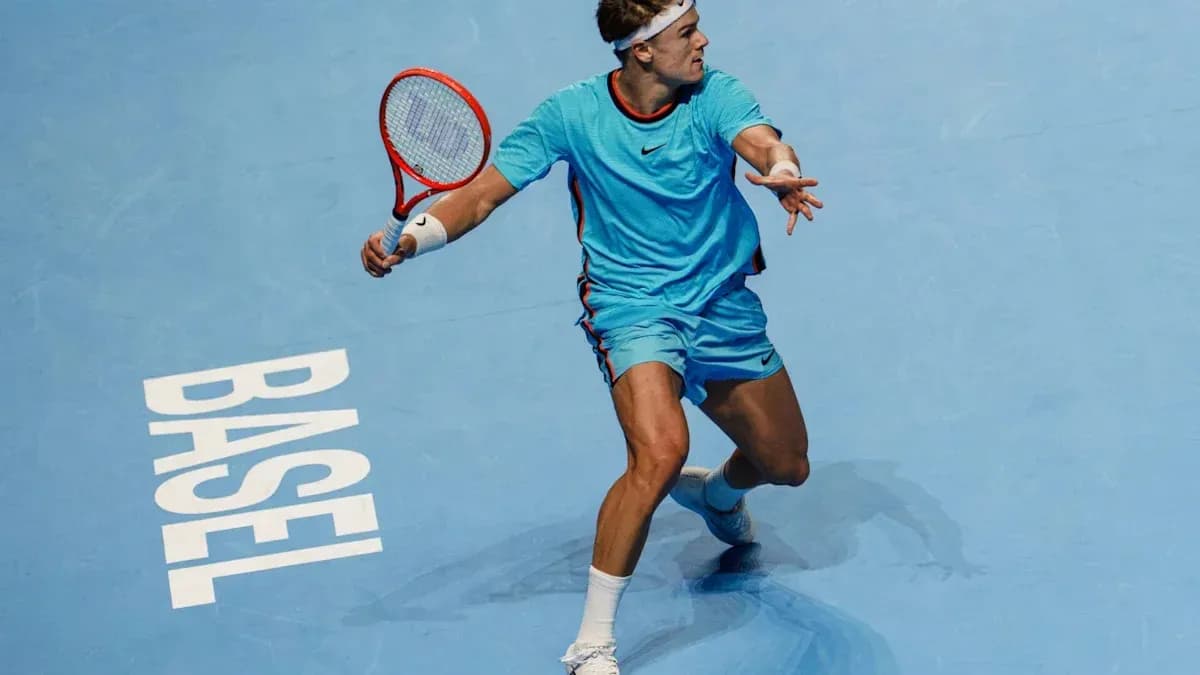
Basel brings real signs of life
Rune’s decision to pull out of Brussels before that was widely accepted as the only sensible call. He needed to manage his body, not chase ranking points. The question was how he would respond once he did step back on court.
In Basel, he answered it.
His first win back came against Quentin Halys, and it did not come easily. Rune had to dig through three sets and a deciding-set tiebreak, a proper test of both nerve and conditioning. He passed it. The movement held up, the forehand didn’t abandon him in the tight moments, and he looked willing to suffer again. That mattered more than any clean stat line.
Then came the real statement: a gritty, high-quality victory over Hubert Hurkacz, one of the form players on tour. Again, Rune went the distance. Again, he found a way through in a third-set tiebreak. Those are the sort of matches you don’t win if the body isn’t responding or the confidence isn’t returning.
These back-to-back battles said plenty about his fitness work during rehab. The shot-making was still there, the competitive edge hadn’t dulled, and the engine — while not yet at full throttle — could handle sustained pressure.
A three-set loss to Valentin Vacherot followed, but it barely dented the mood around him. Rune competed. He pushed. He stayed in the fight. For a player who had gone 373 days without a tour-level victory, the bigger story was that he once again looked like a man capable of building a season, not just surviving one match.
Give him a full off-season, and Australia suddenly looks less like a tentative relaunch and more like a genuine platform. Titles will be back on his agenda soon enough if this curve continues.
Eleven months of waiting
To understand why there is so much optimism around what, on paper, is a modest run, you have to rewind to where this all started.
Rune’s season – and almost his career momentum – cracked in Stockholm. In the semi-final against Ugo Humbert, he led by a set and looked in control. Then came the moment every athlete dreads: the Achilles injury, on 18 October 2025, that instantly turned a promising week into a long, uncertain exile.
While the tennis world pored over the frustrations of Carlos Alcaraz’s five-month absence and Jannik Sinner’s early shutdown, Rune quietly endured something even more drawn out. His return to official ATP action did not come until 1 October this year. That gap – 348 days, or 11 months and 13 days – is an eternity in a sport that barely pauses.
And the wait for a win stretched even longer. Not until Basel, against Halys, did he finally snap a 373-day drought at tour level. More than a year between victories for a player of his talent is not just a statistic; it’s a test of identity.
That’s why these recent steps matter. They are not just about scorelines in Japan, Shanghai, or Basel. They’re about a player rebuilding trust in his own body, re-learning the rhythms of matchplay, and rediscovering the edge that once made him one of the most dangerous young names on the circuit.
The optimism around Holger Rune isn’t built on nostalgia. It’s built on the unmistakable sense that, after almost a year in the dark, he has finally started climbing again — and the real ascent may only just be beginning.