Iga Swiatek's Challenging 2026 Season and Path Forward
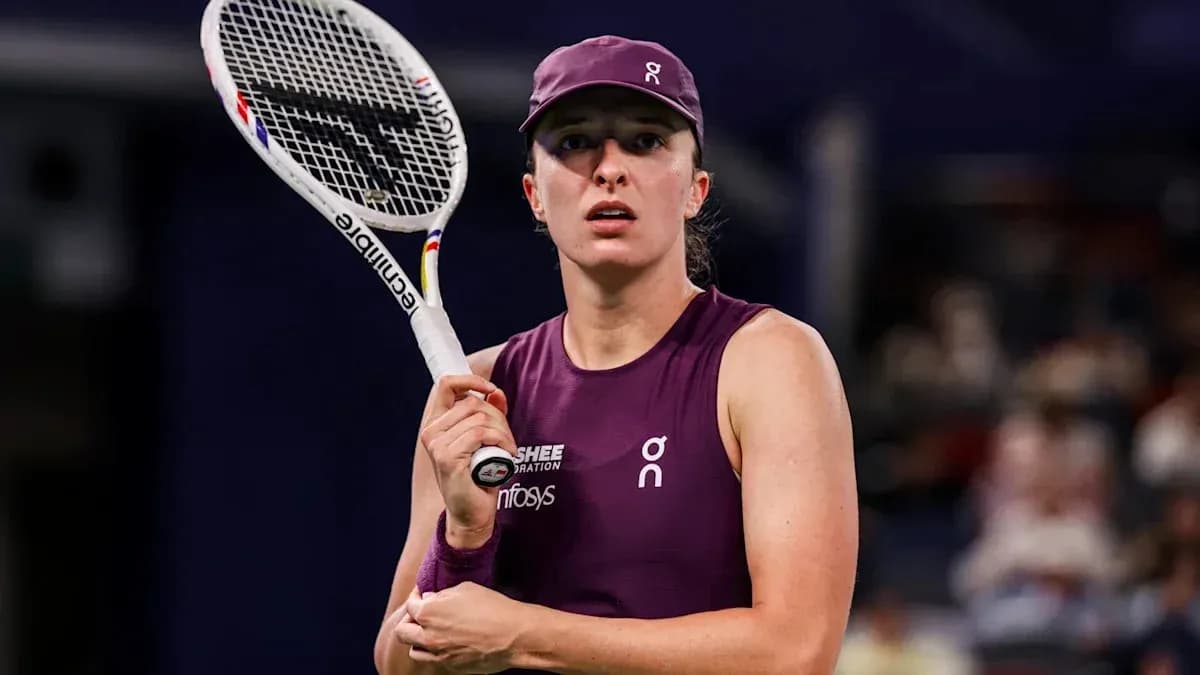
Iga Swiatek has spent most of her career making the extraordinary feel routine. This year, for the first time in seven seasons, reality bit back.
The former world No. 1 failed to qualify for the WTA Finals, a jarring line on a résumé built on dominance and relentlessness. The dip was most visible where the lights burn brightest: the Grand Slams. Quarter-finals in Australia, fourth rounds in Paris and New York, and a third-round exit at Wimbledon, where she arrived as defending champion, told the story of a year that never quite caught fire.
When a player of Swiatek’s stature stumbles, the noise comes quickly. And loudly.
Under the microscope
The criticism came from all angles. Some pointed at her coach, Francisco Roig. Others questioned the influence of sports psychologist Daria Abramowicz. Many simply turned their frustration on Swiatek herself, accusing her of failing to live up to the impossibly high bar she had set in previous seasons.
On the “What’s the Point” podcast, Swiatek didn’t dodge the conversation. She understood the disappointment, even empathised with it.
“If I was a fan of someone, I would also be disappointed if they lost early and I did not have a chance to watch them,” she said, acknowledging that supporters had grown used to pencilling her into semi-finals and finals before tournaments even began. After years of near-flawless consistency, fans had started buying tickets for the business end of events, assuming she’d be there.
Tennis, she reminded everyone, doesn’t work like that.
She spoke candidly about the expectations that trail her into every arena now. She knows why people assume she should be in every final. She also knows that the level she produced in 2022, 2023 and 2024 is not something any player can guarantee on command, year after year.
Fans, criticism and a line she won’t accept
Swiatek doesn’t bristle at all criticism. Far from it. She admitted that most of what comes from fans is manageable, even when it stings. Social media, of course, has its darker corners.
She accepts that some comments are “super hateful” and “not acceptable,” but she’s learned to reframe the more common, slightly “judgy” remarks. When fans try to “coach” her from their keyboards, she chooses to see it as a sign they care, that they invested in her success. They may not fully understand the sport’s demands, but their emotional investment still counts for something in her mind.
There is, however, one boundary she draws clearly.
“The only thing that hurts me a bit more is when the journalists are being mean and judgy, and they are supposed to be experts, but they have never been on tour or been in a tennis tournament,” she said.
That, for her, is different. When those with a platform and a supposed expertise go beyond analysis and into what she sees as personal or unfair territory, it cuts deeper. She knows those opinions don’t just vanish into the ether; they shape narratives, influence how fans see her and, in some cases, harden perceptions.
“I can totally understand the negative comments from the fans,” she continued. “But from people who are supposed to know something about the sport, if they do too many mean things, this is not right for me.”
It was a rare glimpse into the emotional toll of a season in which she took more hits off the court than on it.
A season that steadied late
For all the focus on her ranking drop – she ends the year at No. 9 – the second half of Swiatek’s 2026 campaign quietly shifted in the right direction, particularly at WTA 1000 level.
The year began unevenly: a quarter-final in Doha, another in Indian Wells, a second-round exit in Miami, and a third round in Madrid. For a player used to hoisting trophies, those results felt underwhelming.
Then the tide turned.
She reached the semi-finals in Rome, a familiar hunting ground, and from there her hard-court form sharpened. In Canada, she found her groove and went all the way, lifting the title and reminding the tour – and herself – of the level that once made her untouchable. She backed that up with a semi-final in Cincinnati, then another in Wuhan, with a quarter-final in Beijing (China Open) in between.
The names that stopped her – Maria Sakkari, Elina Svitolina (twice), Magda Linette, Ann Li, Jessica Pegula, Elise Mertens, Maja Chwalinska – underline another truth of this season: the field is deep, and no match is a formality, even for a multiple Slam champion.
Still, the pattern was clear. As the year wore on, her results hardened. The foundation for a resurgence is there.
Brisbane, not United Cup, and a new chapter
Poland’s United Cup triumph in 2026 had been a bright start to that season, and Swiatek has often used the team event as her launchpad. This time, the script changes. Instead of leading her country again, she is expected to open 2027 in Brisbane.
The Brisbane International begins on January 3, and it offers something she may quietly welcome: a cleaner slate, a more traditional build-up, and a chance to reset away from the added weight of national expectations in week one.
She arrives not as the runaway No. 1, not as the automatic favourite in every draw, but as a dangerous No. 9 with a point to prove and a game that showed enough in the latter half of 2026 to suggest the climb back to the top five may not take long.
The critics will still be there. The scrutiny won’t ease. The margin for error at the top of the women’s game has never been slimmer.
What changes now is how Swiatek answers it – not in podcasts or press rooms, but in the only place that has ever truly defined her: on court, with the racket doing the talking.