Italy's Tactical Mastery Shines in 3–1 Victory Over France
Under the floodlights of San Siro, Italy’s 3–1 victory over France felt less like a one-off statement and more like the crystallisation of two emerging identities in League A – Group A of the UEFA Nations League. Following this result, both sides remain locked on 10 points, but Italy’s superior goal difference – 11 goals for and 6 against overall, a +5 margin – underlines how this young Azzurri side is learning to turn promise into control.
I. The Big Picture – Structures and Seasonal DNA
Roberto Mancini doubled down on Italy’s seasonal blueprint: a 4-3-3 that has become the default shape in this campaign, used in 2 matches officially but clearly embedded as the structural reference. At home, Italy have been expansive and volatile – 6 goals scored and 4 conceded in 3 home fixtures, with a home scoring average of 2.0 and conceding 1.3. This match fit that pattern: high tempo, aggressive spacing, and a willingness to trade territory for verticality.
Across 5 Nations League games overall, Italy’s 11 goals have come in distinctive waves. The 16–30 and 61–75 minute windows are their main offensive surges, each accounting for 36.36% of their goals. That timing profile matters: this is a side that accelerates once it has scanned the opponent, then strikes in repeated bursts rather than steady pressure. Defensively, Italy’s vulnerabilities have been clustered between 46–75 minutes, with 66.66% of their goals conceded in that middle-third of the game.
France arrived with a different rhythm. Zinedine Zidane’s 4-2-3-1 has been used as a reference at least once officially, but the broader numbers sketch a team that plays in pulses and often finishes stronger than it starts. On their travels, France have taken 6 points from 3 away matches, scoring 3 and conceding 3, a restrained away scoring average of 1.0 but matched by a 1.0 conceded. Overall, they have scored 8 and conceded 5, a +3 goal difference, with a striking 62.50% of their goals arriving between 76–90 minutes. This is a side that habitually comes alive late.
Yet at San Siro, that late surge never truly materialised. Italy’s capacity to manage the final quarter, usually a French domain, was the quiet tactical story behind the headline scoreline.
II. Tactical Voids and Discipline – Where the Edges Were
With no listed absentees, both managers had close to full tactical decks. That made selection a statement rather than a compromise.
Mancini trusted a back four of M. Kayode, G. Scalvini, A. Bastoni and R. Calafiori in front of G. Donnarumma. It is a line built for proactive defending rather than pure containment. Italy’s season data shows no clean sheets either at home or away, but also a refusal to retreat – they have never parked the bus, even when under pressure. The price has been a goals-against average of 1.2 overall and a complete absence of clean sheets, yet the reward is an attack that averages 2.2 goals per game in total.
Discipline-wise, Italy live on the edge. Their yellow-card distribution shows 27.27% of cautions arriving between 61–75 minutes and another 27.27% between 91–105, a clear sign of late-game strain and tactical fouling when managing leads. In a match against a late-surge team like France, that risk profile could have been fatal. Instead, Italy’s game-state management improved: they absorbed pressure without tipping into chaos.
France’s disciplinary profile is more volatile. A red card has already arrived between 76–90 minutes in this campaign, and D. Upamecano sits among the top yellow-carded players in the competition with 2 yellows and 1 yellow-red in just 3 appearances. His defensive output is substantial – 4 tackles, 3 blocked shots and 7 interceptions – but his aggression is a double-edged sword. In a 4-2-3-1 that often leaves the centre-backs exposed during transitions, his tendency to step in front can either kill counters or ignite them.
III. Key Matchups – Hunter vs Shield, Engine Room vs Engine Room
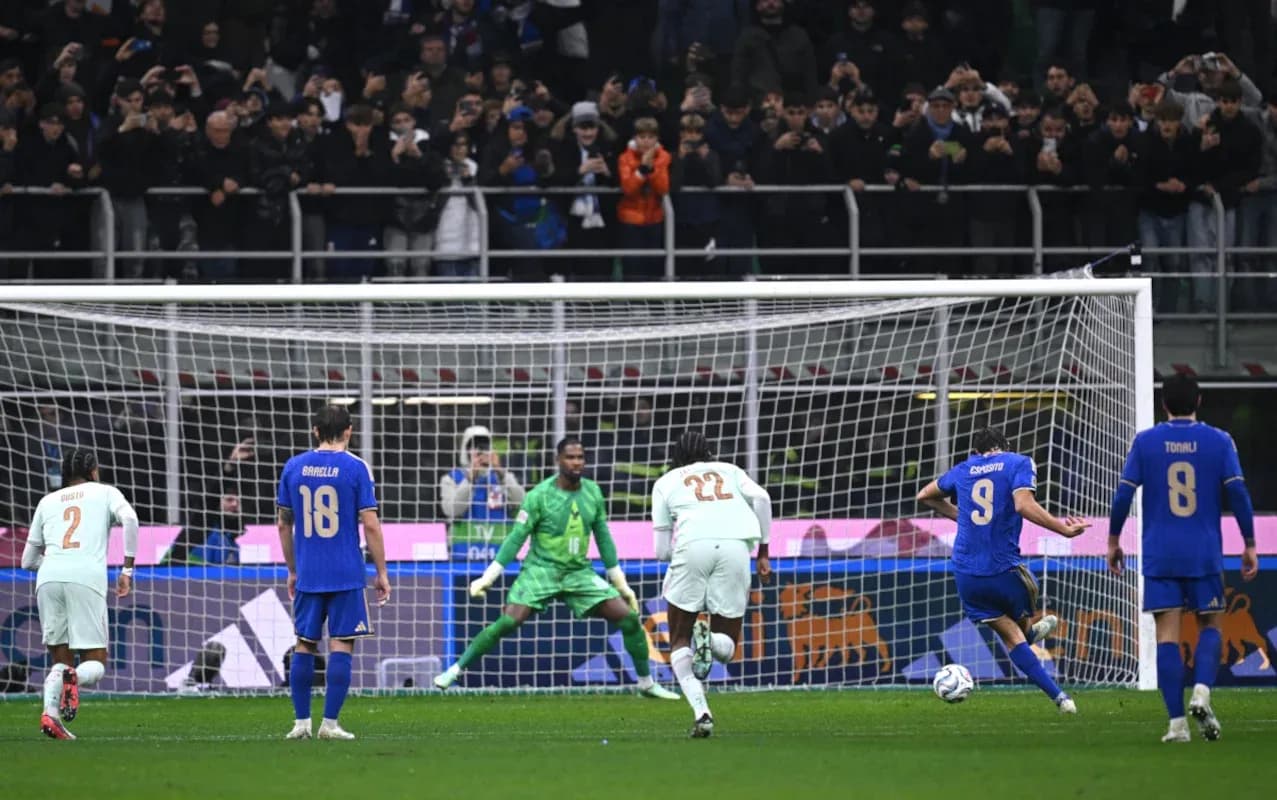
The “Hunter vs Shield” narrative was written in bold up front. For Italy, F. Esposito came into this game as one of the league’s most efficient forwards: 4 goals and 1 assist in 5 appearances, with 11 shots and 8 on target. He is not a volume shooter; he is a penalty-box finisher who thrives when the game is broken and the service is direct. Crucially, he has already scored once from the spot in this competition.
He was supported by S. Esposito and N. Cambiaghi, forming a front three that stretches back lines horizontally. Against a French defence that concedes 1.0 goals per game overall and 1.0 on their travels, the question was whether Upamecano and J. Jacquet could hold their line without overcommitting. Upamecano’s season data – 17 duels, 10 won, 90% passing accuracy and those 3 blocked shots – suggests a defender who wants to engage high. Italy’s timing surges between 16–30 and 61–75 minutes directly targeted the windows where France are statistically most fragile defensively: 60.00% of French goals conceded arrive between 61–75 minutes. That intersection – Italy’s second-wave push against France’s late-mid slump – was precisely where this fixture tilted.
On the other side, France’s attacking trident behind B. Barcola carried enormous creative weight. M. Olise, the competition’s standout attacker so far, entered this match with 5 goals and 2 assists in 5 appearances, supported by R. Cherki and D. Doué, both on 2 assists each. Olise’s numbers – 13 shots (8 on target), 230 passes at 86% accuracy, 9 key passes and 7 successful dribbles – describe a player who can both finish moves and orchestrate them. Cherki, with 230 passes at 90% accuracy and 8 key passes, and Doué, with 165 passes at 92% and 7 key passes, give France a triple-creator axis rarely seen at international level.
Yet that creativity runs into Italy’s midfield engine. S. Tonali and N. Barella, flanked by D. Frattesi, formed a three-man unit designed to compress space between the lines. Italy’s goals-against profile shows that when they are broken, it is usually in the 46–75 window – exactly where France’s creative trio like to accelerate. At San Siro, Italy’s midfield didn’t just screen; they disrupted passing lanes into Olise’s feet, forcing France to play wider and deeper than they prefer.
IV. Statistical Prognosis – What This Result Says About the Future
Following this result, Italy’s overall profile in this Nations League campaign is that of a high-ceiling, high-variance side that is learning to smooth out the volatility. They have scored in every match but one, failed to keep a single clean sheet, and even from the spot they are imperfect: 2 penalties taken, 1 scored and 1 missed, a 50.00% conversion rate that hints at lingering ruthlessness issues.
France, meanwhile, remain a team built around late surges and elite individual creativity. They have yet to fail to score in any of their 5 matches, have kept 2 clean sheets on their travels, and their overall goals-against average of 1.0 suggests a defence that bends but does not usually break. However, their concentration lapses between 61–75 minutes and disciplinary spikes – especially the late red card already on their record – are structural vulnerabilities, not anomalies.
In tactical terms, this 3–1 in Milan reads as a warning to the rest of League A. If Italy can continue to align their offensive peaks with opponents’ defensive troughs, and if their midfield can consistently throttle elite creators like Olise, Cherki and Doué, their +5 goal difference is less a statistical quirk and more a foundation for a deep run into the quarter-finals. France, for all their brilliance, will need to tighten that 61–75-minute window and temper Upamecano’s edge if they are to turn their late-game artistry into knockout inevitability rather than reactive rescue missions.