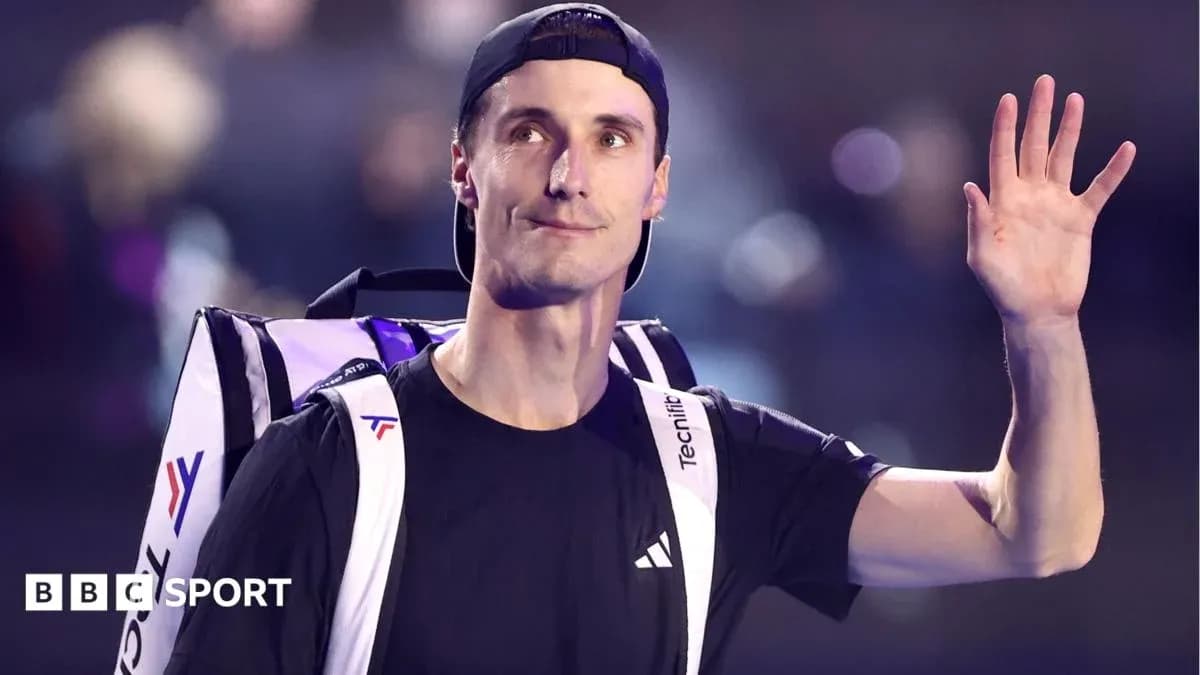
Joe Salisbury Retires: Britain’s Doubles Champion Leaves on His Own Terms
Joe Salisbury walked away from professional tennis where he always seemed most at home – under the lights of Flushing Meadows, with Rajeev Ram by his side and a major title on the line.
This time there was no trophy, just a semi-final exit at the US Open. But as farewells go, it fit. The pair had turned this hardcourt Grand Slam into their personal stronghold, rewriting doubles history together and redefining what British success in the format could look like.
A US Open farewell in the perfect arena
Salisbury, 34, chose this year’s US Open as his final tournament. Ram, his long-time partner and friend, had already decided this would be his last dance too. They pushed through to the semi-finals, one last deep run in a stadium that had witnessed their greatest work.
In 2023, Ram and Salisbury became the first team ever to win three consecutive US Open men’s doubles titles. Three in a row in New York – a feat no pair in the sport’s history had managed before. For a player who built his reputation on reliability in the biggest moments, it was a fitting stage on which to close the curtain.
Britain’s standard-bearer in doubles
Strip it back and the numbers are blunt, and impressive. Salisbury retires as Britain’s most successful men’s doubles player of the Open Era.
He claimed six Grand Slam doubles titles in total: four in men’s doubles and two in mixed. With Ram, he lifted the 2020 Australian Open crown, adding it to that remarkable US Open hat-trick. In mixed doubles, he teamed up with Desirae Krawczyk to win two more majors, underlining his versatility and touch in all formats.
Across the ATP Tour, he amassed 17 tour-level titles, including back-to-back triumphs at the season-ending ATP Finals in 2022 and 2023. Those year-end victories, against the very best in the world, confirmed what insiders already knew: when the stakes rose, Salisbury rarely shrank.
A career built on craft and resilience
Salisbury’s game never relied on noise. No theatrics, no constant gesturing to the crowd. Just clean technique, smart positioning and a calm presence that partners trusted.
That serenity, though, did not always reflect what was happening away from the court.
At the start of this season, he stepped away from the tour for three months. He spoke openly to BBC Sport about the anxiety that had been shadowing him during tournaments. He said he didn’t feel it damaged his tennis significantly, but it wrapped his time on the road in a “feeling of dread” that slowly eroded the joy of competing week after week.
For an athlete whose job is built on constant travel, constant pressure, that kind of mental strain cuts deep. The break was a pause, but in hindsight it also looked like the first step towards a decision that had been forming for some time.
Leaving with clarity, not regret
By the time he announced his retirement, Salisbury sounded certain. He has been thinking about life after tennis for a while, and now, he says, he is “very happy with the decision”.
On Instagram, he reflected on a journey that began long before the trophies and title runs.
“Tennis has been my life for as long as I can remember and I have been incredibly fortunate to have had all the opportunities, experiences and success that I have,” he wrote.
“To be able to travel the world and call playing tennis my job has been a dream come true and I never believed I could have lived the life and had the career that I have.
“I gave it my all and know I can be proud and look back with no regrets.”
There is no drama in those words, just the steady voice of a professional who squeezed everything he could from his talent and his body, then chose to step away before the sport consumed the rest of him.
The legacy he leaves behind
For British tennis, Salisbury’s career lands in an interesting place. Singles stars tend to command the spotlight, but his record forces a different conversation about what success looks like.
He turned himself into a Grand Slam regular, a fixture at the business end of majors, and a benchmark for what a British doubles specialist can achieve. Young players watching from the outside will see a path that does not depend on breaking into the top 10 in singles to matter on the world stage.
Seventeen titles. Six Slams. Two ATP Finals crowns. Three straight US Opens with the same partner. Those are not the numbers of a supporting act.
Salisbury leaves the sport with his ranking still strong, his partnership with Ram still dangerous, and his legacy already written. The decision to stop now, while he can still win at the highest level, says as much about him as any victory.
He walked away not because the game had passed him by, but because, after years of constant travel and quiet internal battles, he chose a different kind of life. The question now is not what more he could have won, but what comes next for a player who has already proved he knows when to go to the net, and when it’s time to walk off court for the last time.