Karolina Muchova and Jakub Mensik Win US Open Mixed Doubles Title
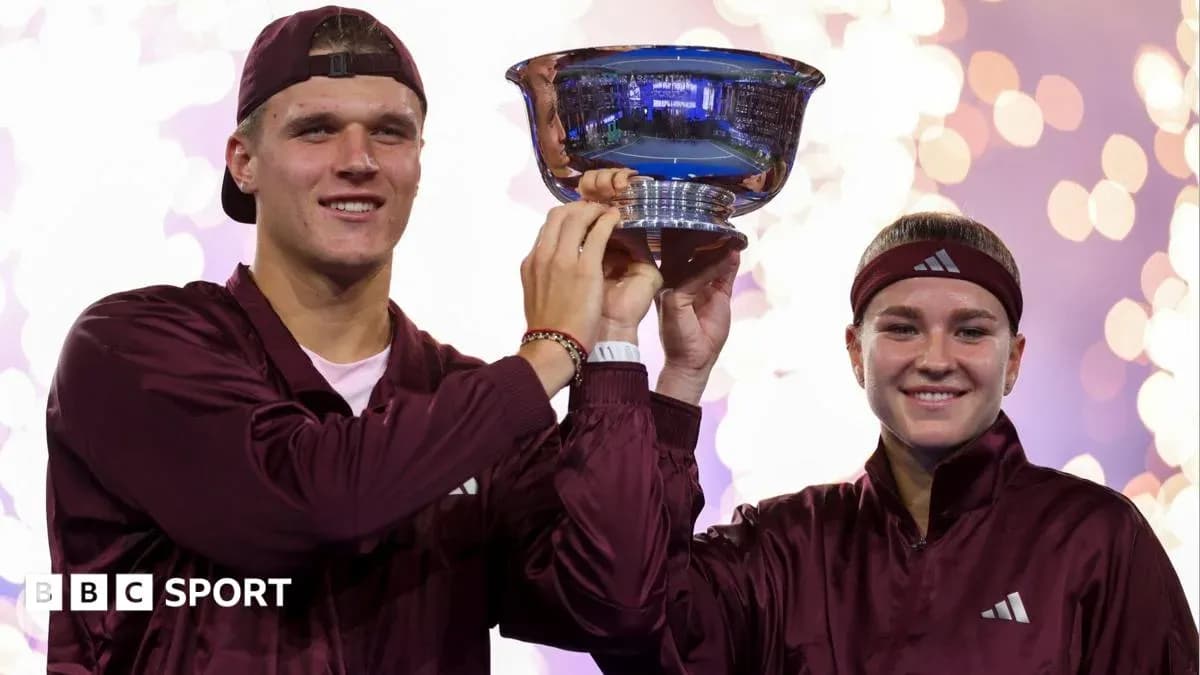
Karolina Muchova walked back into the spotlight in New York with stitches still fresh on her season, a “small surgery” behind her and a Wimbledon final defeat barely six weeks old. She left with a Grand Slam title, $1m in prize money, and a new partner in crime.
Jakub Mensik, just 20 and a mixed doubles rookie, finished the job with a 131mph ace on a third championship point, sealing a 6-3 1-6 10-6 victory over Belinda Bencic and Flavio Cobolli in the US Open mixed doubles final. One swing, one blur of maroon, and the pair had their first major trophies.
They had already stared down the edge once this week. In the semi-finals, Muchova and Mensik saved match points against French Open champion Mirra Andreeva and Andrey Rublev, scraping through 5-4 (8-6) 3-5 11-9 in a format where everything is compressed, accelerated, and unforgiving. Ten-point tie-breaks decide everything. Blink, and you’re out.
The pressure didn’t just build. It piled up.
Bencic and Cobolli had survived their own high-wire act in the last four, winning a 10-point tie-break 10-5 against Elina Svitolina and Gael Monfils. That result shut the door on a little slice of history: Svitolina and Monfils were bidding to become the first married couple to win a Grand Slam mixed doubles title since 1939. There will be no second attempt. Monfils is retiring at the end of the season.
So this final carried more than just prize money. It carried a sense of passing moments, of careers at different stages colliding under the lights.
Muchova, 30, is rebuilding her year after that Wimbledon loss to compatriot Linda Noskova and her subsequent surgery. Mensik is climbing fast, a semi-finalist at this year’s French Open in singles, but a complete novice in mixed doubles. What he lacked in experience, he compensated for with a serve that turned rallies into target practice.
That serve was the weapon that broke the match open. They took the opening set 6-3, then watched the momentum swing violently away as Bencic and Cobolli stormed through the second 6-1. In the match tie-break, with the stadium tightening around them, Muchova steadied the baseline exchanges and Mensik went for broke on serve.
On the third championship point, he didn’t blink.
Away from the power and the points, there was a different kind of chemistry at work. The pair agreed to wear matching maroon outfits, a detail that only came together once Muchova had explained to her younger partner what the colour actually was. It was a small moment, but it said plenty about a team thrown together and suddenly thriving.
Mensik later reflected that the title was only part of the story. The real value, he said, lay in the quality of the matches and the chance to try things on court, to build confidence in the most intense of settings. For both, this was more than a side event. It was a launchpad.
All eight players who reached the mixed doubles semi-finals will step straight into the US Open singles main draw when it begins on Sunday. That crossover is exactly what the United States Tennis Association wanted when it ripped up the old blueprint for mixed doubles and rebuilt it as a sprint.
The traditionalists will never love this reimagined version. A Grand Slam title, decided in under 48 hours, jars with those who believe majors should be long-haul marathons. But the numbers and the noise tell a different story.
The semi-finals and final were moved into the night session, under the lights, no longer tucked away as a sideshow for grounds pass holders. The television audience swelled. The prize money did too. The mixed doubles champions now share a pot five times bigger than under the previous format, and the men’s and women’s doubles purses have risen sharply to match.
There is a cost. Specialist doubles players, who once treated mixed as a reliable avenue to a major title, now face a tougher road. Even with a qualifying competition introduced this year, spots are limited in a draw built around singles stars.
Those stars, though, are not always willing to commit. Iga Swiatek and Frances Tiafoe withdrew shortly before the event, both prioritising rest after strong spells on tour. Daniil Medvedev also pulled out, feeling he needed more singles matches in the build-up to the main draw.
That tension sits at the heart of this new mixed doubles: the lure of big money and big stages against the reality that, for most singles players, this will never sit at the top of the to-do list.
Yet the USTA’s ambition is clear. If they can consistently tempt pairings with the profile of Serena Williams and Carlos Alcaraz, or Aryna Sabalenka and Novak Djokovic, they will consider the experiment vindicated. This is less a gentle warm-up and more a showcase, a centrepiece of an ever-expanding US Open “Fan Week”.
The tennis has been wrapped in spectacle. Roger Federer joined Andre Agassi, John McEnroe and Andy Roddick in an exhibition on Tuesday. Amanda Anisimova and Alexandra Eala headlined the “Stars of the Open” on Thursday night. The Lumineers kicked off the entire fortnight with a gig inside Louis Armstrong Stadium nine days before a single main-draw ball is struck.
In the middle of all that noise, Muchova and Mensik cut through with something simple: high-stakes tennis, played hard, decided fast. A first Grand Slam title for both, won in a format that still divides opinion but now refuses to be ignored.
The singles circus starts on Sunday. The question is how many of those stepping onto Arthur Ashe will be thinking, quietly, about following Muchova and Mensik’s path next year – and how many more aces at 131mph it will take before mixed doubles feels like one of the sport’s biggest stages, rather than its boldest experiment.