Naomi Osaka's Bold Fashion Statement at the US Open
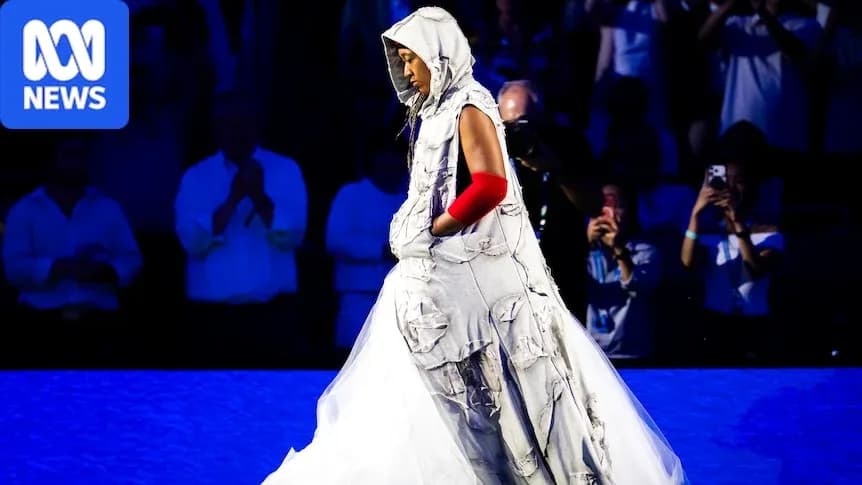
Naomi Osaka stepped back into Arthur Ashe Stadium like it was a runway built for pressure.
Under the New York lights, the two-time US Open champion arrived in a hooded tunic that looked less like sportswear and more like a walking scrapbook of her own story. Patchwork-style panels carried press clippings from past tournaments, the words that have followed her career now literally stitched to her back. Behind her, a billowing white tulle train floated along the blue concrete, part theatre, part statement.
Osaka has turned every major this season into a different chapter of a fashion portfolio. At Wimbledon, she nodded to her Japanese roots with a kimono-inspired look, complete with a traditional kanzashi hair ornament, before switching into a regulation white Nike kit. At Roland Garros, she arrived in a black Kevin Germanier skirt and played in layered yellow, brown and gold, a shimmering tribute to the Eiffel Tower’s night-time glow. In Australia, her outfit took its cues from a jellyfish, fluid and otherworldly.
New York brought something else: attitude. She walked into Flushing Meadows in an Allen Iverson-inspired outfit, channelling the NBA Hall of Famer’s edge as much as his aesthetic.
"It's my tribute to Iverson," Osaka said. "I really like him a lot. Nike said basketball, so I said, 'You want basketball, I'll give you basketball.' I like expressing myself through clothes, and I'm glad you guys appreciate it."
Once the walk-on was done, the work began.
Facing unseeded Russian Anastasia Zakharova, ranked 101 in the world, Osaka looked ready to make quick work of the night session. The 13th seed tore into a 4-1 lead, striking cleanly, the kind of start that usually signals a routine opening win for a four-time major champion.
Zakharova refused to play the role of backdrop.
She clawed her way into rallies, tightened her serving, and slowly dragged the first set into a tie-break. The momentum that had seemed entirely Osaka’s suddenly felt fragile. The crowd, still buzzing from the spectacle of her entrance, settled into something more tense, more familiar: Osaka in a fight.
The former world No 1 met it head-on. She steadied, found her first serve when she needed it most, and edged the breaker 8-6. No theatrics, no roar, just a clenched jaw and a nod. One set down, but nowhere near done.
The second set followed a similar script, only with more jeopardy. Osaka pushed, Zakharova pushed back. The Russian held her ground, forcing Osaka to keep going to the well on a night when she admitted she felt “a little rusty.” Again, the set stretched into a tie-break. Again, Osaka’s nerve held. This time, she shut the door 7-3, sealing a 7-6 (8/6), 7-6 (7/3) victory as the clock crept towards 12:30 am.
"I would say it took everything [to win]," she said afterwards, glancing up at the late-night crowd. "I have no idea what time it is. Thanks for staying. I'm grateful to be able to play on this court again."
There was honesty in what came next.
"I just told myself to not have any regrets. I wanted to come out and compete … I was a little rusty. I get nervous in the first rounds. I want to do well and show you guys new outfits."
That last line drew laughter, but it also summed up where Osaka is right now: a player rebuilding her tennis while fully leaning into the cultural space she occupies. The clothes are not a distraction; they are part of the performance, part of how she steps into these arenas and owns them.
On the scoreboard, it goes down as a straight-sets win. In reality, it was a late-night test of resolve, the kind of match that can sharpen a contender more than any easy blowout.
Next up is Czech player Kateřina Siniaková in the second round. The outfits will keep coming. The real question now is whether the tennis will rise to match the theatre.