Nelson Asofa-Solomona's Brutal Knockout of Paul Gallen
The replays told the story long before anyone found the words.
Nelson Asofa-Solomona’s right hand crashed into Paul Gallen’s face with such force that hardened fight men fell silent. On commentary, Michael Ennis – a former Cronulla teammate of Gallen’s who has seen more than his share of collisions – looked rattled. He admitted he struggled to even watch it back. Tim Tszyu called it “frightening”.
In real time, it felt worse.
“Oh jeez, oh no!” came Ben Damon’s instinctive cry on Main Event as the punch detonated. Gallen’s expression barely changed, but his body told the truth. Danny Green’s voice cut through the chaos.
“The last one was the worst one, boys,” he said, almost wincing through the headset. “That was the one he didn’t need.”
Damon could only add, “That’s no good,” as Green repeated himself, as if trying to process it.
“The last one was a bad one.” “That’s hard to watch,” Damon finally managed.
The whole thing lasted two minutes and 56 seconds. Not even a full round, yet long enough to pose some uncomfortable questions about where the line sits in a sport built on sanctioned damage.
Asofa-Solomona, the giant forward trying to climb boxing’s version of the Penrose stairs, showed both why he is such a terrifying prospect – and why some will wonder if he should be on this path at all.
The opening minute was measured enough. Then the temperature changed.
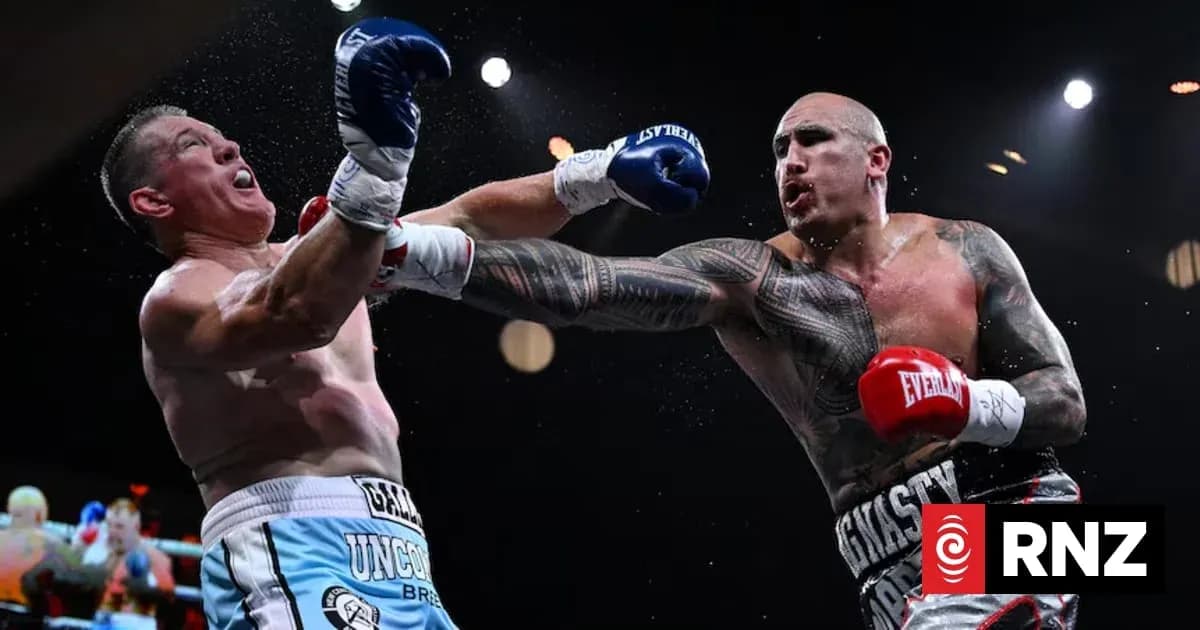
A thunderous right hand from Asofa-Solomona rocked the 45-year-old Gallen backwards towards the ropes. He followed with a left-right combination that pinned the former NRL warrior in place, his head snapping, his balance gone.
Gallen’s arms began to flail. His head rolled back. In that split second, Asofa-Solomona saw the window for an uppercut and drove through it.
The first uppercut almost switched Gallen off. It sent him to the edge of consciousness, eyes vacant, body sagging.
The second one pushed him over that edge. There was no doubt this time. Gallen was gone.
But the punches did not stop.
A third uppercut skimmed Gallen’s famously granite chin as he folded, legs buckling beneath him, his body crumpling into a seated heap like a discarded marionette.
Still, Asofa-Solomona kept firing.
As referee Chris Condon hurled himself between them – a black-shirted barrier arriving a beat too late for comfort – Asofa-Solomona launched yet another blow at the defenceless head of his stricken opponent. The glove whistled in as Condon intervened, a final, sickening image to cap a savage finish.
Some will roll their eyes at outrage in a sport where the objective is, quite literally, to render another human unconscious. This is boxing, isn’t it? Earlier in the night Paulo Aokuso had landed a beautifully timed left hand on Mobin Khahrazeh that had purists purring. That was applauded, replayed, celebrated.
Isn’t the knockout the currency of the game?
Yes. That is the bargain. Two trained fighters agree to risk their brains for entertainment and glory.
But even in the controlled barbarism of modern combat sports, there is a line. The rules try to draw it clearly: you do not hit a man who is down and helpless.
The Australian National Boxing Federation puts it in black and white:
“Some fouls for which a referee may penalise or disqualify a boxer are: (a) Hitting an opponent who is down or is rising from a knockdown.”
There are nuances. From the moment Asofa-Solomona’s first huge shot landed to the instant Condon waved it off, eight seconds passed. The four uppercuts that did the damage came in a blur, about two-and-a-half seconds of mayhem. That is barely enough time for a referee to react, let alone a novice heavyweight charging forward, adrenaline flooding his system, career on the line.
But Gallen was down. More importantly, he was out.
Generations of fighters have learned to recognise that moment, the instant when the man in front of you is no longer an opponent but a patient. The great unwritten code of the ring demands restraint. Hitting an unconscious opponent is not just a rules violation; it breaks the strange brotherhood forged when two fighters touch gloves.
On Thursday night, that line blurred. Asofa-Solomona, clearly amped up, charged straight through it.
His wild leap into the crowd moments after the stoppage underlined just how fired up he was. He vaulted the ropes and surged toward a punter, a scene that looked unhinged until context emerged later.
At the post-fight press conference at the TikTok Entertainment Centre, Asofa-Solomona explained what had triggered him. He said he had been subjected to a racist taunt.
“Someone was doing an ape gesture. I stood on the ropes and it looked like someone threw something at me,” he was reported as saying.
“If I had my time back, I would, because that’s not on. But what that guy did to me, in terms of that gesture, is not on either.”
No one should be asked to calmly absorb that kind of vile, racist abuse. Nobody has the right to dictate exactly how a person should react when confronted with something so degrading and dehumanising.
But the ring is different. The stakes are different. The damage is real and irreversible.
Nelson Asofa-Solomona has the power to end nights with a single punch. That much is now beyond dispute. The next step in his boxing education is learning precisely when to stop throwing them.