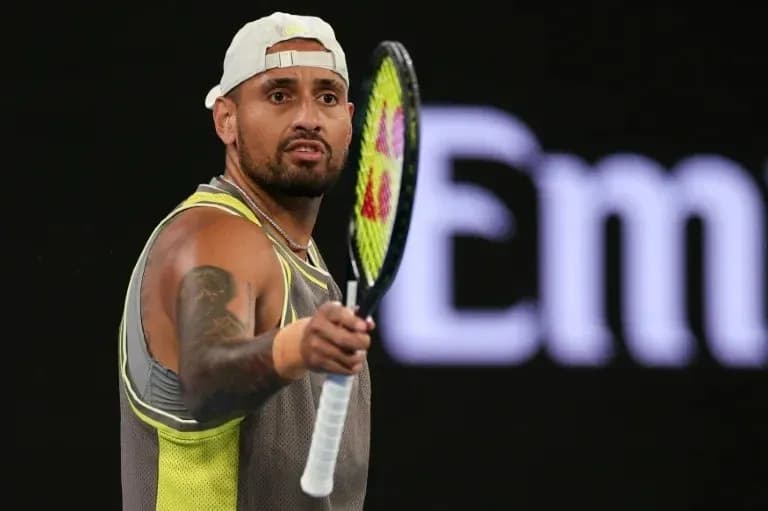
Nick Kyrgios Cleared to Return After Cocaine Ban
Nick Kyrgios has been cleared to return to professional tennis after accepting a one‑month ban for cocaine use and enrolling in a treatment programme, the International Tennis Integrity Agency (ITIA) confirmed on Friday.
The 31-year-old Australian, a Wimbledon finalist in 2022, failed a doping test during an ATP event in Mallorca on June 22 and was provisionally suspended on August 4. He admitted the offence, calling it “a huge mistake”.
According to the ITIA, Kyrgios explained that he had taken cocaine socially during a night out before his matches in Mallorca. An independent scientific expert at a World Anti-Doping Agency (WADA)-accredited laboratory backed up that account, concluding that the levels detected in his sample were consistent with out-of-competition use.
“As a result, the ITIA accepted that Kyrgios’ use of cocaine was outside of competition,” the agency said.
Under WADA rules, this type of violation usually brings a three-month suspension. That can be cut to one month if the athlete commits to a recognised treatment programme.
“Kyrgios has entered into a treatment programme,” the ITIA confirmed. “As such, the player’s suspension will end on September 3, 2026, subject to completion of the programme. Prize-money and ranking points from the Mallorca event will be forfeited.”
It marks another dramatic twist in a career that has veered between brilliance and breakdown.
Career Highlights
At his peak, Kyrgios looked ready to bend the sport to his will. Armed with a thunderous serve and explosive groundstrokes, he climbed to No. 13 in the world in 2016 and collected seven ATP singles titles. His run to the Wimbledon final in 2022, where he pushed Novak Djokovic before losing in four sets, felt like a long-awaited arrival on the sport’s grandest stage.
That proved to be the high-water mark.
Injuries have ravaged his body and rhythm since, culminating in a full reconstruction of his right wrist in 2024. His ranking has collapsed to 918, a stark number for a player once touted as the most naturally gifted of his generation.
His last competitive appearance came as a wildcard in the men’s doubles at Wimbledon this July, partnering Alexander Bublik. They exited in the first round, a brief and subdued cameo from a player who once lit up Centre Court.
When news of the failed test emerged last month, Kyrgios addressed it directly on social media.
“I recently failed a drug test in Mallorca after testing positive for cocaine,” he wrote on Instagram. “I made a huge mistake and I take full responsibility for it.
“I’m sorry to my fans, my family, my sponsors and everyone close to me. Above all, I’m sorry to the kids who follow me. I know the example this sets and I’m deeply disappointed in myself.”
The punishment is relatively short. The consequences for his reputation, and for a career already hanging by a thread, will last far longer.
Kyrgios now has his eligibility back, a treatment programme to complete, and a choice to make: fade out as a cautionary tale, or fight his way back from the margins to the stages where his talent always belonged.