Novak Djokovic Faces Stunning First-Round Defeat at U.S. Open
Novak Djokovic has walked into Arthur Ashe Stadium on countless nights looking indestructible. Sunday was not one of them.
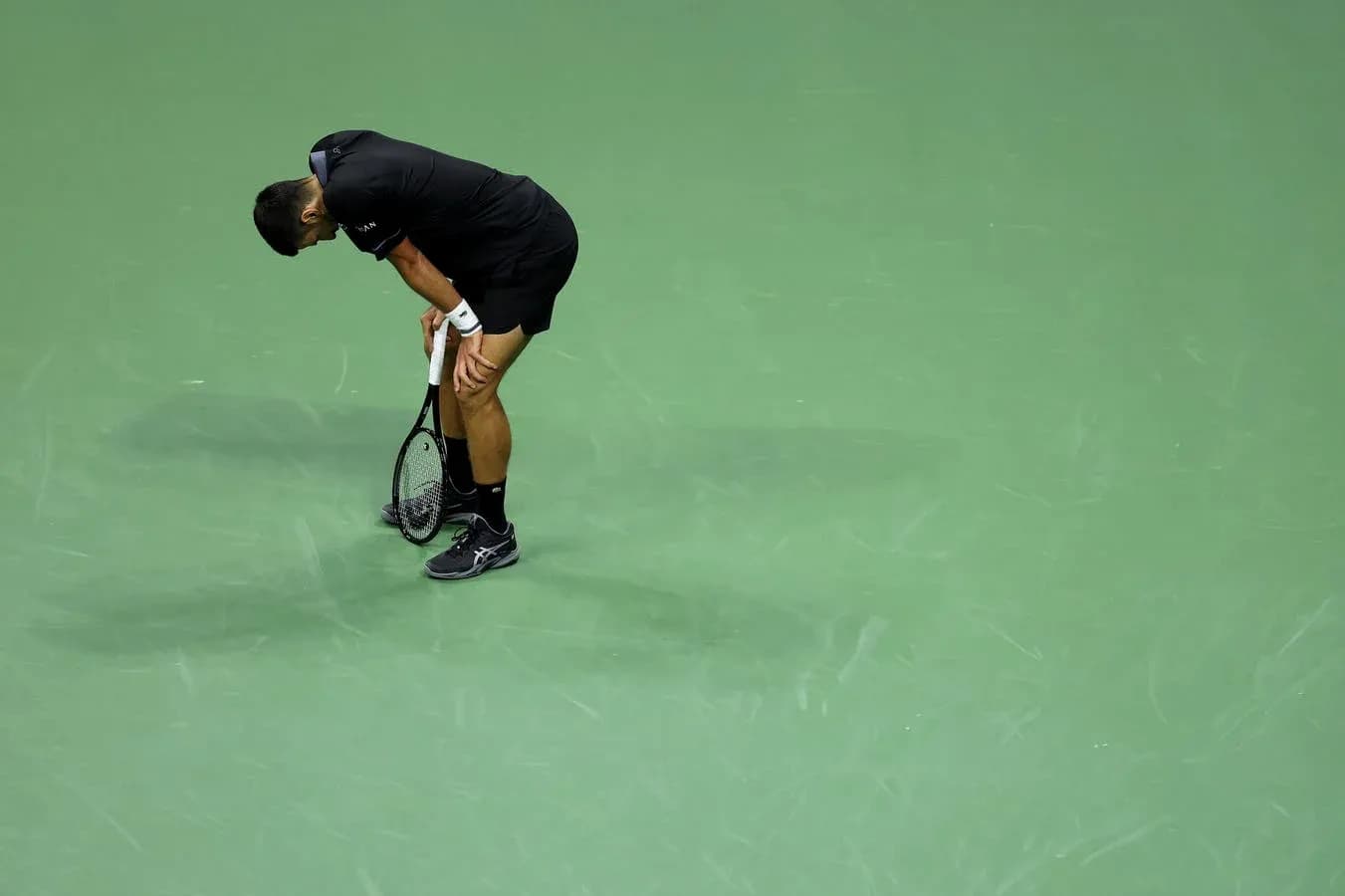
From the opening games against Mariano Navone, something was clearly wrong. The familiar, combustible energy wasn’t there. Djokovic barely acknowledged the crowd. He moved heavily between points, reached for an inhaler, swallowed tablets, and, several times, leaned over a courtside bin to throw up as he battled stomach issues.
What followed was one of the most jarring nights of his career: a 7-6(5), 5-7, 4-6, 6-2, 6-1 first-round defeat to an unseeded Argentine ranked No. 49 in the world, a man without a single ATP Tour title to his name. It lasted 4 hours, 36 minutes under a closed Ashe roof and felt, at times, like a slow, painful unravelling.
Djokovic, 39 now, had not lost in the opening round of a major since 2006. His wife Jelena and their children, Stefan and Tara, watched from the stands as history turned in a direction no one in that family would have wanted. The date added a cruel symmetry: 21 years to the day since his U.S. Open debut against Gael Monfils in 2005, he walked off Ashe beaten at the first hurdle.
He still paused to wave, trace a heart sign toward the stands, and sign autographs before disappearing down the tunnel. A champion’s reflex, even on a night that stripped away the aura.
“This shows he’s human,” John McEnroe said on ESPN. “It gives you an even greater sense of how amazing his accomplishments were.”
Coming from a man who has seen every version of Djokovic, it landed with weight.
The loss also tears a familiar thread from the sport. According to ESPN, the last time none of the “Big 3” — Djokovic, Roger Federer, Rafael Nadal — reached the second week of a major was Roland Garros 2003. Tennis has been living in their world for more than two decades. This felt like a door creaking toward something else.
For Navone, it was the night of his life.
“This is amazing court on the biggest stage,” he said on court, still processing what he had done. “It’s amazing the way we played, I mean five sets against the GOAT is nothing to every day. I’m very happy, what can I say.”
He didn’t hide what it meant to beat the player he grew up idolizing.
“Novak means a lot for me,” he added. “It was very tough for me because you’re playing with the GOAT on this court here and he is here every day in this court when he plays the U.S. Open. This means a lot, it’s a dream come true. It’s certainly 100%. Now I have to recover, I think it’s almost 12 o’clock, we have to go to sleep.”
A Match That Turned, Then Turned Again
The night began with Djokovic in front. He led 4-2 in the opening set, seemingly steadying after a scratchy start. Then the errors crept in. Navone dug in, refused to be overawed, and dragged the set into a tiebreak. The Argentine stayed bold, and Djokovic blinked. Navone stole the breaker 7-5 and the first real shockwave rolled through Ashe.
The response was predictable, at least for a while. In the second set, Navone held for 5-4 with a 100 mph ace, but Djokovic tightened his focus and his grip. He broke at love for 6-5, then held at love to level the match. For a few minutes, the old script reappeared.
“And now all of a sudden, he’s starting to look like Novak Djokovic,” McEnroe observed on air.
Yet something else was missing. The Serb, usually so adept at whipping a crowd into a frenzy or turning their hostility into fuel, stayed oddly detached. “Almost no recognition of the crowd so far, except when he walked out,” McEnroe noted. It was as if Djokovic knew he had only so much energy to spend and couldn’t waste it on theatrics.
The third set brought the most surreal image of the night. Cameras caught Djokovic vomiting into the towel bin, sparking “Boot and rally” jokes from James Blake and the ESPN crew. It was gallows humor, because on the scoreboard he looked fine. He didn’t face a single break point on serve in the set. At 4-4, Navone finally cracked, netting a forehand on break point. Djokovic turned to the stands, hand cupped to his ear, and asked for more noise.
He served it out 6-4. Two sets to one up, in control despite the visible distress. On any other night, that would have been the turning of the screw.
Instead, the fourth set exposed the reality of his condition. Djokovic threw up again early in the set. His movement stiffened. He stretched his legs and back between points, fighting what looked like the onset of cramping. “This is not much fun for him tonight at all,” Chris Fowler said on ESPN, and it sounded like understatement.
Navone sensed the opening and took it. At 3-2, he broke for 4-2 when Djokovic sailed a forehand wide. The Argentine rode that surge to the set, 6-2, as Djokovic’s resistance thinned.
The fifth set was brutal.
Serving at 0-1, Djokovic fell behind 0-40. He clawed back a couple of points, but Navone eventually broke for 2-0 with a crisp passing shot that Djokovic, legs heavy and late to react, couldn’t reach after coming forward. Ashe, perhaps out of habit, tried to lift him when he held for 1-3. The roar was familiar; the response from Djokovic was not. He looked close to tears, trapped between the will that built 24 majors and a body that wouldn’t obey.
Navone didn’t flinch. He closed the door, game by game, until the final scoreline — 7-6(5), 5-7, 4-6, 6-2, 6-1 — told the story of a younger man outlasting a legend who simply ran out of fuel.
A Giant at a Crossroads
Djokovic arrived in New York as the No. 4 seed, a 10-time U.S. Open finalist with six defeats in those championship matches and a last major title here in 2023. He is still chasing a record 25th Grand Slam crown, still capable of beating the very best — he defeated world No. 1 Jannik Sinner to reach the Australian Open final earlier this year and made the semifinals at all four majors last season.
But he also walked into this tournament having admitted, after his first-round loss in Cincinnati, that he has been “dealing with [a health issue] for many years now.” On Sunday night, under the lights of Ashe, that private battle finally spilled into public view.
What comes next is unclear. The numbers say he’s not finished. The body, at least for one night, said something else. And as the sport begins to imagine Grand Slams without Djokovic, Federer, or Nadal anywhere near the second week, the question hangs over Flushing Meadows:
How many more nights like this does Novak Djokovic have left — and how many more does he want?