OU's Headington Family Tennis Center Wins 2026 USTA Award
In Norman, the trophies keep arriving even when no balls are being struck.
The University of Oklahoma’s Headington Family Tennis Center and Gregg Wadley Indoor Tennis Pavilion have been named 2026 USTA Outstanding Facility Award winners, a national stamp of approval that places the complex among the elite venues in American tennis. The honor was announced by the United States Tennis Association and presented during a ceremony in New York at the U.S. Open, a fitting backdrop for a college facility that has long aspired to professional standards.
Only 12 educational institutions across the country made the list. Just six of those sit on a college or university campus. Oklahoma is now one of them.
A home built to impress
For OU, this isn’t just about bricks, benches and blueprints. It’s about a home that both programs lean on every day.
“We are incredibly proud to call the Headington Family Tennis Center our home,” head women’s coach Audra Cohen said. To her, the complex is more than a venue; it’s an experience “for our student-athletes and everyone who walks through our doors.” Cohen singled out tennis club director Dawna Johnston for her “heart, dedication and many years of service to OU Tennis,” crediting her and a wider circle of supporters for helping shape “one of the premier tennis facilities in the country.”
On the men’s side, head coach Nick Crowell sees the same thing from a different angle: a competitive edge. “It’s incredible to walk into our facility every day and see the very best in college tennis,” he said. Donor backing and steady investment, he noted, have “transformed the Headington Family Tennis Center into the finest collegiate tennis facility in the nation.”
Coaches don’t often speak that boldly about infrastructure. OU’s do, and the USTA’s recognition backs them up.
Why the USTA took notice
The USTA doesn’t hand out its Outstanding Facility Award for shiny scoreboards alone. Facilities are judged on a broad checklist: how the complex fits and flows on its site, the quality of the court surfaces and lighting, how easily the place can be maintained, and how well it serves players, fans, media and officials.
They look at aesthetics. They look at signage and landscaping. They look at whether a venue feels like a tennis home, not just a collection of courts.
Amenities matter too. Casual seating, food options, social spaces, and a genuine commitment to grassroots tennis programs all factor into the decision. This is where a college facility can separate itself — not only by staging big matches, but by helping grow the sport from the ground up.
The USTA sorts nominations into clear categories: public courts (small centers with 2–11 courts or large centers with 12 or more), private facilities that still offer USTA and public programming, educational institutions from grade schools to universities, and an “Innovation” bracket for venues pushing the game forward in creative ways. OU’s complex rose to the top in the educational space, a crowded and increasingly ambitious field.
Each 2026 winner receives a wall plaque and an all-weather sign to mount at the facility. Symbolic, yes. But also a permanent marker that says: this place sets a standard.
A complex built for big-time tennis
The Headington Family Tennis Center and Gregg Wadley Indoor Tennis Pavilion serve as the shared home of Oklahoma’s men’s and women’s programs, and the scale is unmistakable.
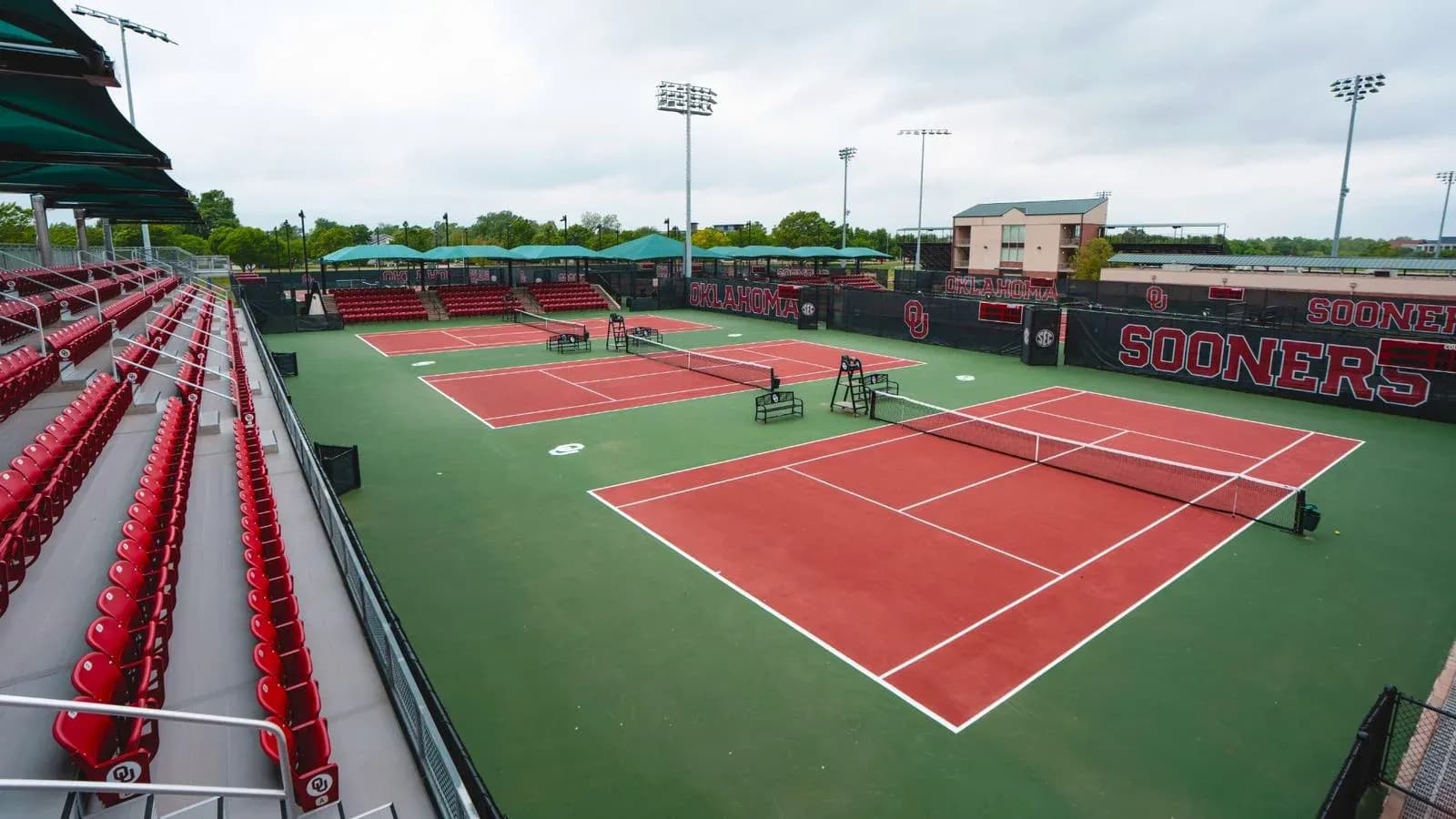
Outside, 12 courts stretch across the grounds, split into four three-court quadrants. That design isn’t accidental. It allows easy access and clear sightlines, letting fans track multiple matches without feeling lost in a maze of fences and walkways.
Seating rings the action, backed by championship-level lighting and playing surfaces. A sound system, electronic scoreboards and benches on every court give the complex the feel of a professional event, even on a Tuesday practice.
Step inside and the numbers grow. Including the indoor pavilion, the complex houses 18 courts in total. There are locker rooms for home teams and visitors, storage for trainers and equipment staff, and indoor spaces designed with fans in mind when the weather turns or the stakes rise.
This isn’t a facility that has to scramble to host big events. It’s one that expects them.
A proven championship stage
The USTA award only confirms what college tennis has known for years: Norman is a regular stop on the postseason map.
The Headington Family Tennis Center has hosted NCAA First and Second Round action 15 times: 2003, 2004, 2010–14, 2016–18, and 2022–26. That kind of repeat selection speaks to more than geography. It reflects trust — in the courts, in the operations, and in the ability to stage high-stakes tennis without a hitch.
The name on the gate carries its own history. The center honors Timothy C. Headington, a 1972 University of Oklahoma graduate and tennis letterwinner whose legacy now stretches from his playing days to the very courts that bear his name.
An award from the USTA won’t win a single point for the Sooners this season. But it does something subtler and just as important: it tells every recruit, every opponent, and every fan walking through those doors that when tennis is played in Norman, it’s played on a stage worthy of the sport.