Qinwen Zheng's Epic Comeback at the US Open
Qinwen Zheng was already writing one of the stories of this US Open. On Arthur Ashe Stadium, she turned it into something close to legend.
For the second match in a row, the Chinese qualifier climbed out of a 0-5 hole in a set and walked off the court as the winner. This time, the opponent was not a fading seed or a nervous newcomer, but six-time grand slam champion Iga Swiatek, an eighth seed with a US Open title and a Wimbledon crown on her résumé.
Zheng beat her 7-5 6-3, coming back from that early avalanche in the opening set and then tightening the screw in the second to reach the quarter-finals in New York for the third time.
From No 121 to the Ashe roar
Two years ago in Paris, Zheng stunned Swiatek in the Olympic gold medal match. Since then, her path has been anything but smooth. An elbow injury wiped out long stretches of her 2025 season and dragged her ranking down to No 121. She had to fight through qualifying just to get into the main draw here.
She has not wasted the opportunity.
By the time she faced Swiatek, Zheng had already survived one miracle. In the third round against former Australian Open champion Madison Keys, she was outplayed for long spells, losing the first set 1-6 and slipping to 0-5 in the decider, match point down against the American 22nd seed.
Then everything flipped.
Zheng reeled off seven straight games to steal it 1-6 7-6 (7-3) 7-5, a comeback so extreme it felt like a once-in-a-career escape. Two days later, she produced the same trick on the biggest court in the sport.
Another 0-5, another storm
Against Swiatek, the start was brutal. The Pole raced to 5-0, Zheng struggling to find her timing, her range, even her footing on centre court after so long away from this stage.
“Well, honestly, I have to say, I started the match not so well,” Zheng admitted on court. But the scoreline stopped being the story. Point by point, rally by rally, she dug in. The serve steadied. The forehand, so often the barometer of her confidence, began to bite. The Ashe crowd, sensing the shift, leaned in.
She won one game. Then another. The pressure that Swiatek had been applying suddenly swung back at her. Errors crept in, then multiplied. Zheng kept her head down, eyes locked on the next point.
“I just focused point by point and little by little I start to play better tennis, I start to find my game,” she said. At 4-5, she was so locked in she “even forgot the score”.
By the time the set closed, Zheng had strung together seven consecutive games to take it 7-5. The scoreboard told the tale, but so did her opponent’s body language. Swiatek, who had looked in complete control, now found herself staring at another grand slam exit in straight sets.
Swiatek spirals, Zheng soars
The second set never turned into a rescue mission for the eighth seed. Swiatek’s game frayed at the edges, then unravelled, her unforced error count climbing to 28 by the end. The forehand that usually pins opponents into corners kept sailing long. The backhand, normally so reliable, wavered under pressure.
For the Pole, this was a painful pattern returning. Since winning Wimbledon in 2025, her last five defeats at the majors have all come in straight sets. On Ashe, the frustration boiled over; she left the court in tears.
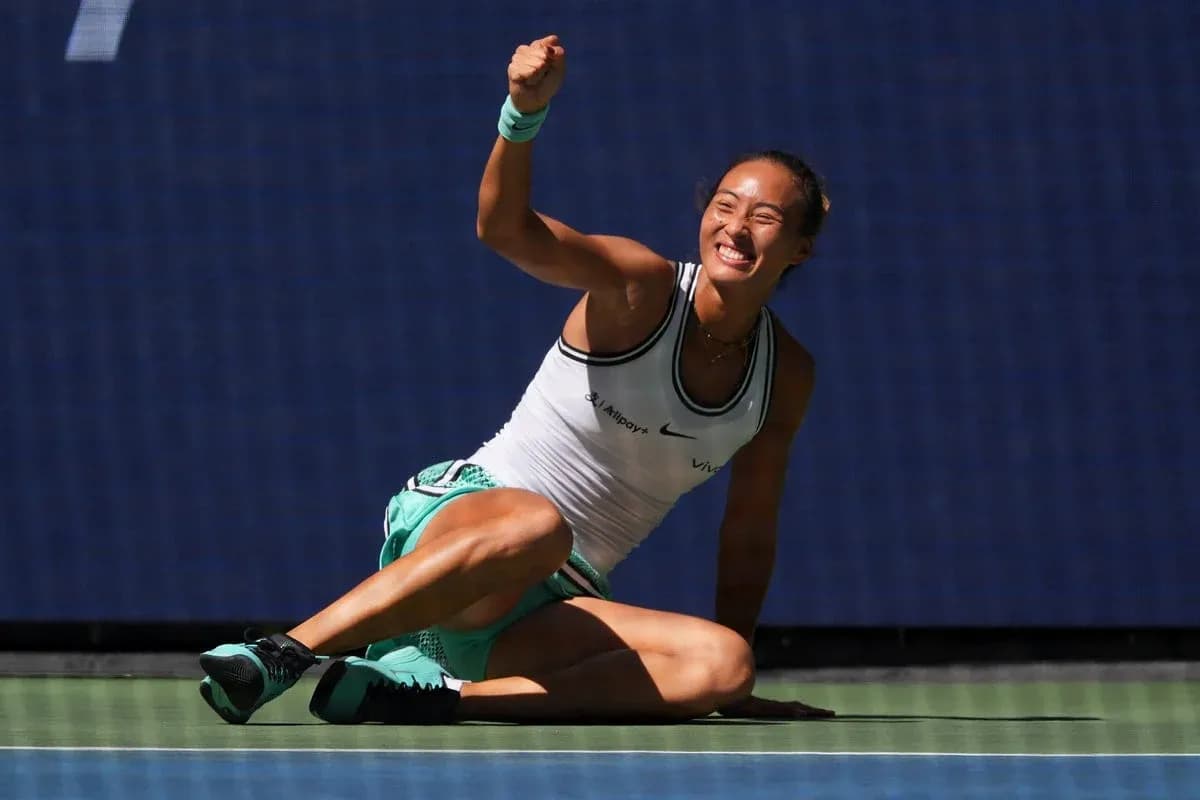
Zheng, by contrast, looked like a player rediscovering her place among the elite. She secured the only break of the second set, then guarded it with a calm that belied the chaos of her season. Serving for the match, she needed four match points, but when the last ball from Swiatek flew out, Zheng collapsed onto her back, arms spread wide, the roar of the stadium pouring over her.
She has now won seven matches in a row in New York, qualifying included. “I’m just really happy to win this match cause it's not easy and it's been a while really. I didn't beat any top 10 player,” she said, the relief obvious. She thanked the fans, soaking in a stage she once feared she might not see again.
Her reward is a quarter-final against either second seed Elena Rybakina or 13th seed Naomi Osaka, the two-time US Open champion. It will be another heavyweight test. Zheng arrives with momentum and a story that grows more improbable by the round.
Andreeva advances, Potapova breaks down
On a different court, another comeback, another emotional ending.
French Open champion Mirra Andreeva reached her first US Open quarter-final with a 5-7 6-4 6-3 win over Anastasia Potapova, a match that swung on both nerve and misfortune.
Potapova, representing Austria, had played her way into control, taking the first set and pushing the fifth seed deep into rallies with aggressive baseline play. At 5-3 down in the third, she still had a foothold, still chasing every ball.
Then came the moment that changed everything. Sprinting after a forehand, she twisted her knee badly. The 25-year-old went down in visible pain, tears following quickly. After treatment, the knee heavily strapped, she chose to continue, limping between points, forcing herself to the finish line.
She did not win another point.
Andreeva, a Russian teenager already carrying the aura of a future No 1, closed it out but wore the weight of the situation. “Anastasia is a good friend, and seeing what a battle we have and then seeing her fall is not easy,” she said. “It’s not the way you want to finish the match. I just told her she is playing amazing and I’m sure she’ll come back even stronger, she’s a warrior.”
Two comebacks, two very different scenes. One built on defiance and belief, the other shadowed by injury and heartbreak.
As the second week of the US Open takes shape, Zheng stands at the heart of it all, a qualifier turned giant-killer, dragging herself back from the brink again and again. The question now is simple: how many more times can she bend the script to her will?