Rafael Nadal's ATP Finals Dilemma: A Champion's Unfinished Puzzle
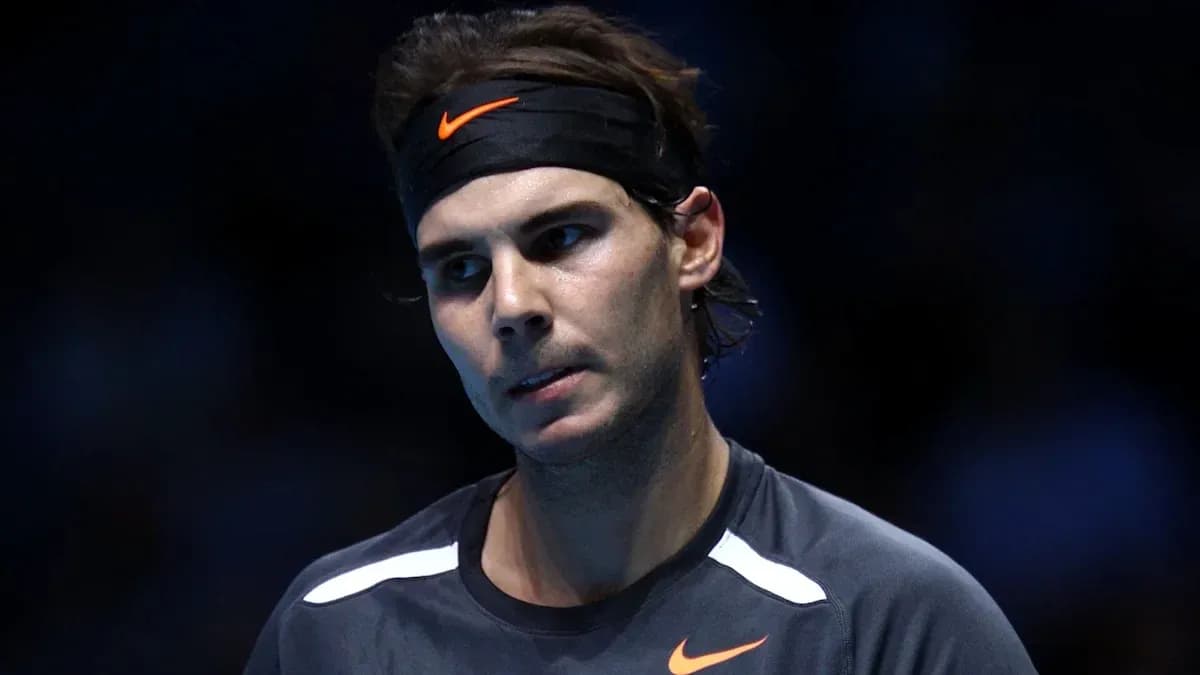
Rafael Nadal has lifted almost everything tennis can offer. Twenty-two Grand Slam titles, 36 Masters 1000 trophies, Olympic gold in singles and doubles, years spent as world No. 1. His résumé is a museum of greatness.
And yet one space in the cabinet always stayed empty: the ATP Finals.
In an era dominated by Nadal, Novak Djokovic and Roger Federer, the season-ending championship became a symbol of that gap. Djokovic and Federer collected 13 ATP Finals titles between them. Nadal, across nearly two decades at the top, never won it once.
A Stage That Never Quite Belonged to Him
Nadal qualified for the ATP Finals 17 times, a number that underlines his consistency and longevity. He actually competed in 11 editions. The pattern, though, became familiar: he arrived with hope, left without the trophy.
His first chance came in 2005, but a foot injury kept him out. The long-awaited debut had to wait until 2006, when he finally walked into the year-end showpiece.
That first campaign showed both his resilience and the limits of his comfort on indoor hard courts. Nadal battled his way out of the group, beating Nikolay Davydenko and Tommy Robredo, even as James Blake handed him a defeat. The reward for surviving the round-robin? Federer in full flight.
The Swiss stopped him in the semi-finals and set the tone for what would become a recurring theme.
Federer, Djokovic and a Tournament of Near Misses
No player caused Nadal more pain at the ATP Finals than Federer. The rivalry that defined so many Grand Slam Sundays also left its mark indoors. Federer beat Nadal four times at this event, more than any other opponent managed against the Spaniard at the season finale.
One of those defeats came in Nadal’s first ATP Finals title match in 2010. It felt like a chance to finally close the circle. Instead, Federer shut the door with a 6-3, 3-6, 6-1 victory, out-hitting Nadal on a surface that tilted the contest in his favour.
Nadal returned to the final in 2013, this time facing Djokovic. Again, it looked like an opening. Again, the man across the net thrived on the quick, low-bouncing indoor court. Djokovic took the title, and Nadal’s second – and last – shot at the trophy disappeared.
Between those peaks came low points that would have looked unthinkable for a player of his stature anywhere else. In 2009, Nadal endured his worst ATP Finals campaign, losing every set he played in the round-robin stage. Three matches, no sets won. For a competitor built on fight and survival, it was a brutal reminder of how unforgiving the conditions could be.
Across his ATP Finals career, Nadal lost to 12 different players. The list stretches from legends like Federer and Djokovic to younger names who caught him on a surface and in an environment that never truly suited him.
The Surface Debate
Nadal never hid his feelings about why this title proved so elusive. Indoors, on hard courts, his heavy topspin loses some of its bite. The ball doesn’t kick up as viciously, the rallies shorten, the reward for first-strike tennis grows.
In 2013, he voiced a broader concern about what the event represented for players whose strengths lay elsewhere.
"I know it's not going to happen for my generation," Nadal said then. "I'm talking for the future generations, something that will be a little bit fairer for the players. And I think for the fans it will be interesting to change the surface every year to the surfaces we qualified on for the (ATP Finals).
"A good player has a chance to qualify for the (ATP Finals) four or five times in his career, so if during this four years you have a different surface every year, a minimum one time he will have the chance to play on his favourite surface."
It was a pointed argument. The ATP Finals, once a more varied event, had narrowed. For the first 26 years, carpet courts dominated, with even a grass-court edition in 1974. Since 2007, though, the tournament has lived exclusively on indoor hard courts. Turin, which has hosted the event since 2021, continues that tradition, and there is no sign of change on the horizon.
For Nadal, the issue was never just personal frustration. It was about what the season-ending championship should represent: a showcase of the year’s best players across the sport’s different identities, not just a reward for those most at home under a roof on a slick court.
The Final Bow
Nadal’s last appearance at the ATP Finals came in 2022. By then, his body had carried him through countless wars, his aura undimmed but his margin for error thinner.
Again, the indoor arena proved unforgiving. He fell in the round-robin stage, losing to Felix Auger-Aliassime and Taylor Fritz. There was no late-career twist, no final surge to rewrite the one stubborn line on his record.
So the story stands: one of tennis’ greatest champions, a man who conquered Roland Garros 14 times and won majors on every surface, never managed to master the ATP Finals.
Maybe that’s the point. Even for giants of the game, some stages remain hostile, some puzzles unsolved. And for Nadal, the season-ending showpiece will always be the one that got away.