Rafael Nadal Joins Real Madrid Board of Directors
Rafael Nadal is stepping off the baseline and into the corridors of power at Real Madrid. This is no polite handshake and framed shirt. This is a door being opened.
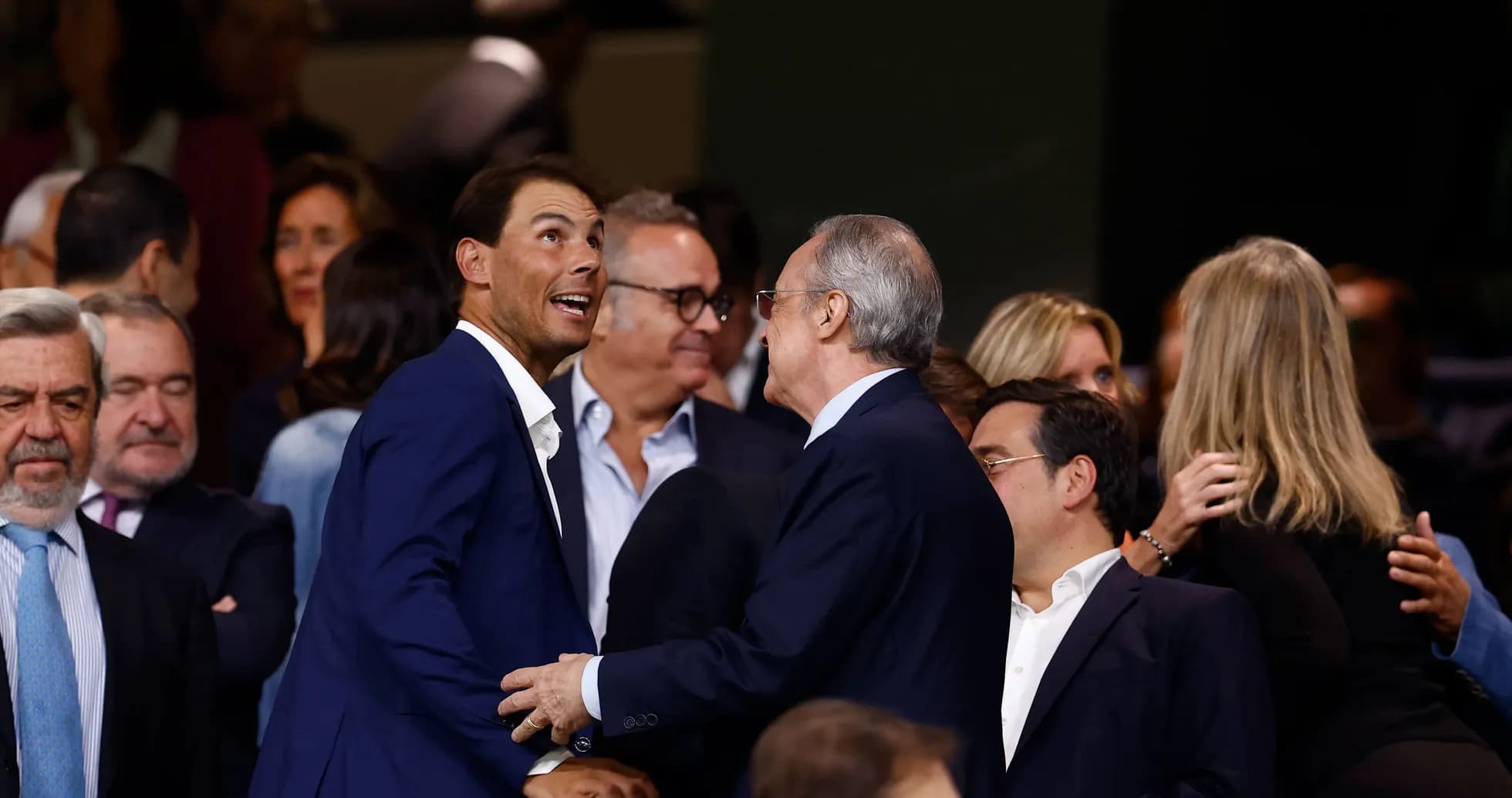
The club announced on 4 November that the 22-time Grand Slam champion has been nominated to join its board of directors, a move that will be put to the members’ general assembly for ratification on 21 November, as reported by Spanish newspaper Marca. On paper, it is a simple governance step. In reality, it feels like the prologue to something far bigger at the Bernabéu.
From honorary icon to decision-maker
For years, Nadal has been the perfect Madridista symbol: a global superstar, a visible fan, an honorary member since 2011. His name has floated around presidential debates like a distant echo, an enticing idea rather than a concrete option.
Now the echo has a desk.
Joining the board gives Nadal what he has never had in football: a seat inside the machine. He will see how the club operates day to day, how decisions are taken, how power moves through the institution that Florentino Pérez has dominated for so long. It is a classroom, a testing ground and, potentially, a launchpad.
None of this guarantees he will one day succeed Pérez. It does something more important: it gives him time and proximity. Time to learn, to make mistakes away from the spotlight of an election campaign. Proximity to understand the politics, the finances, the egos and the expectations that come with the most demanding office in club football.
A president-in-waiting profile
Few potential candidates arrive with Nadal’s built-in capital.
He is one of the most recognisable athletes on the planet, with 22 Grand Slam titles and two Olympic gold medals behind him. His competitive aura, his reputation for humility and respect, his iron mentality – all of it travels well beyond tennis. For Real Madrid, he embodies many of the values the club loves to project: ambition, resilience, an obsession with winning.
He also brings something else: a clean political slate inside football. Nadal has not been forged in the club’s internal battles. He is not a faction leader, not a veteran of bitter assembly debates. That makes him a fresh face for the socios and a powerful media asset for the institution.
Real Madrid underlined exactly that in their statement, highlighting his competitive spirit, commitment and respect for rivals as key reasons for his nomination. Nadal, for his part, has spoken of using the role to understand the club more deeply and to take an active part in its management.
People close to him insist this is not a ceremonial chair. According to Marca, Nadal wants to contribute in a real way, to apply his sporting experience and elite mentality to the club’s decision-making. This is not a victory lap. It is a new match.
The rulebook and the calendar
The romance of the idea still has to answer to the club’s statutes.
Article 40 of Real Madrid’s internal rules is clear about who can run the institution. Any candidate for the presidency must have been a club member for 20 consecutive years. The threshold drops to 15 years for the vice-presidency and 10 years for other board positions.
There is also a serious financial barrier: candidates must present a bank guarantee of at least 15% of the club’s budgeted expenses, backed by the personal assets of the board members. The job is not just about prestige; it is about risk.
Nadal has been an honorary member since 2011, under number 67778. Counting from that date, he would only meet the 20-year requirement in 2031. On a straight reading of the rules, his first fully open window to stand for election comes then.
Yet the statutes offer another, more immediate path. If the presidency becomes permanently vacant, the board itself chooses one of its members to take over, with that decision then put to the general assembly for ratification. The other conditions still apply, but the mechanism is different. Power, in that scenario, would move from inside the room rather than from the ballot box.
By joining the board now, Nadal positions himself within that inner circle. If a vacancy were to arise, he would at least be in the conversation.
Door ajar, not thrown open
Nadal has never been shy about how much the idea of leading Real Madrid appeals to him, but he has been careful with the timing.
Speaking to Ana Pastor on El Objetivo on La Sexta in 2024, he admitted: “Of course I would be happy with that, but it is not among my future plans.” It was a line that did two things at once – it confirmed the dream and delayed the decision.
In May 2026, when reports linked him with supporting Enrique Riquelme’s potential presidential bid, Nadal publicly distanced himself. He denied any involvement, underlined his respect for Florentino Pérez and pointed to his own ongoing projects. He refused, though, to close the door on what might come later.
That has been the pattern: admiration without campaigning, interest without commitment. A man who knows the weight of his own name and chooses his moments carefully.
The first step of a longer game
Now the theory becomes practice. The tennis legend is about to begin his administrative journey inside the club he has loved from the stands. He arrives without a declared plan to succeed Pérez, without a campaign team or manifesto, but with a profile that no strategist could dream up.
What happens next will depend on three things: the experience he gathers in the boardroom, the evolution of his own ambitions and the unforgiving demands of Real Madrid’s statutes.
For the first time, though, Rafael Nadal is not just a Madridista icon watching from his box. He is part of the institution’s power structure. If the presidency is ever to be his, this is exactly how the story would start.