Ramla Ali Becomes World Champion After Emotional Victory in Texas
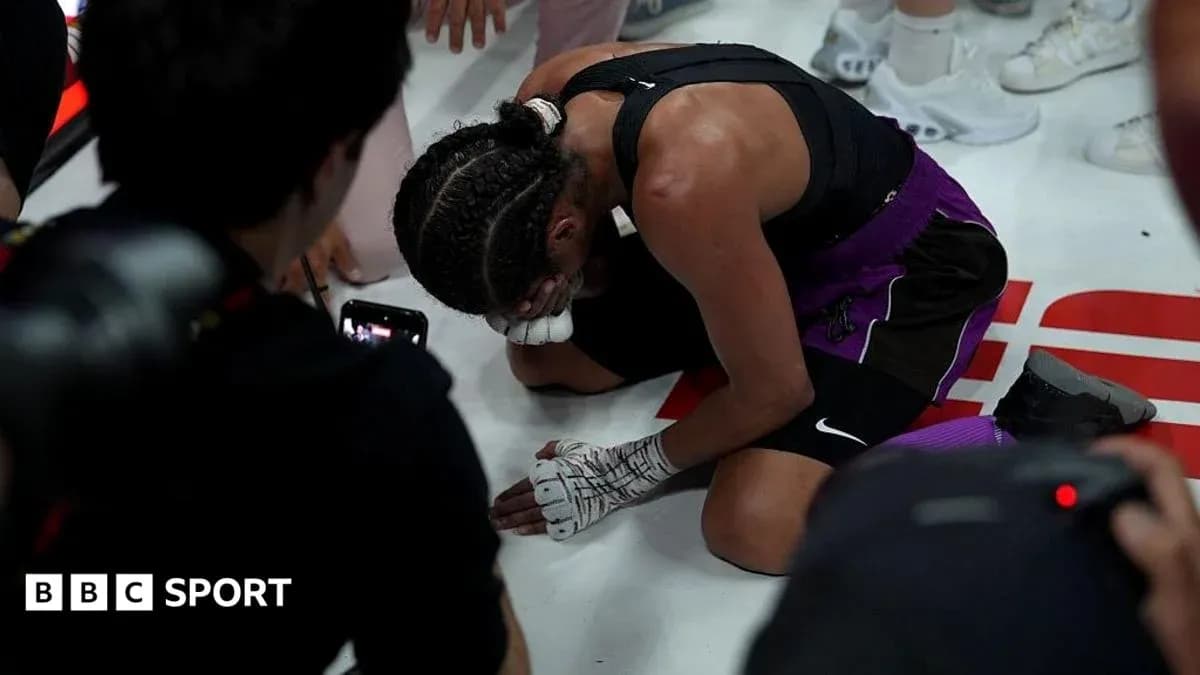
Ramla Ali dropped to her knees in the middle of a Texas ring, tears streaming down her face, as the scorecards were read out in her favour. At 36, the refugee-turned-Olympian-turned-author had finally become a world champion.
A split decision over Mikiah Kreps in Arlington delivered her the WBO and IBF super-bantamweight titles and, with them, the crowning moment of a life spent pushing back against the improbable.
From war zone to world titles
Ali’s journey began in a Somalia ripped apart by war. Her family fled when she was a baby, eventually settling in London as refugees. From there, she built a career that defied every neat category: the first Somali boxer to compete at the Olympics in Tokyo, the first Muslim woman to win an English amateur title, a model gracing magazine covers, an activist running the non-profit Sisters Club for young women.
Now she can add unified world champion to that list.
Only two years ago, that dream looked broken. Her first crack at a world title ended brutally when Yamileth Mercado swept her aside. In 2023, she was knocked out in her ninth professional bout and the chorus of doubters grew louder. Why risk boxing, many asked, when she already had a flourishing life outside the ring?
On Saturday night in Texas, she answered them with blood, grit and a stubborn refusal to stay down.
A fight on the edge
The numbers say Kreps should feel aggrieved. The previously unbeaten American outlanded Ali 115 punches to 78. She connected with 91 power shots to Ali’s 70. One judge saw it so clearly in Kreps’ favour that he scored it 98-91 to the home fighter.
But the two other judges went the other way: 97-92 and 96-93 for Ali, handing her the split-decision win and two world title belts.
The turning point came in the third round. Kreps, aggressive and on the front foot, walked straight onto a sharp left hook. The shot snapped her head and forced her glove to brush the canvas as she tried to steady herself. She protested the knockdown call in the moment, but the replay told the story: it was clean, it was heavy, and it was enough for a 10-8 round to Ali.
That should have been the launchpad. Instead, it became a lifeline.
Kreps roared back, swarming Ali with constant pressure, dragging the Briton into a fight that looked, at times, like it might run away from her. As the rounds ticked by, the American’s work rate refused to dip. Ali, by her own admission, felt like she was running on fumes.
“I remember going to the corner every round and saying, ‘I’m so tired, I can’t do this’,” she said afterwards. Her coach had only one answer: think of your father.
Ali’s dad died in May. His absence, and his memory, stalked every second of her camp and every second of this fight. When the exhaustion closed in, that was the lever her corner pulled. “Do this for him.”
So she did.
A mental battle, a personal promise
This was not a performance built on dominance. It was built on resolve. Ali described every round as a mental battle just to rise from her stool. She spoke of boxing “out of my skin” because she was “so knackered”, a fighter forcing her body to obey a promise she had made to someone who was no longer there to see it.
When her arm was raised, the emotion crashed over her. She sobbed, dropped to her knees and dedicated the victory to her late father and to Somalia, the country her family had fled but which she has carried with her into every ring.
“I can’t put into words what this means to me and what this means to all of Somalia,” she said. “I’ve hopefully inspired so many young girls and boys out there to dream big and that’s all I’ve ever wanted to do.”
On the other side of the ring, Kreps wore the look of a fighter who believed the night should have been hers. Undefeated before this, she had thrown more, landed more and forced the tempo. For her, the knockdown call and the final verdict will sting for a long time.
Doubts silenced, doors opening
Ali’s win lands at a moment when her life already feels like a film script. Her biopic has just been released, charting the journey from a child refugee to Olympian and trailblazer. Now reality has raced to catch up with cinema: she is a unified world champion.
The questions that once circled her – about whether she should keep boxing, whether the modelling, the activism, the public profile meant the ring was an optional extra – have been answered in the most definitive way a fighter can manage.
She stayed. She rebuilt after the Mercado loss. She absorbed the humiliation of being knocked out in 2023. She listened as people wondered if that was the end. And then she walked into a Texas arena and left with two world title belts.
The possibilities from here are obvious. Skye Nicolson, who retained her WBC belt on the same card with a unanimous decision win over Miyo Yoshida, looms as a natural unification rival. Both are signed to Jake Paul’s Most Valuable Promotions. Both now sit atop the same division with pieces of the same puzzle.
That can wait.
For now, Ali has earned the right to sit with what she has done: a Somali refugee who grew up in London, once told boxing was no place for someone like her, standing as WBO and IBF super-bantamweight champion of the world.
The belts are tangible proof. The tears in the centre of that Texas ring told the rest of the story.